Frank Mercer had been a legend on the highways of Wyoming for thirty years. As president of the High Plains Riders, his name alone could clear a crowded bar or settle a dispute between men twice his size. But legends don’t age the way people expect. At sixty-three, Frank sat in a wheelchair, paralyzed from the waist down, and the men who had once trembled at his voice now crossed the street to avoid his gaze — or worse, stared right through him.
It was a rainy Tuesday afternoon in November when Frank made a decision that felt both ordinary and monumental. He was going to June’s Roadside Grill, the little diner where his late wife, Rose, had always ordered apple pie. Rose had been gone four years, taken not by the road but by illness, quiet and cruel. Frank had gone quiet too. After the motorcycle accident eighteen months earlier that left him permanently paralyzed, he had stopped answering the phone. Walt, his oldest friend and the club’s former vice president, had left dozens of messages. Frank told him he needed space. What he really meant was that he couldn’t stand the thought of men who had once followed him through deserts and blizzards watching him struggle to open his own front door.
Frank sat in his van for twenty minutes before he worked up the nerve to lower the lift. The diner’s glass door rattled in the wind. Inside, the air smelled of coffee and rain-damp jackets. He ordered coffee and a slice of apple pie that sat in front of him mostly untouched. Through the rain-streaked window, he watched a little girl coloring while her mother wrestled a stroller between the tables. He backed up his chair to give them room.
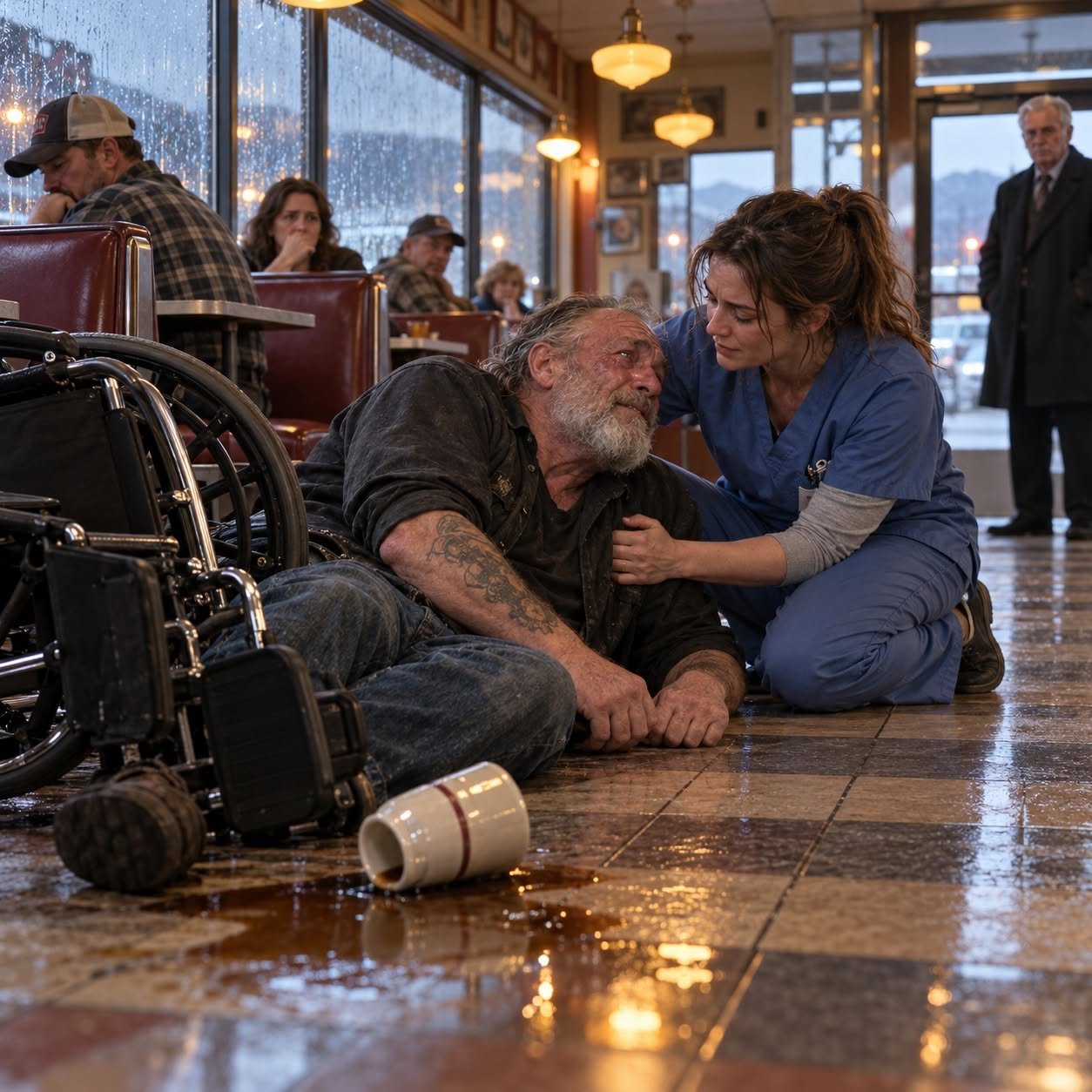
That was when one wheel caught the folded edge of a floor mat.
The chair tipped before he could correct it. He grabbed at the table, overturned his coffee, and landed hard on his shoulder. For a moment, the breath was knocked clean out of him. And then the entire diner went silent — not the kind silence of shock, but the heavier kind. The kind of silence made by people deciding not to help.
“Could somebody help me get this chair off?” Frank asked.
A waitress took one step toward him, then looked at the manager. A teenager started to rise, but the older man beside him caught his sleeve and held him down. Nobody came. And then a man in a trucker’s cap — who had clearly recognized the faded club tattoo on Frank’s arm — stepped around the overturned wheelchair so carefully, as if the real danger were getting coffee on his boots.
“Guess you’re not so tough anymore,” he said, and walked away to the register.
Frank stared at a crack in the tile floor and felt something inside him fold smaller than his body had. This was what the road had brought him to: a man who had once led a hundred bikes through mountain passes, lying on a diner floor, invisible.
Then the front door opened.
The woman who reached him looked about thirty. Her ponytail was coming loose, and there were tired shadows under her eyes, the kind that don’t come from one bad night but from months of them. Her scrubs were faded blue, soft at the seams.
“I’m a nurse,” she said. “Did you hit your head?”
“No. Just my shoulder.”
She checked him over with careful, unhurried hands, asked a few quiet questions, then turned to face the room full of watchers. “I need someone to steady the chair,” she said, her voice carrying cleanly across the silence. “And somebody call for assistance.”
This time the teenager stood up despite the hand on his sleeve. The waitress brought towels and made the call. The nurse stayed on the floor with Frank until help arrived, explaining every movement before anyone touched him, treating him not like a curiosity or a cautionary tale but like a man who had taken a fall and deserved dignity.
When he was finally upright in his chair, she crouched so they were looking directly at each other. “I’m Natalie Hayes,” she said.
“Frank,” he said.
“Okay, Frank. Let’s make sure that shoulder gets checked.”
There was no frightened glance at his tattoo. No pity, no syrupy voice. She spoke to him like a person. “You don’t know much about me,” he said quietly.
“I know you were hurt,” she answered.
“People here remember who I used to be.”
She glanced toward the register, where the trucker was paying his bill. “They can remember that and still help you.”
Rose had been a nurse for twenty-five years. She had said things exactly like that, in exactly that tone — plain, firm, refusing to let the world be smaller than it was. For one unbearable second, Frank could almost hear her agreeing with the stranger in the faded scrubs.
Natalie waited while Frank called his doctor. Then she walked beside him through the parking lot to his van, and she stood in the rain until he was safely inside. Her own car had a cracked bumper and an engine that needed convincing. Frank watched her drive away, and then he drove home and sat beneath Rose’s photograph for a long, long time.
The next morning, the phone rang. A hospital administrator wanted Frank’s “account” of Natalie’s public conduct.
“What conduct?” Frank asked.
Her assistance at the diner, the man explained, had prompted a complaint alleging poor judgment and behavior damaging to the hospital’s reputation. Natalie Hayes had been placed on administrative leave pending review. Her career — the thing she had spent years building — was now sitting on a desk somewhere, waiting for someone else’s decision.
Frank remembered a man in an expensive dark coat standing near the diner entrance. Russell Voss. A property developer who liked photographs of himself presenting oversized checks. Frank had watched him watching the scene on the floor.
“Did Voss file that complaint?” Frank asked.
The administrator’s silence answered him.
Frank set down the phone. He sat in his kitchen and looked at Rose’s photograph, and he heard her voice as clearly as if she were standing behind him: Well, Frank? What are you going to do about it?
He picked up the phone and called Walt.
Two rings. “Frank?”
“I need help,” Frank said. The words felt strange in his mouth. He hadn’t said them to anyone in fourteen months.
Walt didn’t hesitate, didn’t lecture, didn’t ask why it had taken so long. “I’m on my way,” he said.
By nightfall, Walt had done what old bikers do best — he had started digging. He found an employment attorney who worked with nurses. He pulled public records tying Russell Voss to several buildings the hospital leased. He found three nurses who had left the hospital after asking questions about missing overtime pay. And he learned that Natalie Hayes had been asking the same questions — polite, persistent, on behalf of the exhausted women on her floor who were afraid to speak.
Then Walt told Frank the rest: Natalie’s father had suffered a stroke. The rehabilitation bills were crushing, and Natalie was working extra shifts — double after double — to keep her dad in care. “She’s keeping everything together by inches,” Walt said quietly.
And then Frank’s phone lit up with a message from the hospital’s attorney. A statement, prepared for him to sign. Frank read it twice, the way you read something you can’t quite believe.
They wanted him to say that the only woman who had helped him was the person who had put him in danger.
Frank looked at that statement for a long time. Then he called Walt back. “Get the boys,” he said.
Four days after the fall at June’s Roadside Grill, Frank Mercer wheeled himself into a hospital conference room. Across the table sat the administrator, the hospital’s attorney, and, on speakerphone, a very uncomfortable Russell Voss. Behind Frank sat Walt — and behind Walt stood eleven men in leather vests with the High Plains Riders patch, the kind of men who fill a room just by walking into it.
Frank didn’t raise his voice. He didn’t need to. He had learned, over thirty years of leading men, that the quietest voice in the room is the one everyone listens to.
He refused to sign the statement. Then he laid out, calmly and completely, everything Walt had uncovered: the complaint filed by a developer with a financial relationship to the hospital, the three nurses who had left after questioning missing overtime, the pattern of retaliation against anyone who asked where the money went. He read aloud the texts from two of those nurses, who had finally agreed to speak on the record.
Natalie Hayes hadn’t endangered anyone, Frank said. She had done exactly what her profession — and her heart — demanded. And a hospital that punished its best nurse for kneeling on a diner floor was a hospital that had forgotten what it was for.
The administrator went pale. The attorney started talking about “reviewing the matter.” Russell Voss hung up the call.
Two weeks later, the hospital dropped its review of Natalie Hayes entirely. The missing overtime — thousands of dollars owed to the nursing staff — was paid out in full. The hospital quietly ended its leasing arrangement with Voss’s company. And Natalie, who had been suspended without pay, received back pay and a formal apology.
But the part of the story Frank tells most often happened later, on a Sunday afternoon. The High Plains Riders rode to Natalie’s father’s rehabilitation center — a slow, rumbling parade of chrome and leather that made the old man’s eyes light up like Christmas. Natalie stood on the curb in her scrubs, laughing through tears, while her dad — who had once ridden a Triumph in the seventies — swapped stories with men who treated him like a brother.
Frank gave Natalie an envelope that day. Inside was a check — enough to cover her father’s remaining rehab bills — drawn from an account Rose had quietly built over twenty-five years of nursing. Rose had called it her “rainy day fund for somebody else’s rainy day.” Frank had finally found the somebody else.
“She would have been proud of you,” Frank told Natalie. “I know, because she would have done exactly what you did.”
Natalie Hayes still works at that hospital. She still kneels beside strangers when they fall. And every November, on the anniversary of the rainiest Tuesday of Frank’s life, she gets a slice of apple pie delivered from June’s Roadside Grill — with a note in shaky handwriting that says: Thank you for stopping. — Frank.
Frank Mercer learned something on that diner floor that thirty years of riding had never taught him. Strength isn’t about who fears your name. It isn’t about the size of your engine or the hardness of your stare. Real strength is the woman in faded scrubs who kneels in front of a room full of people who won’t — and reaches out her hand anyway.
Some falls break you. And some falls, if you’re lucky, put you exactly where you need to be: on the floor, looking up at the person who will remind you who you are.