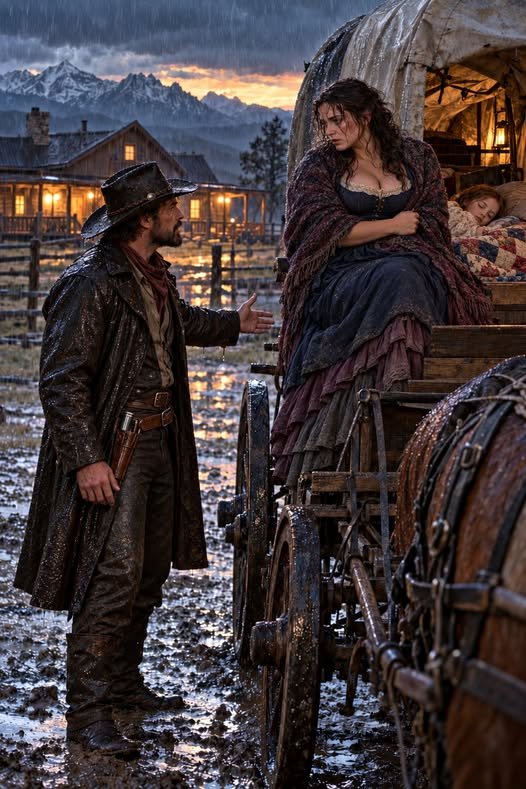
Wade Mercer stood in the mud and watched Orla Byrne press a handful of wet gray scraps to her chest, and he felt something crack open in his own chest that he hadn’t felt in a very long time. He had built this ranch with calloused hands and stubborn pride. He had fixed fences, birthed calves in blizzards, and buried his father on the far hill. But none of that had prepared him for the sight of a woman kneeling in the ashes of six years of hope.
Behind them, on the porch steps, little Nan stood barefoot in her nightgown, clutching her battered picture book like it was a life raft.
“Come here, sweetheart,” Wade said softly, and held out his hand. “Let’s look at that book together.”
Orla looked up, her face streaked with soot and tears. “It’s just her drawings, Wade. Houses. Roads. Nothing that can help.”
But Wade had learned something over the years, watching cattle and weather and people. Sometimes the most important things were hiding in plain sight. He sat down right there in the mud, his coat spread over the wet ground, and opened Nan’s picture book on his knee.
The first pages were what you’d expect from a five-year-old: a crooked yellow sun, a house with a crooked chimney, a horse that looked suspiciously like a dog. But as Wade turned the pages, something changed. The drawings grew more deliberate. A town with a church steeple. A town with a water tower. And beside each picture, in wobbly, oversized letters, town names.
CREDE. LAKE CITY. DEL NORTE.
“Did you help her spell these?” Wade asked quietly.
Orla stared. “She was always asking. I thought she was just… passing time.”
Nan knelt beside him and turned several more pages with the seriousness of a schoolmarm. “I did all the ones on your map, Ma. Every town. Even the crossed-out ones.”
Wade looked at Orla. Orla’s mouth had fallen open.
“But that’s not all,” Nan whispered. She flipped to a page near the back. It showed a town with a big white building and a bell. Underneath, in her careful letters: SILVERTON.
And beside the drawing of the church, in smaller script, as though she’d copied it letter by letter, were words: Maeve Byrnes — no bell.
Wade frowned. “Nan, honey, what does that say?”
“The lady at the church said the name wrong,” Nan said. “She said ‘Maeve Byrnes, no bell.’ I drew it how it sounded.”
Orla went very still. “What lady, Nan?”
“The bread lady. At the white church. She gave us bread and said there was no bell for Maeve Byrnes.” Nan tilted her head. “She said it like ‘no bell.’ But I think she meant ‘Nobel.'”
Wade felt the hair rise on the back of his neck. “Orla. Did you ever hear the name Nobel?”
“The town of Silverton sits near an old mining claim,” Orla said slowly, color rising in her cheeks. “The claim was called the Nobel Lode. But Maeve wouldn’t be at a mine. She’s a girl. She’d be with a family.”
“Would she?” Wade asked gently. “The county authorities split you apart, Orla. You found one church note saying she’d been sent west. What if the note was wrong? What if she was never given to a family at all?”
He turned the page. On the next sheet, Nan had drawn something that made his heart thud. A building with bars on the windows — the child had drawn it as a gray box with straight dark lines. Underneath, in her shaky letters: girls house. aunt mave mabe here. the cook said so.
Orla’s hand flew to her mouth. “Nan, where did you see this?”
“In Silverton,” Nan said. “The cook at the boardinghouse. She said the girls from the county home had to work the kitchens when the miners came to eat. She said one of them was named Maeve, and she cried at night for her sister.”
The words hung in the cold morning air. Six years. Orla had crossed out Silverton because the church clerk told her no Maeve Byrne had ever been registered there. She had never asked about the county workhouse kitchen. She had never known to ask.
Wade closed the book carefully, the way you’d close a Bible.
“Orla,” he said, “your daughter didn’t just save the places. She saved the one place you never thought to look twice.”
Orla stared at her daughter — this small, quiet child who had sat beside windows with a stubby pencil, listening to everything, copying everything, holding the truth in a book covered with crayon suns. Then Orla pulled Nan into her arms so fiercely the book pressed between them, and she wept — not the broken weeping of the mud and the ashes, but something warmer, something like dawn breaking.
They left for Silverton three days later, once the creek fell enough to cross. Wade hitched his own team to his spare buckboard. Eli stayed behind to start clearing the burned barn, grumbling the whole time about “young folks chasing ghosts” — but he pressed a pouch of coins into Orla’s hand anyway and told her to buy the girl a proper new dress.
The ride took two days. Orla barely slept. Nan sat between them on the seat, her picture book on her lap, pointing out every landmark she remembered. “That’s the crooked tree, Ma. That’s where the bread lady’s church is.”
Silverton was smaller than Orla remembered — a mining town past its boom, clinging to the mountainside. The white church still stood on the corner. But Wade drove past it and straight to the boardinghouse Nan had drawn, the gray building with the barred kitchen windows.
The cook was a broad woman named Hattie with flour on her apron and sharp eyes. She listened to Orla’s story without interrupting. Then she wiped her hands and said, “Maeve? Yes, I know Maeve. She works for the schoolmistress now — keeps house for her up on Miners’ Row. Changed girl, that one. Quiet. But she still asks every new face that comes through my kitchen whether they’ve heard of an Orla Byrne.”
Orla made a sound like air leaving a bellows. Wade steadied her with a hand at her elbow.
The house on Miners’ Row was small and neat, with geraniums in the window — someone who had decided that even a rented room deserved beauty. The schoolmistress, a Mrs. Alden, opened the door, took one look at Orla’s face, and called over her shoulder.
“Maeve, dear. There’s someone here to see you.”
The girl who appeared in the doorway was seventeen, tall and thin, with Orla’s dark hair and Orla’s stubborn chin. She wore a plain gray dress and an apron. For a long moment, the two sisters simply stared at each other across eleven years of silence.
Then Maeve whispered, “Orla?”
And Orla Byrne — who had refused charity, who had bargained a rancher up five cents on a stack of shirts, who had knelt in burning mud rather than surrender — collapsed to her knees on a stranger’s porch and held out her arms, and her little sister fell into them, and the two of them wept while Nan stood beside Wade, holding his hand very tightly, beaming like the sun she’d drawn on page one.
Mrs. Alden, dabbing her own eyes, explained what the county records never had. Maeve had been sent west under a clerical error — her name entered as “Maeve Byrnes,” with an S, which was why no search for “Byrne” ever found her. She’d been placed in the county girls’ home in Silverton, worked the boardinghouse kitchens, and at sixteen had been taken on by Mrs. Alden as a mother’s helper. “She’s been saving her wages,” Mrs. Alden said. “Said she was going to hire someone to help her find her sister someday.”
“She was going to find me,” Orla whispered.
“She never stopped,” Mrs. Alden said.
They stayed in Silverton a week. There was so much to say that eleven years couldn’t hold it, and so they said the small things instead — what Maeve liked to cook, how Nan had learned to draw, the way Orla’s needle moved. Maeve held Nan’s picture book for a long time, turning every page, crying quietly over the Silverton drawing.
“You saved us,” she told her niece. “Do you know that? You saved us.”
On the ride home, Maeve sat beside Orla in the buckboard, and Nan rode up front with Wade, chattering about the mountains. Orla watched her sister’s profile against the sky and thought about maps — the one she’d drawn, the one the fire took, and the truer one her daughter had made without ever knowing what it was.
Wade’s ranch came into view at dusk, the house lamplit, smoke rising from the chimney where Eli was cooking. It looked, Orla thought, like the house Nan had drawn on the very first page. Crooked chimney and all.
That night, after supper, Wade walked Orla out to the porch. The stars were thick overhead. The air smelled of pine and coming rain — a gentle rain this time.
“I’ve been thinking,” Wade said. He was looking at the burned ground where the barn had stood. “I’m going to rebuild. Bigger. And I was wondering —” He cleared his throat, a man more comfortable with cattle than with words. “There’s a bunkhouse standing empty. It could be fixed up proper. For Maeve. And there’s always mending to be done on a ranch this size — saddles, harnesses, canvas. More than one woman could handle alone. If you were of a mind to stay.”
Orla looked at him for a long moment. Six years she had run — town to town, map in hand, trusting no one. She thought of the wagon she’d been willing to freeze in rather than accept kindness. She thought of the fire, and the mud, and the small hand that had held out a picture book.
“I was never good at accepting help, Wade Mercer,” she said.
“I know.”
“I’m still not sure I know how.”
“Then we’ll learn together,” he said. “There’s no hurry. Nobody sleeps outside on my land — but nobody has to leave it, either.”
She took his hand. It was the first time she had reached for anyone’s hand in six years.
Spring came to the ranch, and with it, new timber for the barn. Maeve learned to ride and took over the ranch accounts, her neat schoolmistress handwriting filling Wade’s ledgers. Orla set up her mending table by the big kitchen window, and ranchers rode in from three counties because word got around that the woman at the Mercer place could stitch a saddle like new. Nan got a proper sketchbook for her sixth birthday and filled it with drawings of horses, and her aunt, and the man she now called Uncle Wade — though everyone noticed she drew him taller than the barn.
And on the wall of the farmhouse kitchen, framed in pine, hung two maps side by side. One was a fresh copy Orla had drawn from memory — every town, every crossed-out name, every note, restored. The other was Nan’s picture book page for Silverton: the white church, the gray kitchen building, and underneath, in wobbly letters, the words that had ended a six-year search.
Maeve Byrnes — no bell.
Visitors always asked about it. And Orla always told them the same thing.
“The fire took my map,” she’d say, smiling at her daughter. “But it couldn’t take the one that mattered. That one was drawn by a little girl who was listening the whole time — to every name, every town, every hope I thought I’d lost. Sometimes the people we think we’re protecting are the ones carrying us home.”


