Texas Panhandle, 1882. Dust settled over everything. It crept beneath the doors, filmed the windowsills, and turned a freshly scrubbed floor brown before the water on it had time to dry.
On the fourth morning of her married life, Martha Ellison Mercer stood in the neglected kitchen of her husband’s ranch house, leaning on a broom. She was thirty-one years old, a large, full-figured woman whose pale-blue cotton dress clung to broad shoulders and a generous frame. Her cheeks were rounded, her waist soft, her hips wide. She had never, in her whole life, fit anyone’s picture of a delicate frontier bride — and her new husband made sure she knew it.
Eight days after her father’s funeral, Wyatt Mercer had married her in a ceremony that lasted barely twelve minutes. Her father had left her Willow Creek Valley — the only dependable water source for miles across the Panhandle. Wyatt’s cattle needed that water. The county men had insisted a woman alone could not protect such a prize. So Martha accepted the bargain.
Not because she believed Wyatt loved her. Because she had spent fifteen years nursing her sick father, and she would not surrender the one thing he had trusted her to keep.
The Kitchen Nobody Wanted
Wyatt brought her to his ranch, showed her a bedroom, and rode back out into the cattle country. He never asked what she could do. He looked once at her size and decided what she could not.
Supper came as a gray slab of salt pork and a biscuit so hard Martha suspected it had once served as a horseshoe. She stared at it, then carried it outside and gave it to the hog, who devoured it happily. “At least somebody appreciates the cook,” she murmured.
The next morning she explored the house and found the kitchen — a magnificent cast-iron stove buried under years of grime, a pantry smelling of spoiled grain, cobwebs strung across the ceiling. But beneath the neglect lay treasure: good flour, dried apples, cured bacon, beans, onions, garlic, sorghum, crocks of lard. Food enough to feed twelve hardworking men. Yet every evening, those men ate like prisoners.
She laid her palm against the cold iron. “Well, old girl,” she whispered, “looks like we’ve both been underestimated.”
For three days she worked. She scrubbed the stove until the iron gleamed. She washed every shelf, aired the pantry, and coaxed her father’s sourdough starter — carried all the way from home in a crock — back to life. By Friday afternoon, the kitchen smelled of lemon oil and clean wood and fresh possibility.
That was when Wyatt came home.
He filled the doorway, hat in hand, his dark hair damp. His eyes traveled slowly around the transformed room. “What happened in here?”
“I cleaned,” Martha said.
“I can see that.”
A Challenge Issued
She was snapping green beans into a bowl. “Hollis left your supper.”
“I gave it to the hog.”
Wyatt stared. “You didn’t like it?”
“Hollis doesn’t cook, Mr. Mercer. He frightens ingredients until they surrender.”
Something nearly broke in Wyatt’s stern face — almost a laugh. Then it hardened again. “We don’t have time for fancy meals. Men work. Food is fuel.”
“Then perhaps you should stop poisoning the engine.”
His jaw tightened. She kept snapping beans. “Tomorrow, I’m cooking supper.”
“For twelve men?”
“Unless you’ve misplaced a few.”
“You’ll exhaust yourself before noon.”
There it was again. The familiar judgment, the one she had heard from schoolboys, from neighbors, from her own mirror on her worst days.
She set the beans down slowly. “Mr. Mercer, this body has carried flour sacks and water buckets, grief and your family name. Don’t mistake a woman’s size for weakness.”
For several seconds, Wyatt said nothing. Then he turned and walked out. But not before his gaze caught the bubbling sourdough starter by the window, alive and golden in the sunlight.
That night they slept on opposite sides of the bed, as they had since the wedding. Wyatt had never touched her with affection, never asked whether she was comfortable. Their marriage was a business arrangement, and Martha knew it. Still, she believed a wife deserved respect — even one her husband had never wanted.
Thunder Over the Ravine
Before sunrise, Wyatt was in the yard preparing to ride north. Several calves had wandered into the ravines, and the men had to bring them out before a storm broke.
“We’ll be late,” he told her. “Hollis will handle supper.”
Martha met his eyes. “If you can still stomach Hollis’s cooking after smelling mine, I’ll serve it myself.”
He shook his head and rode out.
She waited until the riders vanished beyond the ridge. Then she tied on her apron and went to work. She built a roaring fire under the cast-iron stove, soaked beans with dried peppers, browned bacon in a heavy skillet, set beef bones simmering in a deep iron pot. Out came the last good shoulder of venison. She mixed flour with cold lard, buttermilk, and salt, and soon rows of tender biscuits waited under clean linen. Apples simmered with sorghum until the whole house smelled of cinnamon and sweetness.
The kitchen came alive. For the first time since arriving, Martha felt like herself again — not Wyatt Mercer’s unwanted wife, not the large woman strangers whispered about. Just a capable woman doing what she knew how to do.
By noon, smoke curled from the chimney. The beans were softening, the venison was roasting, and twelve hungry cowboys were about to learn what real supper tasted like.
Then she heard hoofbeats. Fast. Too fast.
The Accident
A young ranch hand thundered into the yard, nearly falling from his saddle. “Mrs. Mercer!”
She hurried onto the porch. His face was pale under the dust. “Something happened at the ravine. The ground gave way. Three men are hurt.”
“And Mr. Mercer?”
“He’s trapped beneath a steer, ma’am. We can’t move it. And the storm’s coming straight at us.”
The northern sky had turned black as iron. Thunder rolled across the plains.
Martha did not hesitate. Blankets, water, clean bandages, the medicine chest — she loaded them into the wagon in minutes. The young hand stared as she gathered the reins. “Ma’am, Mr. Mercer said you weren’t supposed to—”
“I know exactly what my husband said.” She stepped down from the porch and climbed onto the wagon seat. “Son, I was driving wagons before you learned to saddle a horse.”
Lightning split the sky beyond the ridge. She snapped the reins, and the wagon lurched toward the ravine.
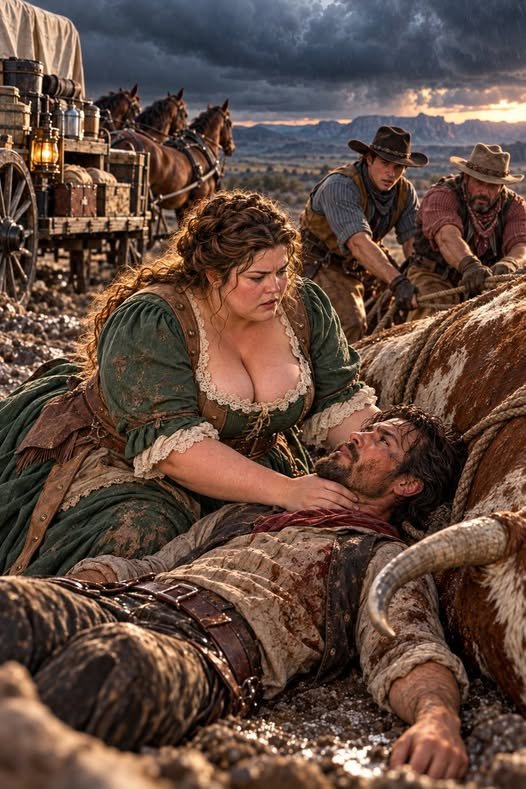
The scene was worse than she had feared. The earth had collapsed where the bank had softened after rain. Wyatt lay pinned beneath a dead steer, his face white with pain. Two other men sat clutching broken arms; a third had a gashed leg bound in a bloody kerchief.
Martha worked without a word of panic. She cleaned and bound the wounds, set one shoulder that had slipped, and splinted a broken wrist with strips torn from a flour sack. The men watched this big, quiet woman move among them with a steadiness that shamed their own fear.
Then came the harder task: freeing Wyatt. The steer was too heavy for one man to shift, and Wyatt could not be dragged without risking worse injury. Martha studied the ground, the slope, the wagon.
“Dig here,” she told the able-bodied hands, pointing at the downhill side of the carcass. “Dig the bank out from under it. Then we’ll roll it with the rope and the team.”
It was her father’s trick — she had seen him free a mired wagon once. The men dug. Martha hitched the team herself and set the rope. On her count — one, two, three — the dead weight rolled down into the hollow, and Wyatt was free.
She knelt beside him in the mud. “Can you feel your legs?”
He nodded, grimacing. “I can feel everything. Lord, it all hurts.”
“Good. Pain means nothing’s broken clean through.” She bound his crushed ribs with strips of linen, tight but not cruel, and packed a gash on his thigh. Above them, the storm broke — rain hammering down as they loaded the wounded into the wagon.
The Supper Table
Wyatt rode back the long way to the ranch with his ribs wrapped and his thigh bound, jolting over every rut, and by the time the wagon rolled into the yard the supper Martha had started that morning was ready. The other hands carried the food to the porch themselves, because no one was going to miss this meal.
Twelve men ate in silence at first — the silence of men eating the best meal they had had in years. Fluffy biscuits with butter. Beans simmered with bacon and peppers. Tender venison. Apples sweet with sorghum and cinnamon. Then the silence broke into laughter and talk, and it stayed that way long into the evening.
Wyatt ate slowly, his eyes never leaving Martha as she moved among the tables, filling plates, steady on her feet after the hardest day of her life.
Later, on the porch, he found her alone watching the storm roll east. He sat down beside her with a groan, holding his ribs.
“Those hands you hired,” Martha said quietly, “the ones who laughed at me after the wedding — I heard them.”
Wyatt went still. “I’m sorry.”
“They said I wouldn’t last one Texas summer.” She looked at him. “It’s been four days, Wyatt.”
He was quiet a long time. The rain dripped from the eaves. Then he said, “You pulled a dead steer off me today. You set bones. You fed twelve men like they were kings. I don’t know what I was laughing at.”
“I do,” she said. “You were laughing at a woman you never bothered to see.”
Willow Creek Valley
The next morning, Wyatt came into the kitchen early. Martha was already at the stove, feeding the sourdough starter.
“I want to change the arrangement,” he said.
She waited.
“Half the valley’s water rights. In your name alone, deeded and recorded. Not the ranch’s. Yours.” He set a folded paper on the table. “I married you for your father’s land, Martha. I won’t insult you by pretending otherwise. But I don’t want to be a man who holds his wife’s inheritance over her like a leash.”
She looked at the paper, then at him. “Why now?”
“Because yesterday a woman the size of you —” He stopped, and something raw crossed his face. “Because yesterday you carried this whole ranch on your back, and I finally understood what I married. Not a valley. A woman who could run it.”
Martha picked up the deed and put it in her apron pocket. Then she poured him coffee and set a plate of biscuits in front of him. “Eat. You’re healing.”
As the weeks passed, Wyatt learned her kitchen. He learned that her sourdough took patience, that she sang old hymns when she kneaded, that her hands — the hands he had once dismissed — were the most capable on the ranch. He watched the men look at her with something close to reverence. And slowly, the man who had married her for a valley began courting his own wife.
On a cool evening that October, he found her on the porch shelling beans. He sat beside her, took the bowl from her lap, and set it on the step.
“I owe you a proper wedding,” he said. “Twelve minutes wasn’t enough.”
Martha smiled — the smile he had never wanted, now the one he waited for every day. “This time, Mr. Mercer, you can do the cooking.”
He laughed, and took her hand, and neither of them let go.
Martha Mercer had come to that ranch as a price paid for water. She stayed as the woman who had earned the whole valley twice over — once by birthright, and once by proving, in front of twelve hungry cowboys and one humbled husband, that a woman’s size is no measure of her strength. The stove that had stood abandoned now warmed a home. And the marriage that had begun as a bargain became, against every odd, a love story written in cast iron and sourdough and rain.
That is what happens when a woman refuses to be small for anyone — and when a proud man finally learns to look up.

