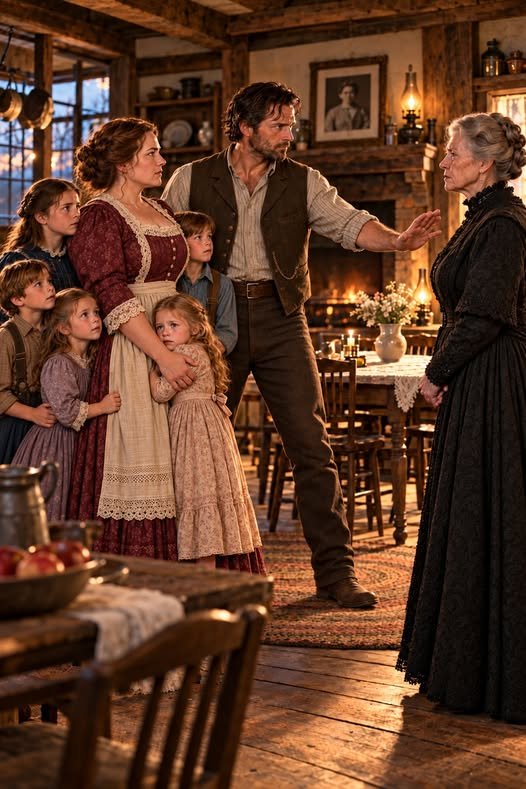
Winifred Shaw arrived at the Marsh ranch on a bitterly cold Montana morning with one carpetbag, two good dresses, and six years of widowhood behind her. She had come to scrub floors, wash clothes, and earn an honest living. She had not expected five motherless children to claim pieces of her heart.
Five children stood on the porch, watching her approach. They were arranged almost by height — except the smallest girl, who rested on the hip of the eldest. The oldest could not have been more than twelve, yet she held the little one with the weary competence of a woman twice her age.
Something was terribly wrong here. Not dangerous. Not cruel. Just heartbreakingly empty. The porch needed painting. The windows looked dull. No smoke rose from the kitchen chimney. And not one child smiled.
“You’re the housekeeper?” The voice came from behind her.
Gideon Marsh stood beside the barn, broad-shouldered beneath a weathered coat, his dark hair touched with gray. He was forty-one, but grief had carved years into his face.
“Winifred Shaw,” she answered. “Though most folks call me Winnie.”
He studied her without smiling. “Three women came before you. None lasted a week.”
“Were they poor workers?”
His jaw tightened. “No. They just couldn’t manage the children.”
Winifred looked toward the porch. Five small faces watched her as though expecting another disappointment.
“Mr. Marsh,” she said, “I’ve never been frightened of children.” She paused. “It’s grown folks who worry me.”
For the first time, something almost like amusement crossed his face. Then he stepped aside. “House is yours to tend.”
A House Gone Quiet
Inside, the farmhouse looked as though someone had abandoned it halfway through living. Dirty dishes crowded the basin. Dust softened every shelf. Old flour lay scattered across the kitchen floor. And above the cold fireplace sat a framed photograph, turned facedown.
Winifred noticed it immediately. She did not touch it. Some things deserved to remain undisturbed until the living were ready.
Instead, she rolled up her sleeves and began to clean. The children watched from the staircase. She didn’t ask them to help. Didn’t demand smiles. Didn’t promise them anything. She simply worked. And as the afternoon faded, she began humming an old song her mother had once sung over the washtub.
Eventually the smallest child appeared on the bottom step. Her hair was tangled, and she wore only one shoe.
“Hello there,” Winifred said.
The little girl stared. “I’m Posy,” she said.
“I’m Winnie.”
Before the child could say more, the oldest girl hurried down and lifted her away. “We don’t need looking after,” she announced sharply.
“And you are?”
“Maribel.”
“And the little one?”
“Posy. The boys are Jonah and Tad. Pearl’s the other girl.” Maribel adjusted Posy on her hip. “I take care of them.”
Winifred studied the child’s exhausted eyes. “I can see that,” she replied gently. “And I believe you’ve done a mighty fine job.”
Maribel looked startled — as though nobody had thought to tell her that before. Then she carried Posy upstairs. But she left the bedroom door slightly open.
Winifred considered that a victory.
The Sixth Plate
Over the following days, she learned how Eleanor Marsh had died. The children’s mother had taken ill nearly two years earlier. She had faded through a long winter and slipped away one quiet morning in May, surrounded by her husband and children. Gideon had never recovered. He worked from before sunrise until after dark, returning home too exhausted to do anything but sit silently at supper. He loved his children — that much was obvious. But he had forgotten how to reach them. And Maribel, at twelve, had quietly become the mother of the house.
Until the eleventh evening. That was when Winifred found little Tad carefully arranging six tin plates around the supper table. He stood on tiptoe, reaching for the last plate with fierce determination. Maribel entered behind him. The instant she saw the sixth plate, her expression crumpled, and she reached to remove it.
“Leave it,” Winifred said.
Maribel froze.
“There isn’t any harm in keeping a place for somebody we miss.”
The girl stared. Winifred crouched beside Tad. “You did a fine job setting this table, sweetheart.”
Tad looked up. “Did you know Mama?”
The question struck Winifred harder than she expected. “No, darling.”
“Then how do you know she’d like it?”
Winifred swallowed. “Because any woman who raised five children as wonderful as you must have had a mighty big heart.”
Tad’s lower lip trembled. Then he whispered, “I miss her.”
Winifred opened her arms. The little boy stepped into them. And for the first time since arriving, she heard a Marsh child cry without trying to hide it.
Something changed after that evening. Pearl began following Winifred through the kitchen, asking questions. Jonah started carrying firewood without being told. Posy fell asleep against her shoulder beside the evening fire. And Maribel — poor, exhausted Maribel — finally began behaving like a twelve-year-old girl.
One afternoon, Winifred caught her chasing Pearl across the muddy yard, both children laughing so hard they could barely run. Winifred stood in the doorway, pressing a hand against her heart. She hadn’t realized how badly she’d missed the sound of children laughing.
Then Gideon appeared beside her. He watched his daughters for a long moment. “I haven’t heard that in almost two years,” he said quietly.
Winifred glanced at him. His eyes were bright. “Children remember how to be happy, Mr. Marsh,” she answered. “Sometimes they just need somebody to remind them it’s allowed.”
Gideon turned toward her. For one suspended moment, neither spoke. Then he removed his hat. “I’m grateful you came, Mrs. Shaw.”
She looked away before he could see how deeply those simple words affected her.
The Grandmother’s Accusation
But happiness rarely returned to a grieving house without awakening someone else’s sorrow. Agnes Crowder — Eleanor’s mother — arrived the following Sunday. Sixty-one, stern-faced, dressed in black from collar to boots. The children immediately grew quiet.
Agnes stepped into the freshly cleaned kitchen and stopped. Fresh bread rested on the table. Sunlight poured through spotless windows. And Posy was laughing as Winifred tied a ribbon into her hair.
Agnes stared. Then her eyes settled on Winifred — and on the apron tied around her waist. Eleanor’s old apron.
“So,” she said coldly. “You’re the new woman.”
“Good morning, Mrs. Crowder.”
“My daughter’s barely cold, and already some stranger is wearing her clothes and singing in her kitchen.”
Every child heard. Maribel moved protectively toward Posy. Winifred kept her voice steady. “I’m not here to take Eleanor’s place.”
Agnes gave a bitter laugh. “That’s what women like you always say.”
“Mrs. Crowder—”
“You think because you’ve cleaned a few floors and baked some bread, these children will forget their mother?”
“No,” Winifred replied softly. “I pray they never do.”
Something flickered across Agnes’s face. Winifred continued. “Their mother gave them their eyes, their laughter, their memories. Nobody can replace that. I only want them to have a warm home again.”
For a moment, Agnes looked almost wounded. Then she turned toward the door. “We’ll see how long you last.”
But just as her hand closed around the latch, little Posy slipped free of Maribel, hurried across the kitchen, and wrapped both arms around Winifred’s skirt.
“Don’t go, Winnie.”
Agnes stopped. Slowly, she turned. And Winifred saw something in the older woman’s expression that frightened her more than anger — recognition. As though Agnes had just witnessed the beginning of the one thing she feared most: her dead daughter’s children learning to love another woman.
Then Agnes spoke, in front of all five children: “You’re here to replace my dead daughter.”
The Widower Speaks
Before Winifred could answer, a deep voice sounded from the doorway.
“That’s enough, Agnes.”
Gideon Marsh stood there, his hat in his hands. And the look on his face told Winifred that something was about to happen that had never happened in this house before.
“Don’t,” Agnes warned. “Don’t you dare defend her.”
“I’m not defending anyone,” Gideon said quietly. “I’m telling the truth. Something I should have told two years ago.”
He walked to the fireplace and picked up the framed photograph — the one that had lain facedown since Eleanor died. He turned it over. Eleanor’s young face looked out, smiling.
“After she died,” Gideon said, “I couldn’t bear to look at her. Couldn’t bear to hear her name. Couldn’t bear the children needing me, because needing me reminded me she was gone. So I worked. I hid in work, and I left five children to raise themselves.” His voice broke. “Maribel was ten years old when she started braiding her sisters’ hair and cooking their supper. Ten.”
Maribel’s lip trembled.
Gideon set the photograph upright on the mantel. “Winifred didn’t replace Eleanor. She did what I was too broken to do — she gave these children back their childhood. And you, Agnes — you loved your daughter. But she wouldn’t want you using her memory as a weapon against the woman who taught her babies to laugh again.”
Agnes stared at the photograph. Her shoulders began to shake. “I just — I couldn’t stand the thought of them forgetting her.”
“They’ll never forget her,” Winifred said gently. “I won’t let them. A house can hold more than one woman’s love, Mrs. Crowder. There’s room for Eleanor in every wall of it — and room for you, too, whenever you want to come.”
Winifred’s Secret
That evening, after Agnes had stayed for supper — her first meal at that table in two years — Gideon found Winifred on the porch. The photograph of Eleanor now stood upright on the mantel inside, and someone had placed fresh wildflowers beside it.
“Mrs. Shaw,” he said, “there’s something I’ve wanted to ask. You understand loss better than anyone I’ve met. You knew exactly what to say to Tad about his mother. How?”
Winifred was quiet a long time. Then she said, “Six years ago, I buried a husband and a baby daughter in the same week. Scarlet fever. I came home to an empty house and a cradle I’d never rock again.” She looked out at the darkening fields. “I know what it is to set a table and count the chairs. That’s why I told Maribel to leave the sixth plate.”
Gideon closed his eyes. “I’m sorry.”
“Don’t be. That grief is what brought me here.” She smiled through tears. “I couldn’t save my own little girl. But maybe I was sent here to help save five others.”
Gideon took her hand — the first time he had touched her. “Stay,” he said simply. “Not as the housekeeper. Stay as family.”
Winter’s Promise
Before the winter was over, everything had changed. Agnes Crowder came every Sunday, and slowly the sternness left her face; by Christmas she was teaching Pearl to make Eleanor’s sugar cookies from the old recipe. Maribel went back to school and finished top of her class. Jonah built Winifred a bookshelf with his own hands. Tad’s sixth plate stayed on the table every night — and beside it, eventually, a seventh.
In the spring, Gideon and Winifred were married in the farmhouse kitchen, with five children standing witness and Agnes Crowder crying openly in the front row. Eleanor’s photograph smiled down from the mantel, framed now in wildflowers.
Winifred Shaw had arrived with one carpetbag and two good dresses, expecting to scrub floors. She left the title of housekeeper behind and became something far greater: the woman who taught a grieving house that love is not a candle that burns down when shared — it is a fire that grows brighter the more hearts gather around it.
No one replaced Eleanor Marsh. They simply learned, at last, what Winifred had known from the beginning: that honoring the dead and loving the living are not enemies. They are the same promise, kept twice.


