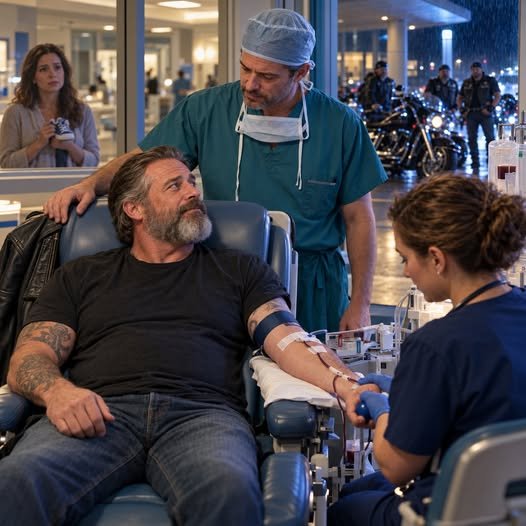
The ambulances kept coming that night. Outside Richmond, Virginia, Westhaven Medical Center’s emergency bays glowed under floodlights while rain hammered the pavement, and Dr. Andrew Mercer stood in the middle of it all, a trauma surgeon whose hands had long since learned to stay steady when everything around him shook.
He was not supposed to be thinking about five years ago. He was supposed to be thinking about the next hour.
The Boy in the Wrong Line
Seven-year-old Ben Walker had not been part of the highway pileup that had stretched the hospital thin that evening. He had been hit by a car near his own apartment building, crossing the street to see Mrs. Ellis, the kind neighbor who watched him while his mother worked. His mother, Julia, followed the stretcher with one of his blue sneakers clutched in her hand, the silver stripe across the heel catching the fluorescent light.
Mercer remembered that shoe. He remembered wishing she had something better to hold.
Ben needed surgery, and he needed it soon. But there was a second problem, the kind that makes even experienced surgeons feel the room tilt: the boy’s blood was rare. Not just an uncommon type — his blood carried additional factors that ordinary labels didn’t capture. The transfusion team had a few compatible units on the way up. A regional blood center was searching its wider network and arranging transport from a specialist reserve. They could begin. Nobody could promise the next supply would arrive before the boy needed it.
The Number in His Phone
While the surgical team prepared Ben, the blood bank physician called Mercer with a possibility. There was a local donor with a matching rare profile. The center couldn’t reach him on its listed number. Then the physician said his name, and Mercer felt five years collapse into a single second.
Daniel Keane.
Five years earlier, Daniel had been wheeled into Mercer’s operating room after a roadside shooting. Mercer had operated through the night and Daniel had lived. During his recovery, routine testing had flagged his unusual blood profile, and the blood center had asked him to join its rare-donor program. He had agreed. Before discharge, he had pressed a folded slip of paper into the surgeon’s hand.
“If you ever need somebody to show up,” he had said, “try that one.”
Mercer had saved the number in his phone and forgotten it was there.
Now, standing outside the operating suite with a child’s life narrowing to minutes, he pulled up the contact and dialed. The phone rang three times. A rough voice answered: “Yeah?”
Mercer said his name. A pause. “I remember you.”
Then he explained about Ben — quickly, honestly, without promises. The blood collection team would have to assess him. But they needed him to come. “How soon do you need me?” Daniel asked.
Mercer told him the donor entrance on the east side. “What’s the kid’s name?” Daniel asked.
“Ben.”
“All right.” He hung up.
A Thunder of Engines
Back in the operating room, Mercer let the world narrow to the work beneath his hands. Control the bleeding. Watch the numbers. Ask for what was needed before it was needed.
Then a nurse leaned in with a message from the administrator. “Your donor is on his way,” she whispered. “Apparently, so are quite a few of his friends.”
Daniel Keane led the Blue Ridge Riders, a motorcycle club with members spread across several Virginia counties. His call for help had traveled faster than anyone expected. A handful became several dozen. Then more. They came offering blood, transportation, contacts — anything useful. They filled the roadways around the hospital until the rumble of engines seemed to rise up through the building’s foundation itself.
Unfortunately, nobody had told the police captain managing traffic outside the crowded emergency department what the gathering was for. By the time the first motorcycles rolled onto hospital grounds, security was moving to restrict access.
The administrator called Mercer mid-surgery. “We have officers at the doors. They’re asking whether this is connected to patients already here.”
“They’re responding to our request,” Mercer said.
“I’ve told them.”
“Tell them again.”
Mercer couldn’t leave Ben. So the charge nurse, Denise, went downstairs with the donor coordinator. Later, Mercer watched the security footage: Daniel stopped where an officer directed him, removed his helmet, held up his donor identification card. Behind him, rain ran off leather jackets onto the pavement. He didn’t argue or move closer. He simply pointed toward the hospital.
“Somebody called me about a boy.”
The coordinator confirmed his name. They let him through.
For the first time that night, something loosened inside Mercer’s chest.
One Donation Was Not Enough
Then the blood bank physician called the operating room. Daniel had passed the initial assessment and donated. But one donation would not cover what Ben was likely to need. The distant supply was delayed by the same weather and highway closures that were filling the emergency department.
Mercer looked at the clock. Then at the child on the table. The man he had called had come — and they still might not have enough.
That was when the blood bank physician called with the news that made Mercer ask those men for one more miracle: Daniel’s blood matched even better than the initial profile suggested, and — more than that — two of Daniel’s fellow riders, screened on the spot, carried compatible rare profiles too. The Blue Ridge Riders had their own donor program, Mercer learned. After Daniel joined the rare-donor registry years ago, he had quietly asked his whole club to get tested. Nobody knew. They had just done it.
Mercer stepped out of the sterile corridor and asked Daniel for one more thing: would the club stay, in case the delayed supply didn’t arrive? Daniel looked at him like the question hardly needed asking. “We’re not going anywhere, Doc.”
The Longest Night
The surgery stretched through the darkest hours. Ben’s small body needed more blood than anyone had dared to estimate. Unit after unit came from the donor suite downstairs, where a line of leather-jacketed men waited their turn in hospital chairs, trading jokes in low voices and holding coffee cups like they were at a rest stop instead of an emergency room.
Julia Walker sat with Denise in the family room, still holding the blue sneaker. When Denise told her what was happening outside, Julia pressed her face into her hands and wept — not with fear this time, but with something like awe.
Just before dawn, the regional supply finally arrived, but by then it was almost a formality. The riders had carried Ben through. Mercer closed the last suture as the sky outside the windows began to pale, and for a long moment he simply stood there, hands resting on the table, listening to the steady beep of the monitor.
The Visit
Ben woke up the next afternoon. His first question, whispered to his mother, was whether the motorcycles were still outside.
A week later, when Ben was strong enough to sit up, Daniel Keane came to his room. He filled the doorway — big, graying, a man most people crossed the street to avoid. He stood at the foot of the bed holding his helmet, looking for all the world like he had ridden straight in off the highway.
“Hey, Ben,” he said. “I’m Daniel.”
Ben studied him. “Did you bring the motorcycles?”
“Every one of them,” Daniel said, and something rough and warm moved across his face. “You scared us pretty good, kid.”
Julia took Daniel’s enormous hand in both of hers and held it. She didn’t say thank you. The words were too small, and they both knew it.
Five Years Forward
Years later, Mercer keeps a photograph on his office wall — not of an award or a ceremony, but of a hospital parking lot full of motorcycles in the rain, their headlights glowing like a string of lanterns. When medical students ask about it, he tells them about a boy named Ben, and about a man named Daniel, and about what it means when someone answers on the third ring and asks only one question.
“How soon do you need me?”
It is, Mercer tells them, the finest sentence he has ever heard.
Ben Walker grew up to be a young man who donates blood every eight weeks without fail. He tells the intake nurses he learned it from his friends — the men in leather jackets who once filled a parking lot in the rain because one surgeon made one phone call to a number he had carried in his pocket for five years.
Some debts, it turns out, can only be paid forward. And some miracles arrive on two wheels, in the rain, asking for nothing but the name of a boy.


