The school bus carrying eighteen children disappeared three hours after Daniel Mercer put his name on a maintenance form and called it safe.
By sunset, deputies were walking ditches with flashlights. Parents stood in the depot parking lot calling hospitals that had nothing to tell them. And Daniel stood in the empty garage bay, staring at one word in the maintenance log, written in his own handwriting.
Checked.
Daniel was fifty-eight that October, the district’s senior mechanic in a small mountain town outside Asheville, North Carolina. He rode an old motorcycle on weekends, wore the same leather vest he’d owned for twenty years, and knew every bus in the fleet by its engine sound before he ever looked at the number painted on the side.
Bus Twelve had developed a small oil seep, nothing that would keep it off the road. That morning its driver, Ruth Parker, had walked the inspection sheet over to him herself. “Look close, Danny,” she’d said. “The pressure gauge dipped yesterday.”
He’d checked the level, slid underneath with his light, and found the damp seal. He’d run the engine, watched the gauge, and decided the repair could wait until Saturday, when the bus wasn’t needed.
He’d written checked instead of explaining what he’d found.
That shortcut would haunt him longer than the oil stain on the concrete.
At 3:18 that afternoon, Ruth pulled out of the elementary school with eighteen children aboard. At 3:43, dispatch lost the bus’s tracking signal. Her radio went silent. Nobody reached the first stop on the route.
By five o’clock, the depot office was full of parents trying to keep their voices steady. Ruth had driven that route for twenty-two years. She knew every allergy, every custody schedule, every child who needed an extra minute to say goodbye at the door. She had driven Daniel’s own daughter when she was little.
Ruth Parker did not simply vanish. Not ever.
Deputies ran the regular route from both ends, checked every shoulder and creek crossing, every place a long vehicle might leave the pavement. They found nothing. One deputy asked Daniel whether an engine failure could have stopped the bus.
“Yes,” Daniel said. It was the hardest honest word he had ever spoken.
Outside, a mother stood beside her car holding a small purple jacket. Her little girl had left it behind that morning. Looking at that empty jacket, Daniel went back into the garage, because he needed to look at something that made sense.
Bus Twelve’s parking space was empty, but three dark spots marked the concrete where its engine had sat. Another spot waited closer to the gate, and another past that. He called the search coordinator.
“There may be a fluid trail,” he said.
“We’ll send someone out.”
“I’m starting at the yard.”
He drove his pickup slowly, stopping where it was safe, sweeping his flashlight across the shoulder. Most dark marks were old stains or wet leaves. Then, at the mouth of a disused timber road, he found a fresh drip beside wide tire impressions, and a low branch scraped pale where something tall had turned in.
He sent the location to dispatch and called his friend Ben, who rode with their local motorcycle club. Ben and two other riders, Luis and Terry, were already helping search nearby.
“Bring lights,” Daniel told him.
“On our way.”
They left their vehicles at the timber-road entrance and walked. The road climbed through wet pines and dropped toward an abandoned lumber yard. Ben marked every turn with bright ribbon. Luis kept dispatch updated whenever his phone caught a signal. Terry carried the portable CB radio he used on backcountry rides.
Half a mile in, the tracks crossed a broad shelf of rock and vanished. They spread out along the edges and found nothing. Rain began ticking against the leaves, and Daniel stood in the middle of that empty clearing picturing eighteen backpacks scattered beside some road nobody had checked.
Then Terry’s radio crackled, and they all froze.
A thin voice pushed through the static. “Is somebody there?”
Terry lifted the radio. “Yes. Can you hear me?”
A breath. A scrape. “My name’s Owen.”
Daniel took the microphone. “Owen, are you on the school bus?”
“No.” Daniel’s heart dropped through the floor.
“We’re in a building,” Owen said. “Mrs. Parker. Everybody.”
“How many children?” Daniel asked.
Owen started counting, and other small voices joined in. Eighteen.
“Owen, what can you see?” Daniel asked, pressing his free hand against a tree to steady himself.
“Boxes. A little radio on a desk. Mrs. Parker said keep trying it.” A pause. “The windows are too high.”
“Can you open the door?”
“No.”
Ben was already studying an old lumber-yard map on his phone. Daniel asked whether Owen could hear running water, and Owen said there was a creek outside. They hurried downhill, and through the trees Daniel’s flashlight found a yellow roof — and the black number painted above the rear windows.
Twelve.
He ran toward it, calling Ruth’s name. A small hand slapped against a narrow warehouse window. He reached the loading door and pulled, and a bright new chain snapped tight across the handles.
Behind it, Owen began to cry.
“Please hurry,” the boy whispered. “The men said they’re coming back.”
Daniel’s first thought was the children, and his second was Ruth, and his third was that brand-new chain. New chain, old warehouse. That meant the men who’d hung it had been here recently — and might return at any minute.
“Luis, stay on that radio with Owen,” Daniel said. “Terry, you got bolt cutters in your truck?” Terry shook his head. “Then we’re doing this the old way.” Daniel pulled the heavy tow chain from his pickup bed. Ben understood immediately — they fed it through the warehouse door handles and took up the slack around the pickup’s tow hitch.
Meanwhile, Terry was on the phone with dispatch, reading Ben’s ribbon-marked turns out loud so the deputies could follow them straight in. “Tell them to come quiet,” Daniel said. “No sirens until they’re close.”
The pickup strained. The door groaned. Then the chain gave with a crack that echoed off the trees, and the door swung open.
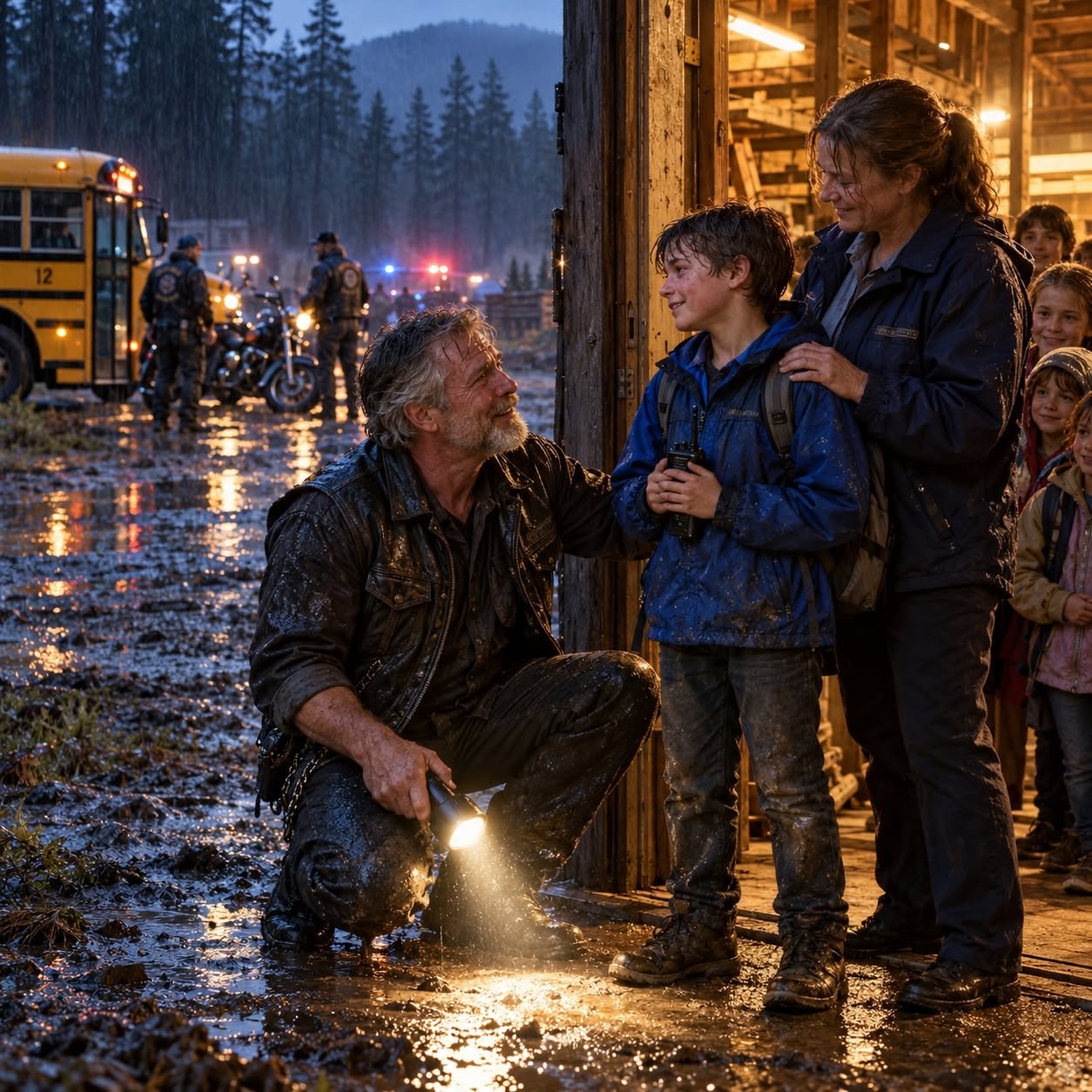
Ruth Parker stood in the doorway with her arms full of children. She was pale and shaking, but her voice was steady as she counted heads out loud while the kids poured into the rain. Eighteen backpacks, eighteen faces, eighteen pairs of shoes splashing toward the flashlights.
Daniel knelt in the mud and let Owen crash into him. The boy’s purple-jacketed sister — the mother with the jacket back at the depot had been right to bring it — wrapped her arms around Daniel’s neck like she’d known him all her life.
Ruth told the story in pieces as the children were checked over. The oil seep Daniel had signed off on had worsened on the route — the pressure gauge dropped, the engine began to labor, and Ruth, doing exactly what twenty-two years of driving had taught her, pulled off the main road at the timber entrance to keep the children safe. While she was calling dispatch, two men came out of the lumber yard. The yard had become a hiding place for stolen motorcycles and parts, and the men decided a bus full of witnesses couldn’t be allowed to see the inside of that warehouse. They forced everyone inside, chained the door, and left to move their truck closer — promising they’d be back before dark.
That was what someone had tried to hide. Not an accident. A secret.
Headlights swept through the trees not ten minutes later — the men, returning with a box truck, driving straight into the deputies Daniel had asked to come quiet. The ribbon trail Ben had left made it simple. By midnight, three men were in custody, and the warehouse’s hidden stash was being loaded onto a flatbed as evidence.
The oil seep never caused the disappearance. But Daniel knew it had caused the stop — and he didn’t hide from that. At the town meeting the following week, he stood up in front of every parent in the district and told them exactly what he’d written in that log, and what he should have written instead.
“I decided a repair could wait,” he said. “Nothing about your children waits. Not anymore.”
The district adopted a new rule that week: any fluid leak, no matter how small, grounds a bus until it’s fixed. Daniel personally rechecked every bus in the fleet that weekend, working until his hands bled, and he didn’t sign a single form until he’d explained every word on it out loud.
On Saturday, the depot held a barbecue. Eighteen children ran around the buses with juice boxes, and Ruth Parker — who announced she wasn’t retiring after all, “not while there’s a route with my name on it” — let every one of them honk Bus Twelve’s horn. The kids presented Daniel with a banner they’d painted themselves. It read, in wobbly letters: THANK YOU FOR FINDING US, MR. MERCER.
Owen’s mother pressed the small purple jacket into Daniel’s hands. “She wants you to keep it,” she said. “She says it kept her brave.”
Daniel hung that little jacket on the wall of his garage bay, right above his workbench. Every morning since, when he slides under a bus with his light, he looks at it first.
Nothing waits anymore. Not the repairs, not the truth, and never — never — the children.