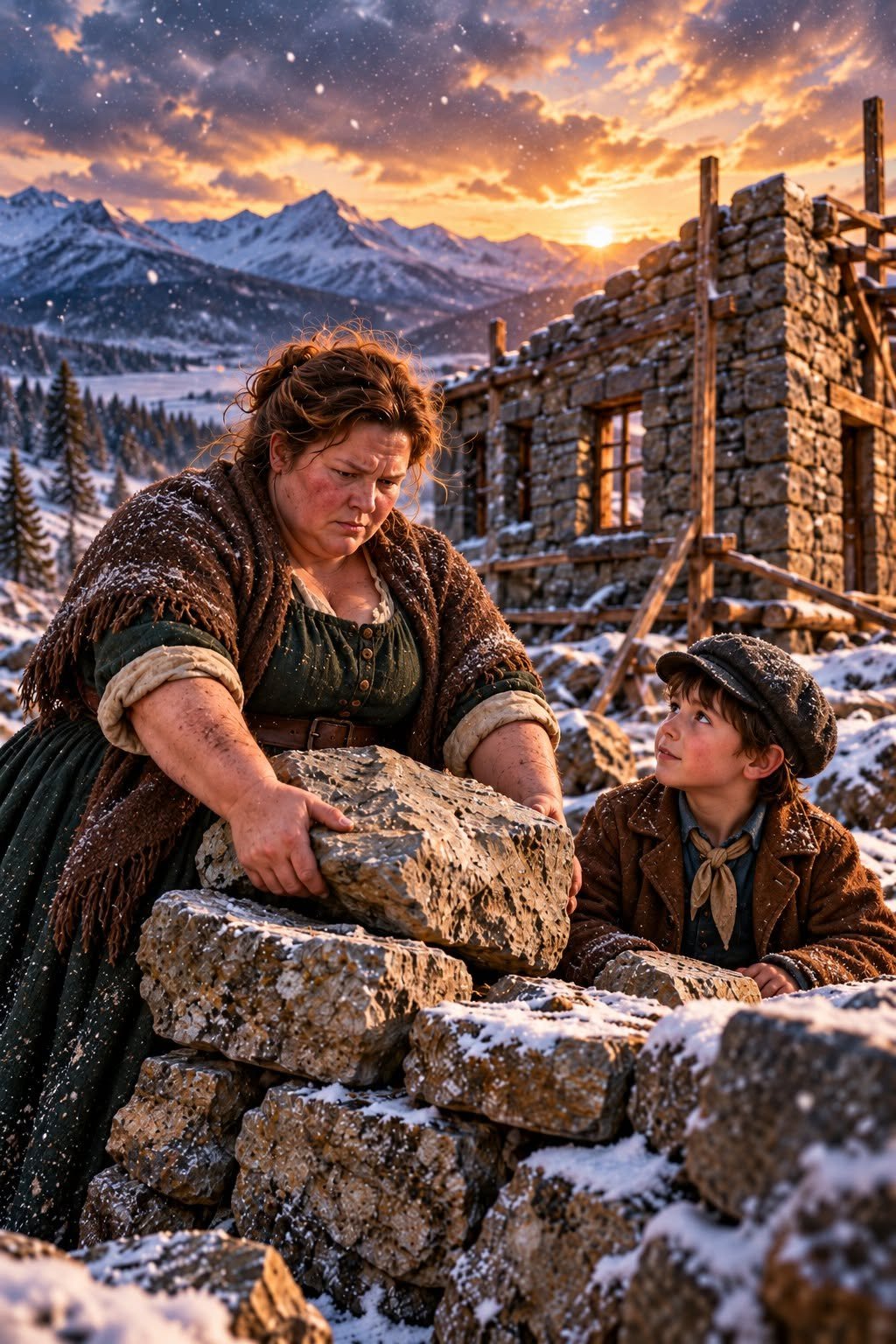
The whole town laughed when Hattie Wickham, a 370-pound widow, started stacking stones on a frozen Wyoming hillside. They called her hut a tomb. They said her children would freeze inside it before Christmas. But Hattie kept building — and when the deadliest blizzard in decades swallowed Sage Hollow, the townspeople discovered something terrifying: the houses they trusted were failing, and the strange stone hut they had mocked might be the only shelter left standing.
It was October 1884 in Sage Hollow, Wyoming Territory, when eight-year-old Silas Wickham held up his tin cup and showed his mother the ice inside it. “The water froze,” he said. Hattie bent her broad frame over the cup — 370 pounds of woman, chestnut hair in a loose braid, faded blue wool dress straining as she moved — and touched the thin sheet of ice. Frost was already spreading across the windowpanes like white branches, and it wasn’t even November.
Hattie knew what winter could do. Her husband Jonas had built their wooden cabin with his own hands and promised the Wyoming wilderness would never defeat them. Then a freight wagon accident took his life eighteen months ago. Their first winter without him, Hattie burned furniture, fence rails, even pieces of Jonas’s old wagon just to keep the children warm. By March, eleven pieces of firewood remained. She remembered sitting outside in the snow, crying where her children couldn’t hear — and she made herself a promise: never again would her family’s survival depend on a shrinking pile of timber.
Then a letter came from Colorado. Her father had died, and among his belongings was an old leather journal filled with drawings of stone shelters built into mountainsides — thick walls, south-facing windows, earth-covered roofs, clever passages to trap warmth. He had helped build such shelters in Colorado mining country, and some had kept entire groups of miners alive when blizzards buried their camps. Hattie studied every page. But one page had been torn out. Only a fragment remained: “My daughter, if you ever read this, never…” Never what? She had no time to wonder. Winter was coming.
So she took Silas up the ridge behind their cabin, knelt beside a great sandstone rock, wrapped her powerful arms around it, and carried it several yards to set it in place. “Building us a home that winter can’t steal,” she told her boy. He looked at the lonely stone, then at the enormous hillside. “People are going to laugh.” Hattie wiped the sweat from her forehead. “Yes, sweetheart. They probably will.” “What do we do when they laugh?” She rested her rough hand on his shoulder. “We don’t fight them. We carry stone. We mix mortar. We keep building.”
For weeks she worked from sunrise to darkness — digging the northern wall into the hillside, stacking sandstone in thick courses, measuring the small southern windows to her father’s drawings. Her fingers cracked. Her shoulders burned. Every evening she dragged herself home barely able to stand; every morning she climbed the ridge again. Then the neighbors noticed, and the laughter began.
Bo Coulter, the county’s wealthiest rancher, rode up on his expensive chestnut horse, watched her lift a stone, and roared, “Good Lord, woman! Building your own grave?” His companions laughed. “Building a house,” Hattie said without looking up. “Out of rocks? Everybody knows stone stays cold!” Bo threw back his head. “The fat widow thinks she’s smarter than every carpenter in Wyoming!” By sundown the whole town had heard. By Sunday the preacher was discussing it. And by Tuesday, Prudence Halloway — the banker’s wife, whose polished manners concealed a cruelty sharper than any winter wind — had decided something must be done.
At a gathering of respectable ladies, Prudence set down her teacup. “This isn’t about a foolish building. It’s about a woman refusing to know her place. A widow doing men’s work? What example does that set for our daughters?” The decision was made: nobody would help Hattie, nobody would trade with her, and nobody’s children would associate with hers. The punishment reached Silas first — his classmates moved away, his desk partner Betsy Fenton whispered, “My mama said I can’t.” He walked home alone, and when Hattie saw his red eyes she understood. “Did someone hurt you?” He shook his head, picked up an empty bucket, and asked, “What do you need me to do, Mama?” She swallowed the ache in her throat. “Fill that with water, son.” And together they kept building.
Then the cruelty sharpened into sabotage. Hattie went to Perkins’s general store for lime; the shopkeeper wouldn’t meet her eyes. “Sold out.” “All of it?” “That’s right.” She understood: Bo Coulter had bought the remaining supply, and Prudence’s banker husband had refused her credit. So Hattie walked to Rock River — forty miles round trip — and carried fifty pounds of lime home across her broad shoulders through rain and wind. Ten miles from home her knees buckled; she sat beside the road, exhausted, and for one terrible moment wanted to surrender. Then she remembered Jonas’s hands around hers, his quiet voice: “You are the strongest thing I ever loved, Hattie.” She stood. And kept walking. When she reached home after dark, Silas was waiting. He saw the sack, saw her trembling legs, and sat beside her. “You got it, Mama.” Tears filled her eyes. “I got it, sweetheart.”
Three weeks later, an unexpected visitor stopped beside the unfinished walls. Wendell Ashcraft, a lean carpenter traveling from Denver, stared at the thick walls, the hillside foundation, the carefully positioned windows. “Who designed this?” he asked. When Hattie named her father, Wendell’s expression changed. “I heard about a man who built a shelter near Leadville. Saved twelve miners when a mountain pass closed.” He climbed the scaffolding, came down, and said quietly, “Your father knew what he was doing.” Then: “But there’s a problem. Water. When the snow melts, water will collect behind that northern wall, freeze, expand, and crack the stone from the inside.” Hattie’s heart sank — months of work, flawed. “Can it be fixed?” “Yes. But not easily.” He described the drainage channel, the sloping stone bed, the careful arrangement to carry water away. Then he looked at the dark clouds gathering over the mountains. “I’d like to help you finish.” “Why?” He glanced at the walls. “Because somebody ought to see whether your father’s idea can save another family.”
That night the first snow fell. Old Barrow, Jonas’s half-blind sheepdog, raised his head and growled at the door. Three sharp knocks. Wendell stood outside, snow on his shoulders, face pale, holding Hattie’s father’s journal with a folded paper protruding from its damaged binding. “The missing page,” he whispered. He unfolded it, and the first words made her blood run cold: “My daughter, if you ever read this, never trust the men who offer you pennies for the hill, for they have found what lies beneath it.”
The page went on, in her father’s shaking hand: a surveyor’s mark, coal seams running under the sandstone ridge, worth a fortune to the railroad. “They will mock your building,” her father had written, “for a frightened woman sells cheap.” Suddenly everything was clear — Bo Coulter’s laughter, the bought-up lime, the refused credit. It wasn’t scorn. It was strategy. They wanted her to fail, to freeze, to sell the hill for nothing before she learned what slept beneath it. Hattie folded the page with steady hands. “Then we’ll finish the hut,” she said, “and we’ll never sell.”
They worked through the early snows, Wendell beside her now, digging the drainage channel, laying the sloping stone bed, sealing the roof with earth and sod. When the last stone was set, Hattie stood back and looked at what her hands had raised: a low, thick-walled shelter sunk into the hillside, small southern windows catching the pale sun, warm as a held breath inside. She moved her children in before December. The townspeople shook their heads. The preacher called it pride. Prudence Halloway called it a disgrace.
Then the sky turned the color of iron, and the deadliest blizzard in decades came down on Sage Hollow like a hammer.
For three days the wind screamed and the snow buried fences, then roofs, then whole outbuildings. Wooden houses — the ones everyone trusted — began to fail. Chimneys cracked in the cold. Roof beams groaned and split under the weight. The Fenton family’s roof caved in on the second night; the Coulter ranch house lost its chimney and filled with smoke. One by one, through the white hell of the storm, families stumbled up the ridge toward the strange stone hut with its warm lamplight glowing in the small southern windows — the hut they had laughed at, the tomb they had mocked.
Hattie opened her door to every one of them. Prudence Halloway arrived half-frozen, her fine coat stiff with ice, clutching her children — and Hattie wrapped them in blankets and set hot soup in their hands without a word about teacups or knowing one’s place. Bo Coulter came last, his expensive horse dead in the drifts, his pride finally broken, and Hattie gave him the warmest corner by the stove. Forty-three people sheltered in that stone hut for five days. The thick walls held the heat. The drainage channel carried the melt away. The earth-covered roof bore the snow like a strong back bears a burden. Not one person inside caught so much as a frostbitten finger.
On the sixth morning the wind died, and Sage Hollow dug itself out into a silence of blue and white. The town that had laughed stood in the ruins of its winter — collapsed roofs, split chimneys, frozen pipes — and looked up at the ridge where the stone hut stood untouched, smoke rising steady from its chimney. Bo Coulter walked up to Hattie in front of everyone. “Mrs. Wickham,” he said, and his voice shook, “I came to apologize. And to ask — will you sell me the hill?” Hattie looked at him for a long moment. Then she smiled. “Mr. Coulter, this hill is not for sale. But if the railroad wants coal, they can negotiate with the woman who owns it — at a fair price, in daylight, with witnesses.”
Spring came, and with it the railroad’s men, and Hattie Wickham — the fat widow they had tried to starve out — sold the coal rights for enough money to secure her children’s future and endow the town’s first schoolhouse. She named it for Jonas. Wendell Ashcraft stayed on, and in time the lean carpenter and the strong widow found in each other something neither had expected: a partner who had seen them at their lowest and stayed. Silas grew up telling anyone who would listen that his mother once carried fifty pounds of lime forty miles through the rain — and that she carried a whole town through the winter besides.
The neighbors don’t laugh at the stone hut anymore. They point it out to travelers on the ridge road, and they say: that’s the house the blizzard couldn’t break. And if you ask Hattie Wickham what her father meant by his warning, she’ll tell you plain: never trust the men who laugh at your building — because sometimes they’re laughing to make you sell.


