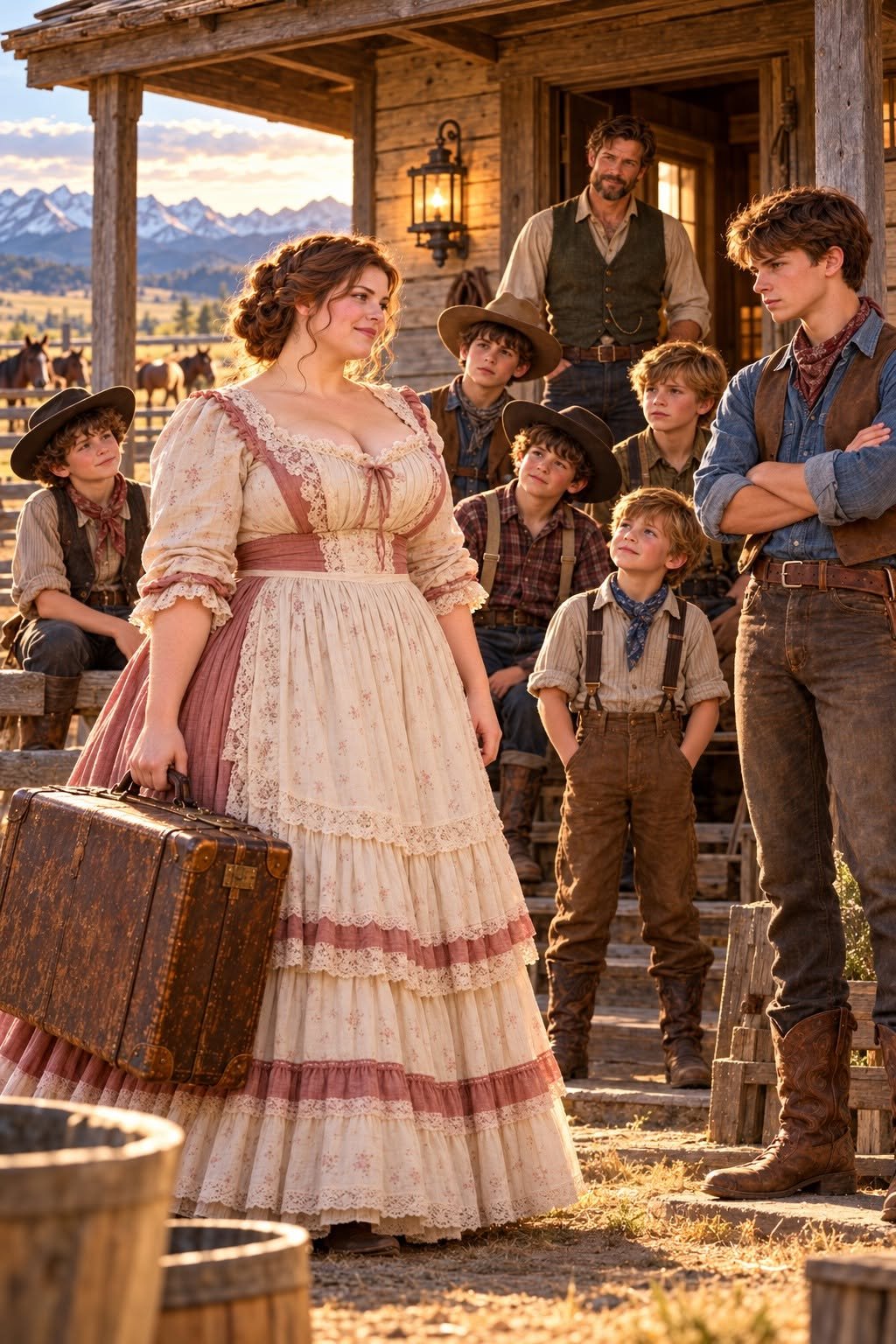
They gave Mercy Callaway one week to survive seven motherless boys. Then a wealthy woman threatened to starve them all unless Mercy left Wyoming before winter. Adeline Prescott expected the mail-order bride to pack her bags. Instead, Mercy opened her kitchen ledger — and what she wrote on the next page turned the whole county upside down.
Four weeks earlier, Mercy had arrived in Lark Crossing with one battered traveling case and fourteen years of experience feeding hungry strangers. She had crossed nearly a thousand miles from Missouri to marry Thomas Bell, a widowed rancher with three hundred cattle and seven sons aged six to nineteen. The boys met her on the porch with folded arms and a verdict: she wouldn’t last the week. The last woman hadn’t survived five days.
Mercy simply smiled. “Well, gentlemen,” she told them, “if I survive six days, we’ll have ourselves a new family record.”
What greeted her inside was worse than suspicion. The stove sat cold. Gray water filled the basin. A pot of beans had begun to sour, the flour barrel held barely enough for two loaves, and little Peter, the six-year-old, looked desperately hungry. “When did these boys last eat a proper supper?” she asked. Thomas Bell cleared his throat and claimed they ate regularly. Mercy had run her aunt’s Missouri boarding house for years. She knew a starving household when she saw one.
She tied on an apron, rolled up her sleeves, and went to work. Within minutes the kitchen came alive — the beans rescued, a ham hock trimmed, onions chopped, potatoes salvaged. Her hands kneaded dough the way they had a thousand times before, and by evening all seven boys sat down to their first proper family supper in months. Smoked ham, tender beans, potatoes with onions and herbs, bread with a golden crust, and — a small miracle — Ruth Bell’s final jar of preserved peaches, opened in the dead mother’s honor.
That night something shifted in the Bell ranch house. Peter whispered “More, please?” and then asked for thirds. Thomas laughed so suddenly that twelve-year-old Eli nearly dropped his spoon. For one bright moment, the house felt less lonely. But beyond the fence, a polished automobile sat idling. Inside it, Adeline Prescott watched — and her smile vanished.
Adeline Prescott was the wealthiest unmarried woman in Lark Crossing. Her family controlled Prescott Mercantile, which held sway over nearly every food supplier in the county. For years she had pictured herself as Thomas Bell’s second wife. The arrival of a practical Missouri woman had ruined those plans, and she told anyone who would listen that Thomas had settled for a hired cook.
The harvest social brought the confrontation into the open. Mercy walked into Prescott Mercantile Hall in a simple forest-green dress, carrying a homemade apple pie with perfect golden latticework. Adeline swept over in shimmering burgundy silk and announced, loud enough for the whole room, “Well, I suppose useful is useful.” A few women laughed. “A man with seven boys can hardly afford to be particular,” Adeline added. The room went quiet. Mercy uncovered her pie, set it on the table, and looked her rival straight in the eye. “I didn’t come to Wyoming to be particular,” she said, her voice carrying across the hall. “I came here to stay.”
Three mornings later, the retaliation began. Thomas opened the ranch ledger at breakfast and went pale. The winter flour delivery was canceled. So was the salt pork, the kerosene, even the animal feed. Every supplier depended on Prescott Mercantile, and suddenly nobody would sell the Bell family anything. Then Caleb walked in carrying an unmarked envelope. Inside was a single sentence: SEND THE MISSOURI WOMAN HOME BEFORE WINTER, OR THE BELL RANCH CAN LEARN WHAT HUNGER REALLY MEANS.
The wind rattled the windows. Winter was coming, seven boys needed feeding, three hundred cattle needed tending, and one rich woman had decided hunger would be her weapon. For one terrible moment, Mercy saw Thomas weighing whether sending her away might be the only way to protect his sons. She didn’t cry. She didn’t argue. She walked into the pantry, counted every sack of flour, every potato, every jar of preserved fruit — and opened her household ledger.
“Mercy, what are you doing?” Thomas asked. “Counting,” she said. “Counting what?” “Everything Adeline Prescott thinks she can take away from us.”
That night, after the boys were asleep, Mercy did something none of them expected. She took the ledger to the kitchen table, lit the lamp, and wrote two columns. In the first, everything the ranch had: stored grain, root vegetables, preserved fruit, salted meat, the cattle themselves, the garden still giving late squash. In the second, everything they lacked — and beside each lack, a name that was NOT Prescott Mercantile.
You see, Mercy’s fourteen years at a boarding house had taught her something Adeline never learned: a monopoly only works if you believe you have nowhere else to go. Mercy had fed twenty boarders on pennies by shopping around, trading favors, and buying from people the grand merchants forgot existed. She wrote letters that night — to a flour mill in Cheyenne, to a Cheyenne freight hauler who ran the rail spur line, to three small ranching families she had met at the social whose own tables were being squeezed by Prescott prices.
Then she rode to the bank. Mercy’s boarding-house years had taught her to read numbers, and she had noticed something while going through Thomas’s accounts: three of the suppliers tied to Prescott Mercantile had been quietly overcharging the Bell ranch since Ruth’s death — raising prices on a grieving widower too exhausted to check. She laid the ledgers out for the bank manager, a careful man named Harlan Duffy, and showed him the pattern. “This isn’t just my family’s problem, Mr. Duffy,” she said. “If she’s squeezing the Bells, she’s squeezing every ranch family in this county — and they’re all your borrowers.”
Duffy went pale. A merchant who strangles her own customers’ ability to pay back loans is bad for a bank. Within a week, the banker’s cold letter reached Prescott Mercantile, and rumors began moving through the county like wind through wheat. Meanwhile, Mercy’s letters came back with answers: the Cheyenne mill would sell flour at honest prices, the freight hauler would deliver, and — the sweetest surprise — four neighboring ranch families wanted in. They had all been paying Prescott’s inflated prices for years, silently resenting it. Mercy simply gave them a place to stand together.
Caleb watched all of this unfold, and one evening he cornered her by the barn. “You’re not our mother,” he said, but this time there was no shout in it — just a boy testing the ground. “No,” Mercy answered, the same as before. “I’m Mercy.” He looked at the ground, scuffed his boot, and said quietly, “Ma would’ve liked you. She kept ledgers too.” Then he walked away before she could see his eyes shine.
The showdown came on the first Saturday of November. Adeline arrived at the ranch in her automobile, certain the family was weeks from hunger. What she found instead: a freight wagon from Cheyenne being unloaded by four neighboring ranchers, the pantry shelves full, the boys hauling sacks of honestly priced flour, and Thomas Bell standing on his porch with his arms folded. Adeline’s smile cracked. “You think this changes anything, Mr. Bell?” she said. From behind Thomas stepped Mercy, holding the ledger. “Adeline,” she said calmly, “your suppliers charge honest prices to Cheyenne. They charge inflated prices to Lark Crossing because you tell them to. I have the receipts, the bank has the pattern, and half the county knows it now. Would you like me to read it aloud?”
Adeline left without another word. Within a month, two of the suppliers quietly broke from Prescott Mercantile’s grip and began selling directly to ranch families at fair prices. The overcharging stopped. The winter deliveries resumed — not because of threats, but because the county had learned it had choices. Adeline never spoke to Mercy again, but she never crossed her either.
And what of the seven boys who had given Mercy one week? Winter came, and the house stayed warm. The pantry stayed full. Every morning the smell of fresh bread rose through the ranch house like a promise. On Christmas Eve, Thomas Bell stood before his sons and — with a ring that had been Ruth’s, offered with the boys’ blessing — asked Mercy Callaway to marry him properly, before God and the whole county. She said yes through tears, and seven boys cheered so loud the cattle stirred in the far pasture.
The wedding took place in the little Lark Crossing church in January. Eli rang the bell. Peter carried the ring on a cushion. Caleb stood beside his father as best man, straight and proud, and when the preacher asked who gave this woman, all seven boys answered at once: “We do.” Mercy hung her apron by the door that night — not because she was done cooking, but because she finally had a home.
Adeline Prescott had tried to starve out a mail-order bride. Instead, she discovered what happens when you threaten a woman who spent fourteen years turning pennies into meals: she doesn’t run. She opens her ledger, counts what she has, and feeds everybody anyway.

