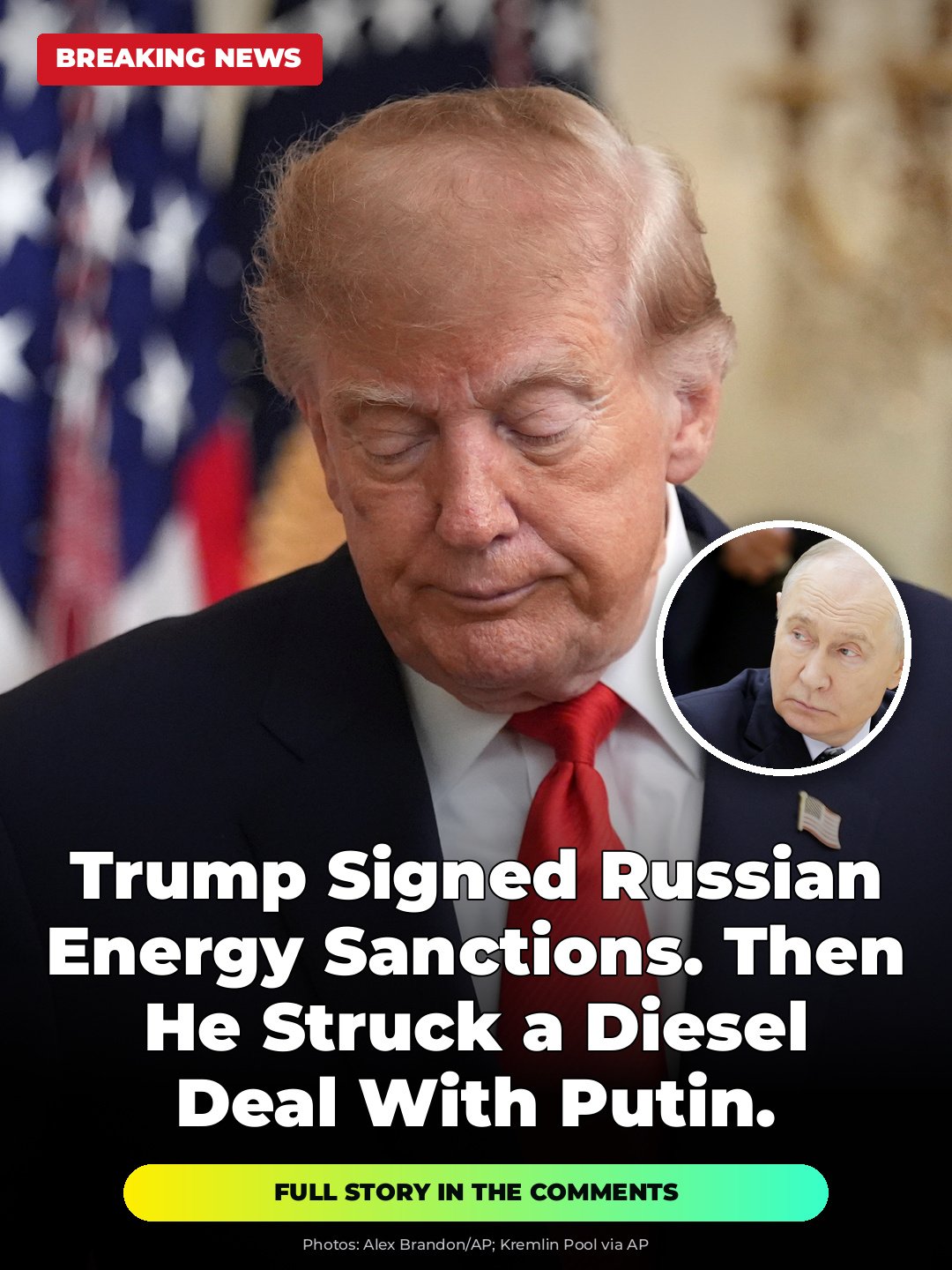
Donald Trump had recently signed a new sanctions law aimed at increasing pressure on Russia. On Friday, October 9, he announced an agreement with Vladimir Putin to bring Russian diesel into American and global markets. The reversal immediately raised a question that reaches far beyond a presidential phone call: can Washington make fuel cheaper without weakening the pressure it has placed on Moscow over the war in Ukraine? For Americans watching their expenses, the appeal of additional fuel is easy to understand. For Ukraine, the source of that fuel makes the announcement deeply troubling. Between those two realities sits a deal whose political significance is already clear, while its practical benefits still have to be demonstrated. [1]
The numbers in Trump’s announcement were substantial. He said Russia would supply more than 300,000 tons of diesel immediately, another 500,000 tons during November, and 1 million tons shortly afterward. He also described a further 3 million tons, with that later supply depending on the condition of Russian diesel refineries. Taken together, the announced stages amount to more than 4.8 million tons. But the sequence matters as much as the total. Most of the promised fuel belongs to later stages, and the largest portion carries an explicit condition. An impressive headline number therefore cannot establish how much fuel will become available first, where buyers will receive it, or when consumers might notice a difference. [2] [12]
Another important detail is the destination. Trump’s announcement referred to the American and global marketplace, rather than reserving every ton for the United States. That distinction changes how the deal should be understood. A larger international supply could potentially help American buyers even when some cargoes go elsewhere, because energy markets are connected. Equally, announcing a global quantity does not tell an American trucker how much additional diesel will reach the nearest terminal. The relevant question is how the fuel changes the balance of supply and demand where it is sold. The announced total is a starting point for evaluating that possibility, rather than a measure of the savings already secured for any particular community. [2] [10]
There is a concrete government action behind the announcement. The Treasury Department’s Office of Foreign Assets Control issued Russia-related General License 135 on October 9. It authorizes transactions covered by two Russia-related sanctions regulations when they concern the sale, delivery, offloading, or importation of Russian-origin diesel, including imports into the United States. The authorization runs through 12:01 a.m. Eastern daylight time on April 7, 2027. That provides a temporary legal opening for the specified transactions. It does not publish a shipment contract, name the commercial buyers, set a price, or lay out Trump’s promised delivery stages. Those business details would be necessary to evaluate how the announcement translates into actual purchases and deliveries. [3] [4]
The license also contains a specific restriction: it does not authorize debiting accounts held at U.S. financial institutions for Russia’s central bank, National Wealth Fund, or Ministry of Finance. Its scope is Russian diesel transactions under the regulations it identifies. Describing the document as the removal of every sanction on Russia would therefore overstate what it says. The distinction is consequential even for readers who never encounter a sanctions document themselves. A government can open a particular channel for trade while leaving other restrictions in place. Judging this decision requires examining that channel and its effects, rather than treating a temporary authorization as proof that Washington has abandoned its entire sanctions system or restored unrestricted commercial relations. [4]
To understand why the opening is controversial, look back to the restrictions imposed after Russia’s full-scale invasion of Ukraine. Executive Order 14066, signed in March 2022, prohibited U.S. imports of Russian-origin crude oil, petroleum fuels and related products, liquefied natural gas, and coal, subject to authorized exceptions. It also prohibited new U.S. investment in Russia’s energy sector. The policy tied energy trade directly to the response to Russia’s war. That history gives the new diesel authorization significance beyond the cargo itself. Energy purchases have been treated as part of the pressure on Moscow, so reopening a route for a Russian fuel inevitably raises questions about what that pressure is supposed to achieve and how exceptions fit within it. [5]
The timing adds another layer. The White House confirmed that Trump signed H.R. 5334, the Lindsey O. Graham Sanctioning Russia and Iran Act of 2026, on September 18. Its announcement described the law as authorizing and expanding statutory sanctions, tariffs, and prohibitions on Russia while extending existing sanctions on Iran. Three weeks later, the administration issued the diesel license. That sequence does not, by itself, establish that the license violates the law; such a conclusion would require a detailed legal analysis. It does create a policy question the administration should answer clearly: how does a new opening for Russian energy trade serve the broader strategy of increased pressure? The public deserves an explanation connecting the two decisions. [6]
Diesel matters because it powers much of the machinery behind ordinary life. The U.S. Energy Information Administration identifies freight trucks, delivery trucks, trains, buses, boats, and farm and construction vehicles among its uses. Diesel generators also provide backup or emergency electricity in places such as hospitals and industrial facilities. These uses explain why a diesel announcement can matter to people whose own cars run on gasoline. The fuel sits behind goods being moved, work being completed, and essential equipment being kept available. A change in its cost can affect businesses before consumers notice any connection. The political argument over Russian supply is therefore also an argument about the expense of keeping everyday economic activity moving. [7]
Consider a simple illustration rather than a claim about a particular business. If an operator buys 1,000 gallons of diesel during a period of work, a price change of 50 cents per gallon changes that fuel bill by $500. Whether the operator absorbs that difference, alters a service price, or has an existing contract that limits changes will depend on the business. The arithmetic helps explain the urgency without pretending every company responds identically. It also shows why even a modest reduction could matter to an individual buyer, despite having a limited effect across the national economy. The challenge for this agreement is turning the prospect of relief into a price change that arrives where the fuel is actually purchased.
The latest deal enters a market that was already under strain. In a September analysis, the EIA said reduced refining activity in Russia, China, and the Middle East had tightened global supplies of distillate fuel. Meanwhile, U.S. refineries were operating at nearly maximum levels: utilization reached 97 percent in the week ending September 11. The agency reported a national average retail diesel price of $6.29 per gallon on September 14. These are dated measurements, not a live quotation for every station. Together, they show why additional supplies attract attention, and why the situation involves more than a single restriction on imports. Access to fuel depends on available refining output as well as the rules governing its sale. [8]
An overseas purchase also reaches consumers through several layers of costs. The EIA identifies crude oil, refinery processing, distribution, retail operations, and taxes as components of diesel’s pump price. That framework helps explain why a diplomatic announcement cannot specify the final price at a neighborhood station. A buyer still needs a commercially workable purchase, transport, and distribution arrangement. The retail price then reflects costs further along that chain. It would be premature to promise a particular discount per gallon before those arrangements and market conditions are known. The useful comparison will be between actual prices over time and the supplies available to buyers, with attention to other changes occurring in the same market. [9]
Season and location make that comparison more complicated. The EIA explains that autumn and winter demand for heating oil can influence diesel prices, while agricultural demand also varies in some regions. Transportation bottlenecks can prevent supplies from moving quickly to places where they are needed. This means a delivery that helps one market may provide less immediate relief in another. For a reader trying to assess the agreement, a national promise should therefore be followed by regional evidence. A lower wholesale quotation at one port would be useful information, but the wider test is whether available supply improves and buyers in different areas see a sustained change. That is a practical test, rather than a verdict announced in advance. [10]
Experts interviewed by the Associated Press were skeptical that the agreement would reduce U.S. or global prices. Michael Lynch of the Energy Policy Research Foundation argued that redirecting Russian diesel could simply force its existing buyers to seek supplies elsewhere. He said any relief might be small and localized. His assessment challenges Trump’s expectation of rapid, dramatic savings; it does not establish that every possible delivery would have no value. The issue is how much additional fuel the agreement brings into the market, rather than how much existing supply changes destination. That question deserves attention as purchases develop. [11]
There is also a difference between diesel and the gasoline most Americans put in passenger cars. Both are petroleum products, but a diesel shipment is not a shipment of regular gasoline. The EIA notes that worldwide demand and production requirements help explain why their prices can differ. That matters when a headline uses the broader word fuel and readers understandably imagine their own next fill-up. Any claim of consumer relief should identify which product it concerns and how the benefit is expected to reach people. A diesel agreement may matter through freight expenses or a business’s direct purchases. Its announcement alone cannot establish an equivalent reduction in gasoline prices or an immediate change in a family’s total living costs. [9]
Ukraine’s response was sharp. President Volodymyr Zelenskyy described the move as a weak decision by strong partners, according to a statement reported by Sky News. He argued that easing sanctions without a clear, lasting agreement to reduce the conflict would benefit Russia and help it continue the war. That is his assessment of the decision, rather than a documented outcome of cargoes that have yet to be evaluated. Still, it identifies the strategic concern behind the anger: opening a market for Russian energy can offer Moscow economic relief while Ukraine continues seeking pressure on the Kremlin. The dispute is about whether the benefit offered to Russia is matched by a meaningful change in Russian conduct. [12]
The announcement also overlapped with diplomacy over the war. Reports described U.S. envoy Steve Witkoff and Jared Kushner meeting Ukrainian officials in Miami to discuss proposals for ending the conflict. An energy agreement emerging alongside those discussions can be interpreted very differently by the governments involved. Washington may view access to another fuel source as a practical response to prices; Kyiv may ask whether pressure is being reduced before Russia has made a sufficient concession. The public reporting does not establish that the diesel agreement includes a peace settlement. Keeping the two issues connected, without merging them into a breakthrough that has not been demonstrated, is essential to understanding what was announced and what remains unresolved. [13]
From Ukraine’s perspective, the issue is also the sequence of decisions. If economic relief is intended to encourage a diplomatic concession, the value of that approach depends on the concession and whether it can be verified. If relief is offered primarily to address fuel costs, the administration has a different argument to make: that the domestic benefit justifies the exception. These are questions for evaluating policy, not evidence of a hidden bargain. The distinction matters because public debate can quickly turn uncertainty into an accusation presented as fact. A useful assessment should ask what Russia has agreed to provide, what Washington has authorized in return, and whether any commitments concerning the war have actually been disclosed and can be monitored.
The approaching U.S. midterm elections make the timing politically sensitive. The Washington Post reported that high diesel prices had become a significant problem for the administration as it sought ways to provide relief. That context explains the attention paid to an agreement announced only weeks before voters go to the polls. It does not prove that the transaction has no economic rationale, or establish how any individual will vote. Political urgency and a real concern about costs can exist together. The relevant question is whether the announcement delivers a practical benefit on the schedule being suggested. Voters and businesses will ultimately encounter actual prices and expenses, while the policy debate will also continue to involve the costs of easing pressure on Russia. [14]
The next developments should make the picture more concrete. Commercial arrangements, verified cargo movements, delivery destinations, and the timing of purchases would help show whether the announced stages are being implemented. Price data should be examined with dates and locations attached, rather than using one station or a brief market movement to declare nationwide success. The April 7 expiration of the temporary authorization will also require attention as the policy develops. None of these indicators can answer every diplomatic question, but they can separate an announced intention from a measurable result. A promise that depends partly on refinery conditions needs evidence about what is available, what is purchased, and how much of the expected benefit actually reaches consumers. [4]
Trump has presented a Russian diesel agreement as a route toward cheaper fuel. His administration has issued a temporary authorization to make specified transactions possible. Ukraine has objected to the relief it could give Moscow, while the economic payoff for American buyers remains uncertain. Those points can all be true at the same time. The story now turns on delivery, price, and the wider response to the war. If meaningful relief materializes, it will strengthen the administration’s argument that the exception serves an immediate need. If the benefits are slight or slow, the decision will face harder questions about what was gained. For now, the deal has changed the political conversation; the fuel market still has to show what it changes in daily life.

