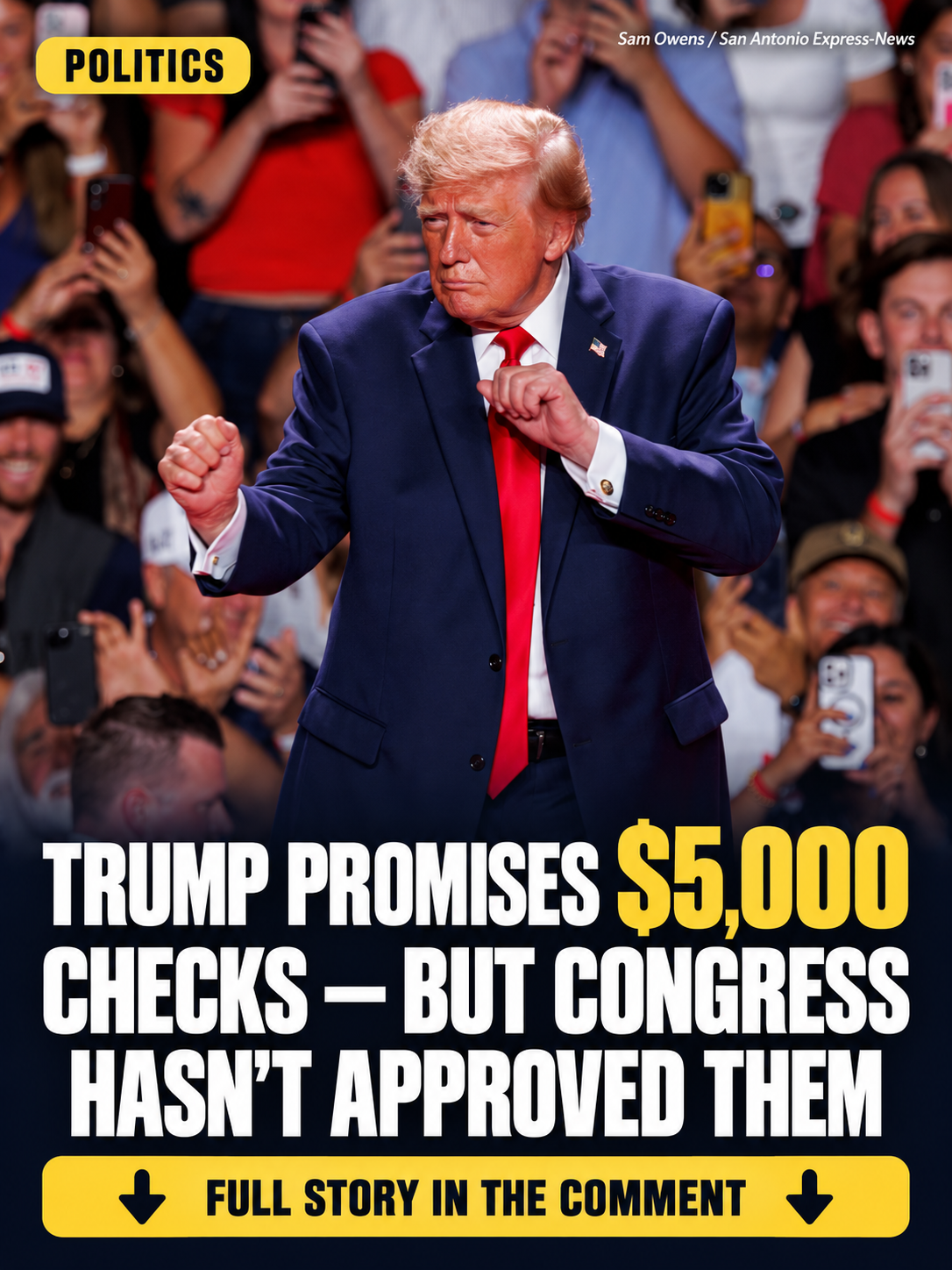
A $5,000 check sounds like the kind of news that could change a difficult month overnight. It could cover a repair, reduce a balance or provide breathing room after another expensive grocery trip. President Donald Trump has renewed a promise of payments that large if Republicans keep control of Congress. But as of October 10, the promise is still a proposal, with no approved nationwide payment program or confirmed deposit schedule. That distinction is the most consequential part of the story for anyone wondering whether to count on the money. [1][2]
The latest attention follows Trump's appearance in San Antonio, where he repeated the pledge during his October 7 rally, according to the San Antonio Express-News. A large number delivered from a campaign stage can travel much faster than the details needed to make it happen. Soon the conversation becomes about who might receive a check, when it could arrive and whether a registration page exists. Those are reasonable questions. At this stage, however, they cannot be answered with a final set of government rules because the payment plan has not been enacted. [1]
The first obstacle is authority. The president can propose a program, promote it and ask lawmakers to support it. Federal spending, however, operates through legal authority and appropriations. The Constitution gives Congress a central role in controlling money drawn from the Treasury. A campaign announcement does not itself supply the legislation and funding for a new nationwide payout. Readers should therefore look for an enacted law and implementing agency instructions before treating the proposed amount as something their household is owed. A strong political promise and a functioning benefits program are different stages of a process. [4]
Control of the House and Senate would not automatically settle that process. Individual lawmakers can disagree about a payment's size, financing and eligibility even when they belong to the same party. A proposal can change as committees consider its details, as costs become clearer or as another legislative priority takes up time. The final measure, if one advances, could resemble the original promise or differ substantially. The practical question is whether Congress actually authorizes the program, rather than whether enough politicians have expressed enthusiasm for the headline. A projected election outcome cannot substitute for a completed legislative record.
Funding is the next question, and it deserves more attention than a slogan can provide. Sending a large amount to a large population requires substantial resources. As an illustration of scale, $5,000 multiplied by 100 million people equals $500 billion; that calculation does not establish how many people would qualify. It simply shows why lawmakers would need a clear financing plan. They would have to decide what revenue supports the payment, how it fits into the budget and what tradeoffs follow. The promise cannot answer those questions without additional policy decisions.
Calling a payment a dividend does not resolve its budget treatment. The word can suggest that money is being returned from a successful investment, but a federal cash program still needs defined authority, recipients and funding. Readers can assess the proposal by asking plain questions: What money is available? Who is authorized to distribute it? Is it a one-time payment? What conditions apply? Those questions are useful regardless of which administration offers the idea. The answer should come from the eventual law and agency guidance, rather than from an appealing label attached to the announcement.
Eligibility is another unresolved point that viral posts often rush past. A phrase such as American adults leaves room for important decisions about citizenship, residency, age, income and tax filing status. Those decisions can change both the cost and the number of people covered. Until official rules exist, a social media checklist claiming to identify every eligible person should be treated cautiously. A household's circumstances may differ from the example used in a speech. The article can explain the proposal's status today, but it cannot manufacture an application rule that the government has not published.
Older readers have a particularly practical reason to demand that clarity. Many households coordinate a limited monthly budget around reliable deposits and known due dates. A possible future payment can be interesting news without being money available for the next bill. Budgeting around an unapproved amount could create a difficult gap if the proposal changes or never becomes law. The sensible distinction is between money already scheduled under an existing program and money being discussed as a potential new policy. That distinction protects a household's planning without requiring any judgment about the candidate making the promise.
The $5,000 discussion also needs to be kept separate from other payment announcements. Reporting on smaller Medicare and Affordable Care Act payments does not establish that a much larger universal payment has been approved. Different programs can rely on different laws, funding sources and eligibility rules. A screenshot combining several amounts into one message can create a misleading impression that they are all part of the same authorized benefit. Each claim should be checked independently. Approval of one payment does not automatically approve the next, even when the announcements come from the same White House. [2][3]
A payment date would be a later-stage detail. Before any distribution could be scheduled, the responsible agency would need instructions about who qualifies, how recipients are identified and how payments are delivered. It would also need a way to address missing information, duplicate records and questions from people who believe they qualify. Those steps are not administrative decoration; they determine whether a promise can become an orderly program. For now, a post naming a guaranteed arrival date goes beyond the verified status of this proposal. A calendar graphic cannot create an authorized deposit.
The same caution applies to claims that a special website can reserve the money. There is no verified application process for this proposed nationwide $5,000 program in the reporting reviewed for this article. A page asking for financial information should not be mistaken for official administration merely because it repeats a popular political phrase. Government benefits attract interest, and that interest can be exploited. Readers can check an agency's official address independently rather than relying on a link forwarded through a comment thread. An attractive headline should never become a reason to surrender sensitive personal details.
The Federal Trade Commission has previously warned that scammers use announcements about government checks to demand fees or personal information. That older consumer warning remains useful context; it is not an announcement that these particular checks exist. Its practical lesson is to pause when someone claims a payment can be unlocked by sending money first or sharing bank credentials. A genuine policy story does not require a reader to purchase access to eligibility. If the proposed program becomes law, its responsible agency should provide authoritative instructions that can be checked without trusting an unsolicited message. [5]
The economic debate is separate from the question of approval. Supporters of direct cash relief may argue that households need help quickly and can decide for themselves how to use it. Critics may question the financing, inflation effects or whether another form of relief would be more effective. Those are policy arguments to evaluate with evidence once a concrete design exists. A campaign outline is too incomplete to establish every economic consequence. Readers should be wary of confident claims that a still-undefined program will either solve every affordability problem or produce a precisely measurable disaster.
Timing gives the proposal added political significance. A cash promise made before an election can draw attention because it connects a future policy to an immediate contest for power. That does not remove the normal need for a law, nor does it prove how any particular voter will respond. The relevant reporting question is what has been promised and what legal steps remain. Citizens can examine those facts without being told how to vote. The amount is attention-grabbing, but the path from a speech to a Treasury payment is the part that determines whether the promise has practical value.
There are several concrete signals to watch next. A detailed legislative proposal would explain more than a rally statement. Committee action would show that lawmakers are considering an actual measure. An enacted law would establish legal authority. An agency notice would clarify administration and eligibility. None of these signals should be confused with a commentator's prediction that a deal is certain. Keeping the stages separate makes it easier to recognize real progress if it happens. It also prevents an old promise from being repeatedly repackaged as a newly approved benefit without a change in its underlying status.
A useful way to read future updates is to identify the verb. Proposed, introduced, passed one chamber and signed into law describe different things. Announced can mean almost anything unless the story explains what action occurred. The strongest reporting will name the document, institution and decision involved. A reader does not need to master congressional procedure to ask whether a measure has actually become law. That single question can cut through a surprising amount of confusion. It helps distinguish movement in the political debate from a payment that can reasonably be added to a household budget.
The same standard should apply to the original amount. If legislation eventually authorizes a different figure, a headline still advertising the campaign number would need updating. If the program limits eligibility, a claim that everyone receives it would be inaccurate. If no measure advances, the continued circulation of the proposal would not make it more official. News should follow the policy as it develops rather than treating a memorable number as permanently fixed. Readers deserve to know both what changed and what remains unresolved, especially when a story involves money they may urgently need.
For families discussing the proposal at home, the most helpful conversation may be a simple one: this is something being promised, and we will watch for an actual approval. That wording leaves room for the policy to develop while preserving a realistic budget. It does not require dismissing the possibility or assuming success. A proposed payment can be worth following without becoming a spending plan. The emotional pull of a large check is understandable. Careful language gives that interest a factual foundation and reduces the chance that hope will be confused with an existing entitlement.
As this story moves forward, the documents matter more than the volume of posts repeating it. An official law, a clear funding decision and published agency instructions would change the status in ways a viral graphic cannot. Until then, the absence of those steps is newsworthy. It is also useful to anyone weighing whether a payment claim is credible. This article reflects the information available on October 10; a later announcement could require an update. Any future report should identify that new action directly and explain how it changes the unresolved questions outlined here.
Trump's renewed promise puts a striking number in front of Americans: $5,000. The verified takeaway today is that it has not become an approved nationwide payout. Congress and the practical design of a program still stand between the proposal and any bank account. That is the detail worth remembering when the next version of the headline appears in a feed. Follow the story, check the documents and keep promised money separate from scheduled income. The announcement is real political news; the deposit remains a possibility whose legal and administrative foundations have yet to be completed. [1][4]

