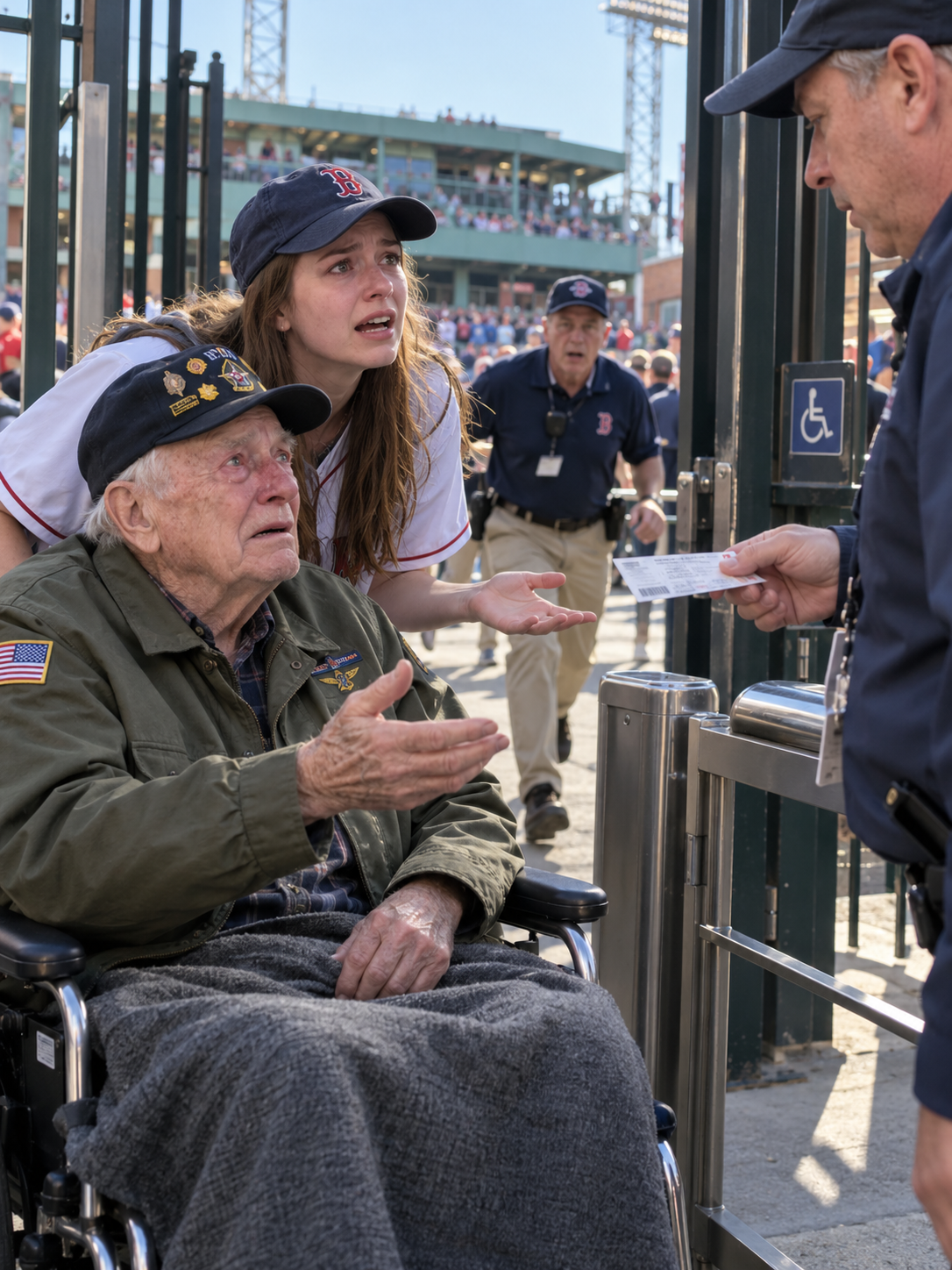
The stadium gate closed inches from Thomas Hale’s wheelchair. His granddaughter Anna held up their tickets and asked the attendant to check them again. A second usher came running toward them. Thomas had waited a full year for this baseball game, and the first pitch was minutes away.
Thomas was eighty-four and had taken Anna to games since she was little. He taught her to keep score on paper, a habit she maintained even after the stadium added bright screens everywhere. Last season he had missed the final game while recovering from an illness.
Anna bought seats with accessible entry for his birthday and confirmed the gate information before they left. Thomas wore a faded veteran cap and brought the pencil he had used to score games with his late brother. The trip was meant to feel familiar, not like an expedition.
At the entrance, the attendant scanned one ticket, then hesitated over the other. His device showed a mismatch between the general entrance and the accessible route. He told them to go around the building to another gate without explaining how far it was.
Anna said the accessible entrance was listed on their confirmation. The attendant repeated that the scanner did not accept the ticket and moved it out of her reach. Thomas asked if the usher could call a supervisor. Around them, the crowd kept moving through the turnstiles.
Thomas disliked being the reason a line stopped. He suggested they follow the direction given, but Anna could see the long walkway and the steep ramp beyond it. They had already checked the route precisely because he could not manage unnecessary distance.
The second usher, Malik, recognized the ticket type from the blue stripe on its edge. It belonged to a group moved to a new seating section after repairs. The tickets were valid; the gate scanner had not yet been updated for that section.
Malik asked the attendant to return the tickets and radioed guest services. Anna watched Thomas rub the pencil between his fingers while they waited. He said that when he was younger he could climb to the cheapest seats and still have breath left to shout at the umpire.
Guest services confirmed the error and opened the gate. Malik offered to escort them by the shorter accessible route. Thomas did not want special attention, but he accepted directions from someone who had actually checked the problem instead of pointing away.
At their seats, Anna discovered that the field was closer than in any game they had attended together. Thomas took out his scorecard and drew the first inning grid before the players appeared. His handwriting was smaller than it used to be, but each box was exact.
Malik returned with a printed map showing the correct route for leaving. He had also reported the scanner issue so the next ticket holder would not be turned away. Anna thanked him for doing the unglamorous work after getting them inside.
The first batter stepped to the plate. Thomas leaned forward and identified a player Anna had overlooked. Then he talked about a game he had attended with his brother forty years earlier, when they had sat under a dripping roof and cheered through a long rain delay.
Anna knew some of those stories. That afternoon she heard new details: her uncle’s lucky scarf, a hot dog they shared because they were short of cash, and the argument about whether a foul ball had landed two rows behind them or three.
During the seventh inning, Thomas put down the pencil. Anna worried he was tired, but he was watching a father teach a small boy how to hold a glove. “That’s us,” he said, then corrected himself. “No. You were the one explaining the rules to me by then.”
The attendant from the gate found them after the game. He apologized for sending them away without checking the ticket’s section or the access route. Thomas accepted the apology and asked whether the scanner problem had been fixed. The attendant said it had.
They took the route Malik had marked and reached the car without a detour. Thomas kept the ticket in his jacket pocket beside the pencil. He told Anna he wanted to return next season, though perhaps earlier in the day so they could take their time.
At home, Anna placed the scorecard on his kitchen table. Their team had lost by one run, but Thomas had recorded every play. In the margin he wrote Malik’s name and a reminder to ask about the updated gate when they bought tickets again.
Anna offered to frame the scorecard. Thomas declined. He wanted to finish the season in the same booklet and leave room for more games. He had learned, after his illness, that plans felt different when he wrote them down in ink.
The following spring, Anna booked another pair of accessible seats. She called to confirm the entry and saved the details in both their phones. Thomas sharpened the old pencil, keeping the worn stub from the previous game in a drawer.
When they reached the gate this time, it opened on the first scan. Thomas rolled through, turned to Anna, and asked whether she had brought a scorecard. She had. Before the first pitch, he drew a box for another day they had almost missed.


