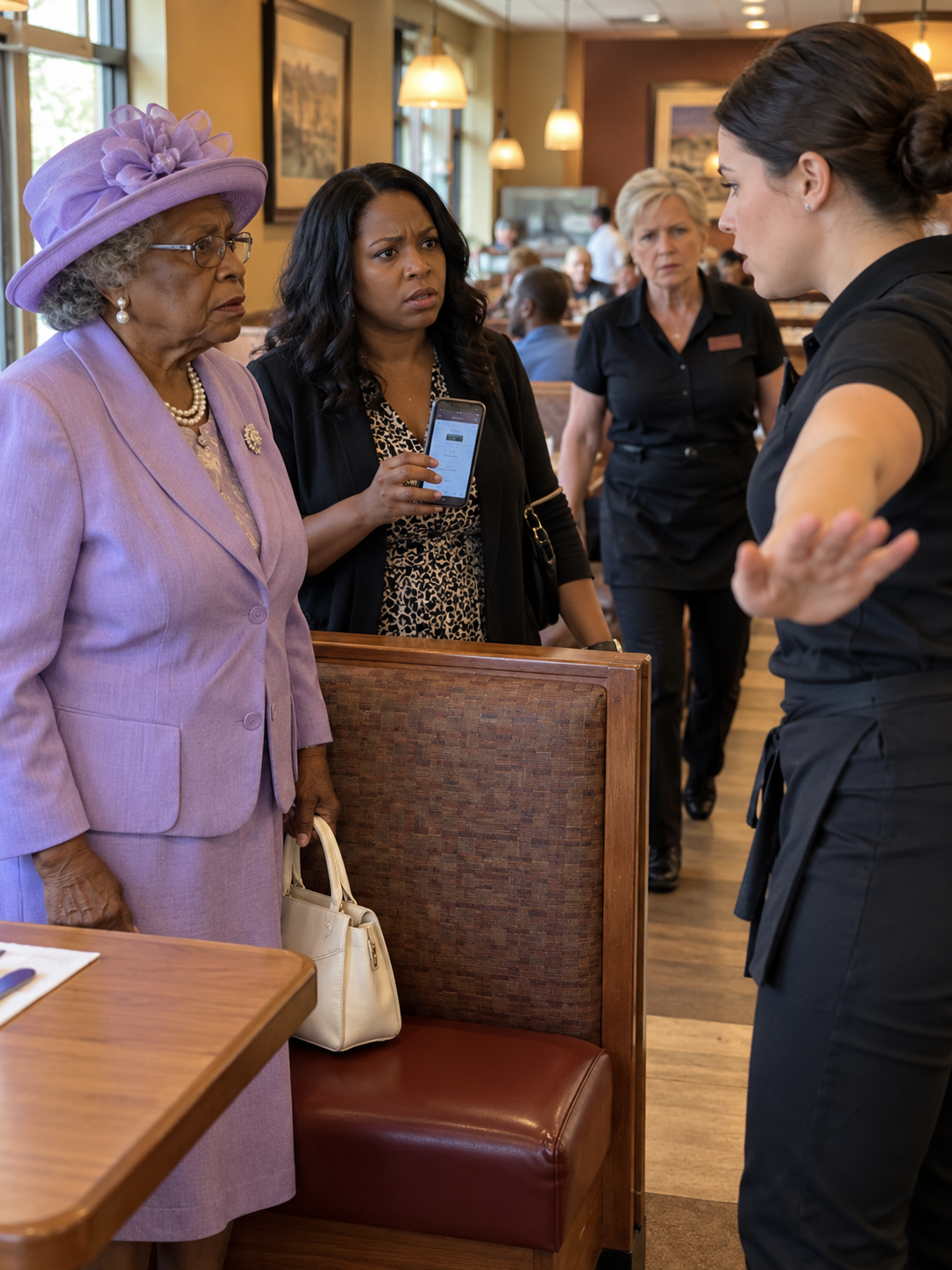
The host held out a hand to stop Eleanor Price from sitting down. Her daughter showed the reservation on her phone, but he waved it away and said the booth was needed for another family. Eleanor, dressed in lavender for her eighty-first birthday, looked at the empty table where her friends were supposed to meet her.
Eleanor had chosen that restaurant because her late husband took her there on their first anniversary. The food had changed and so had the owners, but the corner booth still faced the same windows. She had not been back since his funeral two years earlier.
Her daughter Simone made the booking a week ahead and called on the morning of the celebration. She requested a booth because Eleanor’s knees made the tall stools uncomfortable. The confirmation arrived on her phone, and Simone had brought a printed copy in case the screen was hard to see.
At the door, the host glanced at Eleanor’s hat and pearls before looking at the reservation. He said the group would have to take a small table near the kitchen. Simone pointed out that the corner booth was empty and their name was on the booking.
“That one isn’t available,” he repeated, though he offered no explanation. An older server carrying menus slowed down when she heard him. Eleanor asked whether there had been a mistake. She would have accepted a clear answer, but the host spoke past her to Simone.
Two friends arrived with a wrapped gift and saw Eleanor standing beside the booth. The host told them they could wait outside until another table opened. Simone felt the familiar discomfort of being treated as if asking a reasonable question were itself an offense.
She held up the printed confirmation. The host said it did not specify a particular seat. Simone showed him the note in the reservation about accessible seating. He read it this time and shifted his explanation: a larger party was expected later.
The older server, Angela, asked to see the schedule. She had worked with the owner for years and knew that the booth had no upcoming reservation until dinner. She did not accuse the host of a motive she could not prove. She simply pointed to the empty line on the page.
Eleanor asked Angela whether she recognized her husband’s name. Angela did. She remembered the couple sharing a single dessert every anniversary and leaving a note for the kitchen staff each year. The recognition made Eleanor smile and, unexpectedly, made her eyes fill with tears.
The owner came over when Angela called. He checked the reservation and told the host to honor it. He apologized to Eleanor and Simone, then asked the host to step away for a private conversation. The correction happened before the birthday cake, where it belonged.


