Tommy Callahan was eleven years old, and every school day ended the same way: with his stomach knotted tight before he even reached the front doors of Maple Hollow Elementary.
Tommy had autism. He didn’t talk much, and when he did, the words sometimes came out in the wrong order. He liked to count things — fence posts, cracks in the sidewalk, the clicks his sneakers made on pavement. The other kids called him “the weird kid.” A few of them decided walking home behind him was the best part of their day.
It started with names. Then shoves. Then his backpack in the mud. Tommy never told his mother. He figured that was just the way the world worked for a kid like him, and he was too ashamed to say it out loud.
His mother, Ellen Callahan, worked double shifts at the diner on Route 9. She noticed Tommy eating less. She noticed the bruise on his elbow that he said came from “falling.” She noticed him sitting at the kitchen table long after dark, staring at nothing. Mothers notice everything, even when their sons wish they wouldn’t.
On a Thursday in early October, the sky was that flat gray that comes before rain, and Tommy took his usual route home down Cedar Lane — past the empty lot, past the old laundromat, and past the corner where the three boys always waited.
Jace, the tallest, stepped into his path and kicked Tommy’s backpack so hard it split at the seam. His books spilled across the sidewalk. The other two laughed the kind of laugh that isn’t really laughter at all.
That’s when the engines cut in.
The Iron Spurs Motorcycle Club had been riding through Maple Hollow on their way to a charity breakfast two towns over when their road captain, a barrel-chested man named Gus Delgado, heard something that made him lift his hand and signal a stop. Sixty bikes rolled to a silent halt.
Gus was fifty-eight, with a graying beard and knuckles that had seen their share of bar fights in a younger, wilder life. He’d spent the last twenty years trying to be the kind of man his late father would have been proud of. He took one look at the scared boy on the sidewalk, the scattered books, and the three grinning teenagers, and he felt something old and hot rise in his chest.
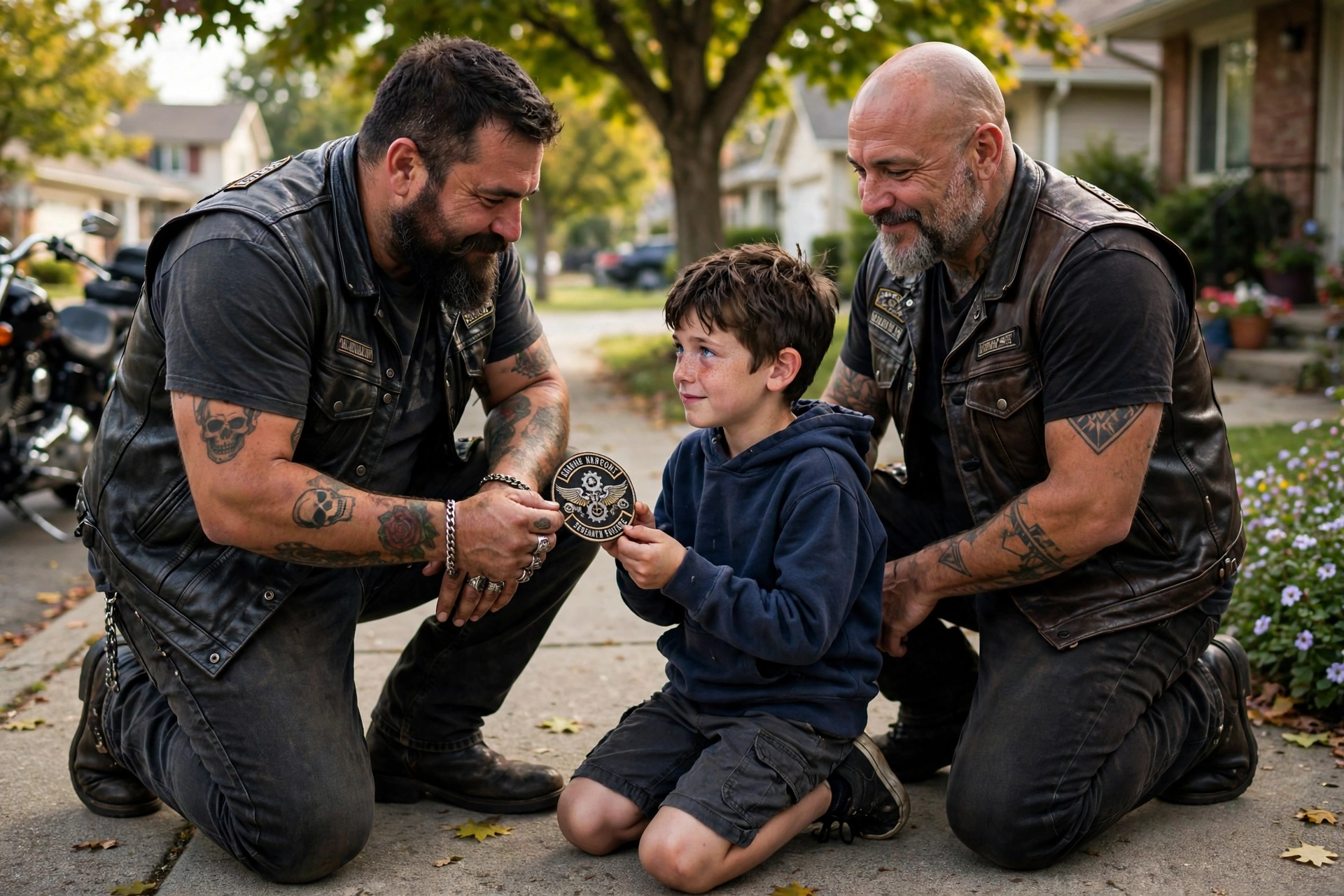
He didn’t raise his voice. He didn’t have to. He just swung his leg off his Harley, walked over, and knelt down to Tommy’s level — all six-foot-two of leather and tattoos folding himself small so the boy wouldn’t be afraid.
“What’s your name, little man?” Gus asked quietly.
Tommy stared at the ground. “T-Tommy.”
“Tommy,” Gus said, “are these boys bothering you?”
The three teenagers had gone very pale. Behind Gus, fifty-nine more bikers had dismounted and were standing in a loose half-circle, arms crossed, saying nothing at all. Silence, it turns out, can be louder than any engine.
Jace tried to mumble something about “just kidding around.” Gus turned his head slowly and looked at him for a long moment.
“Son,” Gus said, “kidding around is when everybody’s laughing. Look at this boy’s face and tell me who’s laughing.”
Nobody laughed.
The ride to get the word out took all of ten minutes. Gus sent two riders ahead to the school to find the principal, and two more to the diner to tell Ellen what had happened — because Gus believed a mother should hear good news fast, for once. By the time Tommy climbed onto the back of that Harley, half of Maple Hollow had heard that the Iron Spurs had adopted a new prospect.
The Iron Spurs didn’t touch the boys. They didn’t threaten them. Gus just told them, in a calm voice that left no room for doubt, that if he ever heard of anyone laying a hand on Tommy Callahan again, the whole club would know about it — and the club had a long memory.
Then he turned back to Tommy, helped him gather his books, and asked the question that changed everything: “You want a ride home, prospect?”
Tommy’s eyes went wide. “What’s a prospect?”
Gus grinned. “It’s what we call a future brother. Somebody we look out for. Somebody who looks out for us.”
That afternoon, Tommy rode home on the back of Gus’s Harley, wearing a spare helmet that swallowed his whole head, holding on tight while the whole club rode escort around them like a rolling wall of thunder. Ellen Callahan came running out of the house when she heard the rumble — and stopped dead on the porch, one hand over her mouth, watching her son climb off a motorcycle with the biggest smile she’d seen on his face in two years.
The Iron Spurs made it official that weekend. At their clubhouse — a converted barn outside town — they held a little ceremony. They gave Tommy a leather vest, two sizes too big, with a patch on the back that read LITTLEST PROSPECT. Sixty grown men, most of them with criminal records from their youth, stood and applauded while an eleven-year-old boy cried happy tears into his mother’s shoulder.
That evening, sitting by the clubhouse fire pit, Gus told Tommy something he’d never told another soul. When Gus was nine, he’d been the smallest kid in his neighborhood, with a stutter so bad he barely spoke at all. The bigger boys had made his life miserable for two whole years — until his own father, a truck driver with hands like catcher’s mitts, taught him that a man’s worth isn’t measured by his fists, but by who he stands up for. “That’s why I stopped today, Tommy,” Gus said quietly. “Because once, a long time ago, I was you.”
Tommy didn’t say anything. He just reached over and held Gus’s pinky finger with his whole hand, the way little kids do. The big biker sat very still, staring into the fire, and nobody at that fire pit ever mentioned the tears on his face.
But the story doesn’t end there. Because brotherhood, real brotherhood, isn’t a single afternoon.
Every school day after that, two Iron Spurs riders were parked at the corner of Cedar Lane at dismissal time. They never said a word to anyone. They just sat there, engines idling, watching. The bullying stopped overnight — not out of fear, Gus always insisted, but because the boys who’d done it had to walk past sixty leather vests every day and think about what kind of men they wanted to be.
Jace showed up at the clubhouse three weeks later, alone, holding a new backpack. He’d bought it with his own lawn-mowing money. He asked to give it to Tommy himself, and he apologized — really apologized, the kind that shakes your voice. Gus let him in, and Tommy, who remembered every kindness the way he remembered fence posts, counted it: one apology, one backpack, one second chance.
By spring, Tommy was different. Not cured — that’s not how it works, and the Iron Spurs never pretended it was — but braver. He started a club at school for kids who felt left out. He called it the Little Prospects. On the first day, fourteen kids signed up, including Jace.
At the Iron Spurs’ annual summer cookout, Gus stood up with a beer in his hand and pointed at Tommy across the yard. “That boy,” he said, his voice rough, “taught sixty outlaws what this patch was supposed to mean all along.”
Tommy stood on a picnic bench, the too-big vest now fitting just a little better, and counted the bikes lined up in the field. “Sixty-three,” he announced proudly. Everybody cheered.
Ellen still works at the diner on Route 9. The Iron Spurs eat breakfast there every Sunday now, all sixty of them, and they tip like kings. And if you walk down Cedar Lane on a school afternoon, you might see two motorcycles parked at the corner, engines idling — keeping watch over a boy who isn’t scared anymore.
Because that’s what brotherhood means. Not the leather. Not the noise. Just this: nobody walks alone.