The stagecoach rolled into Oak Haven just past noon on a cold October day, and Caleb Hayes stood on the depot platform with his hat pulled low, wishing the ground would swallow him whole.
He had spent his last fifty dollars on a bride. Now she was stepping down from that coach, and every fear he had buried during four lonely months on Broken Spur Ranch came rushing to the surface at once.
She was a large woman. There was no gentle way to say it. Broad shoulders, heavy arms, a thick waist under a gray wool dress, and a round face pink from the autumn chill. Two depot boys snickered behind their hands, and Caleb felt a hot shame rise in his chest, though whether it was for her or for himself he could not say.
Her eyes were hazel, steady and calm. “Mr. Hayes,” she said, extending a gloved hand as if she were the one in charge of this introduction.
“Miss Miller.” He lifted her single trunk into the wagon, surprised at how heavy it was. “We have twelve miles before dark.”
They rode in silence through frozen ruts and bitter wind. He had imagined a raw-boned frontier woman who could mend fences and wrestle a stray calf. Instead he had brought home another mouth to feed, another body to keep alive through a Wyoming winter that showed no mercy to the unprepared. His ranch was bleeding money. His cattle were lean. He could not afford a wife who needed looking after.
“The wind is fierce,” she said at last.
“It gets worse,” he answered, and hated himself for the harshness in his voice.
“I am used to work, Mr. Hayes.” She gripped the bench as the wagon lurched, and said nothing more for the rest of the ride.
The cabin told its own story when she crossed the threshold that evening. Caleb saw it through her eyes for the first time in years: the sour smell of wet wool and old grease, dirty plates crowding the counter, the stove buried under rust and ash, unwashed blankets on the beds. It looked less like a home than a place where a lonely man was slowly surrendering. She did not wrinkle her nose. She did not sigh. She simply set down her trunk and looked around the room as if she were measuring it.
Caleb left before sunrise the next morning. He told himself he had fence lines to check on the northern pasture, and that was true enough, but the deeper truth was that he could not bear to watch the disappointment settle into her face. He expected her to be gone by noon, or at least crying when he returned. Women he had known in town would have wept at the sight of that pantry: half a barrel of coarse flour, shriveled potatoes, salt pork, coffee, and a little molasses. Hardly food at all.
For three days he worked the northern fence and waited for a complaint that never came. On the evening of the third day he rode home through gathering darkness, already rehearsing the conversation in which he would admit that this marriage had been a mistake and offer her money to return east. He shoved open the cabin door and stopped dead in the doorway.
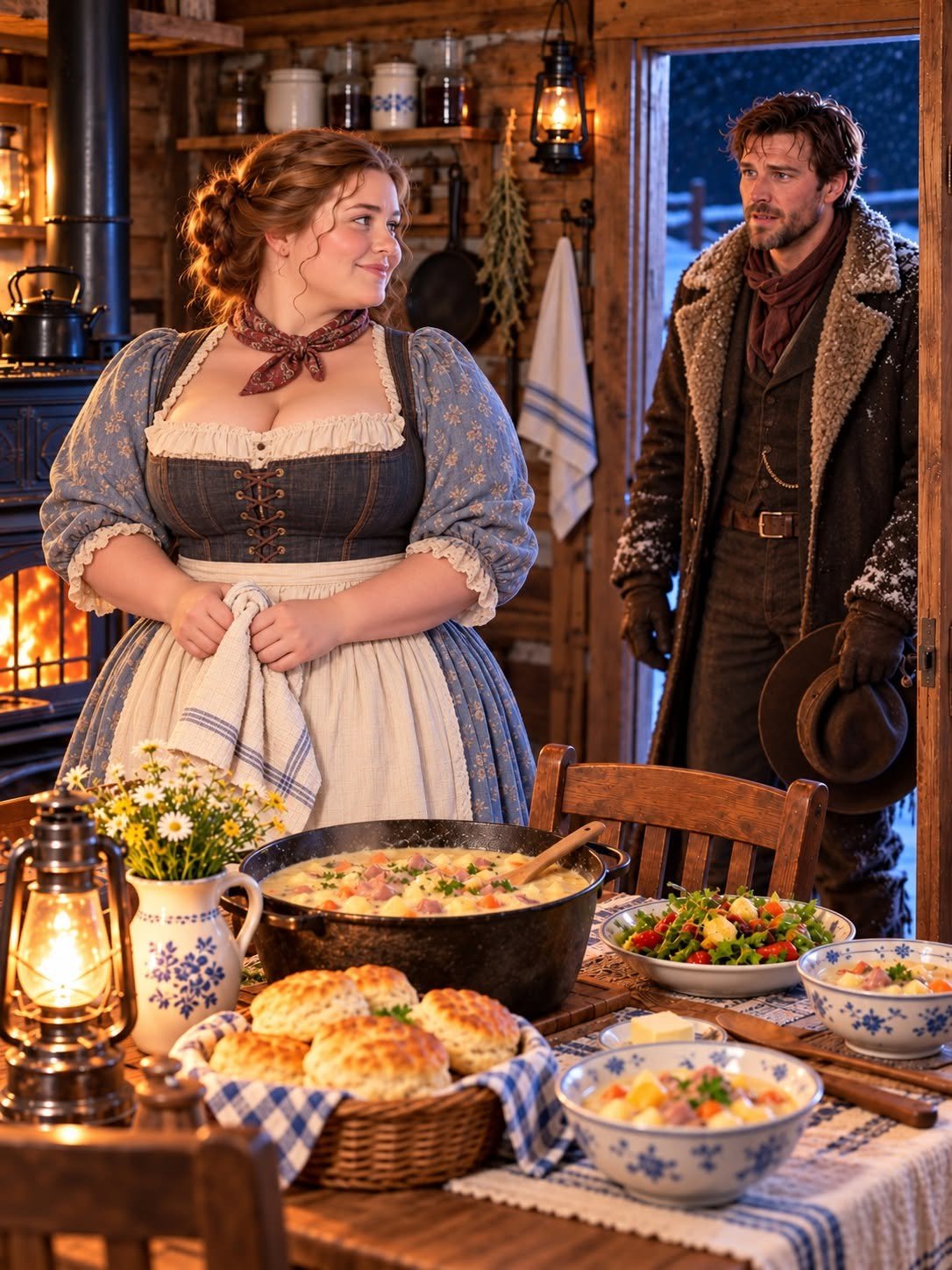
The cabin had been transformed. The counters stood scrubbed clean, pale pine showing through years of grease. The stove glowed with heat, its iron reseasoned and gleaming. The beds were made with washed blankets. And the air was filled with a smell he had nearly forgotten — warm food, real food, the kind that fills a house from floor to rafters.
Beatatrice stood at the table, flour dusting her apron, golden biscuits resting beside a steaming pot of chowder. “Wash your hands,” she said simply. “Supper is ready.”
He sat down like a man in a dream and ate two bowls of the finest chowder he had ever tasted, made from potatoes he would have thrown to the hogs and milk from a cow that kicked at every milking. He ate four biscuits. He did not speak until his plate was empty, because his throat had gone tight in a way that had nothing to do with hunger.
“You scrubbed the whole place,” he managed.
“A house is like a person,” she said, pouring him coffee. “It tells you how it feels, if you listen.”
That night, for the first time in four years, Caleb slept in a clean bed in a warm cabin, and he dreamed of the sound of a woman humming somewhere beyond a door.
Over the following weeks, Caleb began to see the ranch through his wife’s eyes, and the sight humbled him. She asked questions that cut straight to the bone of his troubles. Why did the cow kick? Because she was milked at different hours every day, and a creature craves routine as much as a person does. Why did the fence posts rot? Because the wood was green when he set it. Why did he lose calves each spring? Because he sold off the strong heifers and kept the weak ones for breeding, thinking the money in hand mattered more than the herd to come.
Her wisdom did not come from books. It came from years of scrubbing boardinghouse floors in Kansas City, peeling mountains of potatoes, and listening to the men who ate at those long tables — drovers, freighters, and ranch hands who talked about cattle the way other men talked about gold. She had absorbed more about ranching over a dishpan than Caleb had learned in ten years of doing it alone.
But wisdom alone could not pay the bank note that fell due in January. Caleb rode to Oak Haven the week before Christmas and came home with the letter he had dreaded: the bank would foreclose by the first of February unless he paid sixty dollars he did not have. He sat at the clean table and stared at the wall, and for the first time since she had come, he saw the fear in her eyes too.
That was when she opened the trunk that had surprised him with its weight at the depot. Inside, folded between layers of tissue paper, lay her mother’s recipe book and a small iron seal. She had spent three years in Kansas City baking for a boardinghouse that fed forty men a day, and she had saved the seal from the baker who taught her. “There are men building the new spur line through the valley,” she said. “Men far from home. They will pay for good bread.”
So through the coldest weeks of January, Beatatrice rose at four each morning and baked. Caleb hauled the bread down to the rail camp in a borrowed sleigh, and the hungry men paid in coin and sometimes in beef and flour. She made fruit pies from dried apples, cinnamon rolls that steamed in the cold air, and loaves of brown bread that sold before they cooled. Her hands grew rough and her back ached, but every evening she set the day’s earnings in a coffee tin on the mantel, and the pile grew.
By the last week of January, the tin held sixty-four dollars. Caleb rode to Oak Haven through a driving snow and laid the money on the banker’s desk, and the man stared at it as if it were a trick. When Caleb rode home that night, Beatatrice was waiting in the doorway with a lantern, and the relief on her face nearly broke him in two.
That spring, the herd came through calving season with losses of only two, the smallest Caleb had ever known. The fences held. The cow gave milk without kicking, because she was milked at the same hour every day by a woman who spoke to her gently. And in June, when the wildflowers covered the pasture, Caleb stood beside the woman he had married for convenience and realized he had not been lonely in months.
Years later, when their sons were grown and the Broken Spur was one of the finest spreads in the county, a neighbor asked Caleb what had saved his ranch back in that hard winter of the bride. Caleb looked across the yard to where his wife was teaching their granddaughter to crimp a pie crust, her strong hands sure and patient.
“I thought I was buying a wife,” he said. “Turns out I was buying a partner. I just didn’t know what saving a ranch really meant.”
He had been wrong about Beatatrice Miller from the very first moment. She was never the burden he had feared. She was the answer to a question he had been too proud, and too alone, to ask.


