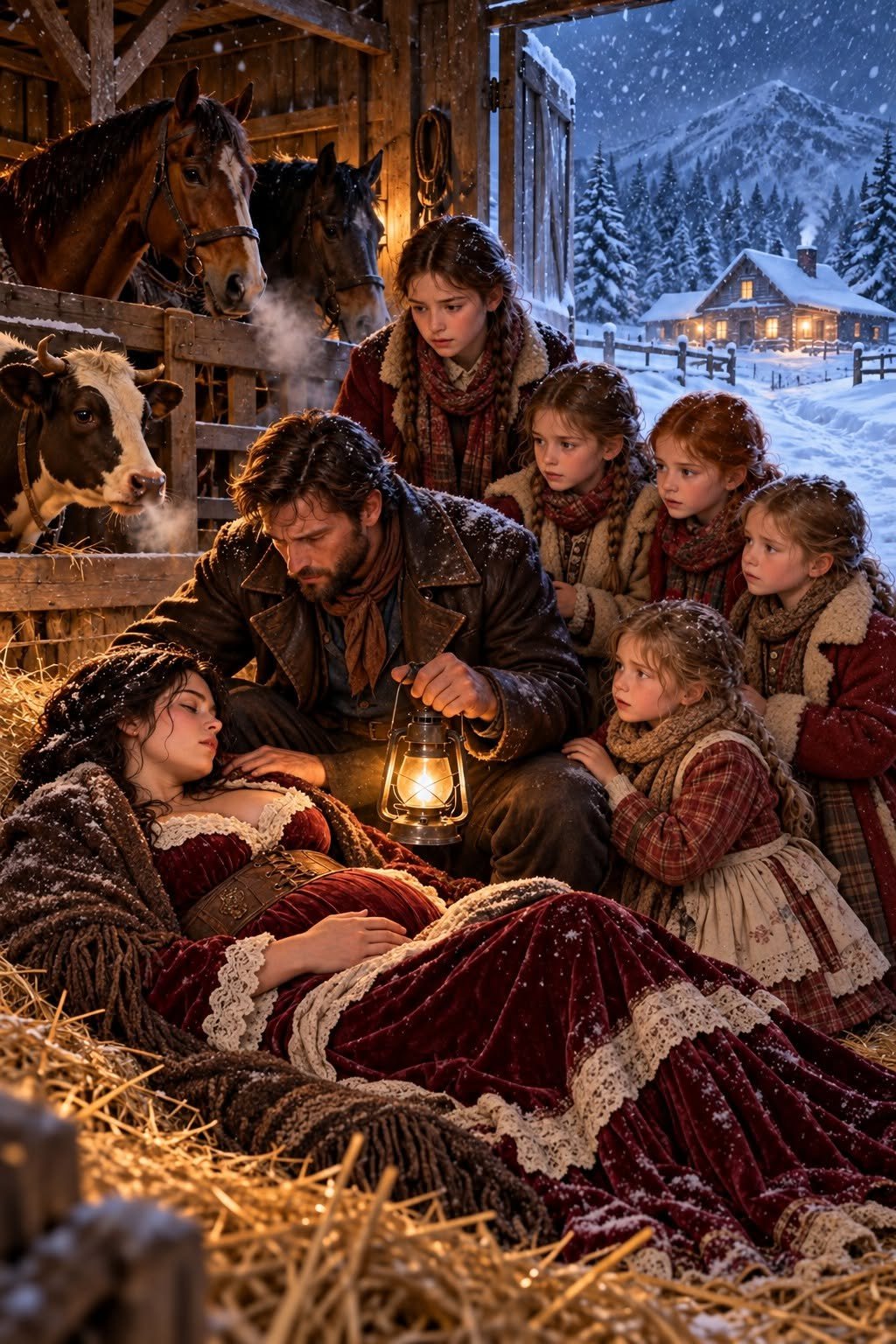
Daniel Holt was certain he had locked the barn before the blizzard came.
He had pulled the door shut with both hands, dropped the wooden latch into place, and tested it twice — the way he now tested everything. The stove. The windows. The quilts tucked around each of his five daughters before they slept. Since Margaret died of typhoid nine months earlier, Daniel had become a man who checked everything twice, because he had learned the hard way that he could not control what life took from him — only what his own hands did.
Through the screaming December wind, he saw the barn door standing open two inches. Every animal inside was terrified of something hiding in the darkness, and his heart hammered against his ribs as he crossed the snow-covered yard with a lantern shielded beneath his coat.
Inside the barn, the milk cow strained against her rope. Both horses had crowded into the farthest stall, blowing clouds of steam. None of them looked toward him. They were all staring beyond him, toward the hay.
Daniel raised his lantern and froze. A woman lay curled in the corner, her arms wrapped protectively around a heavily swollen belly. Ice clung to strands of her black hair. Her dress was the kind a woman might wear to Sunday church in town — not for crossing a mountain road in a December blizzard. Her feet were completely bare.
He dropped beside her and pressed two fingers to her neck. Nothing. Then, faint as a whisper — a beat.
“No, ma’am,” he breathed. “Not in my barn.”
Years earlier, a man who had worked in a war hospital had taught Daniel what to do when someone stopped breathing properly. He began pressing and counting, steady as a drumbeat. Just then his thirteen-year-old daughter Clara appeared in the doorway with a lantern, her four younger sisters crowded behind her in the snow.
“Get inside,” Daniel ordered.
Clara ignored him, knelt beside the stranger, and gently brushed ice from the woman’s hair. “Is she dead?” eight-year-old Wren whispered.
“Not yet.” Clara’s eyes dropped to the stranger’s belly. “Papa… the baby.”
Daniel swallowed hard. “Press when I tell you.” Clara placed her small hands beside his, and together they counted. The cow stamped nervously. The lantern flame trembled. And then suddenly the woman convulsed, and a ragged breath ripped from her throat.
She lived. With shaking arms, Daniel carried her through the blizzard to the cabin, where his daughters moved without being told — Clara heating stones, Wren gathering quilts, ten-year-old Josephine bringing Margaret’s good wool blanket. Soon the stranger lay beneath layers of quilts, color returning to her cheeks, while the little ones watched from beside the fire.
Then her eyes snapped open. She sucked in a sharp breath, but she did not look at Daniel. Her gaze went straight past him to the five girls gathered by the fire, and the blood drained from her face. Her hand flew to her unborn baby. She tried to sit up.
“No,” Daniel said gently. “You’re safe.”
Clara stepped closer. “Ma’am?” The stranger’s eyes widened, and she lifted one shaking hand toward the girls.
“You…” Her voice cracked. “You are Margaret’s girls.”
Daniel went perfectly still. “How do you know my wife’s name?”
Tears began streaming down the woman’s face. “Because I am her sister. My name is Ellen. And I have been searching for her for four years.”
The story came out slowly, between warming sips of broth. Ellen had married a railroad man at seventeen against her family’s wishes and followed him west. The marriage soured. When she found she was expecting a child, he abandoned her in a mining camp with nothing but the clothes on her back. She had written letters to Margaret for years, but she had addressed them to a town Margaret had left long ago. None had ever arrived.
“Last month, a traveler told me my sister lived in these mountains,” Ellen whispered. “I walked the last forty miles. I came to ask her forgiveness — and to beg her to help me. I did not know she was gone.”
The silence that followed was broken only by the wind against the shutters. Clara crossed the room and took the stranger’s hand. “You’re Aunt Ellen,” she said softly. “Mama talked about you. She said you laughed like bells and got in trouble for climbing the apple trees.”
Ellen laughed through her tears, and the sound was exactly like bells.
What happened next, none of them were ready for, and all of them would remember forever. Before dawn, Ellen’s pains began. Clara, who had read her mother’s midwifery book in secret since she was eleven, took charge with a calm that stunned her father. The younger girls boiled water and tore clean cloths. Daniel stood helplessly by the door until his eldest ordered him to hold her aunt’s hand, which he did, and prayed harder than he had since Margaret’s funeral.
At sunrise, as the blizzard broke and pale light spilled across the snow, a baby girl drew her first breath in that cabin. Ellen wept as she held her daughter, and the five girls crowded around the bed, five pairs of eyes shining, five small hands reaching out to touch the tiny fingers.
“Mama would have loved this,” Wren whispered.
Daniel named the baby in his heart before Ellen ever spoke the name aloud: Margaret. Little Maggie Holt, born in a blizzard into a family that had been waiting for her without knowing it.
The weeks that followed were the hardest and sweetest of Daniel’s life. Ellen recovered slowly, and the girls tended her with a devotion that astonished him. He watched his daughters teach their aunt the rhythms of the household — where Margaret had kept the sugar, how she braided hair on Sunday mornings, the hymn she sang while kneading bread. And he watched Ellen bring something back that had been missing since the typhoid took his wife: laughter in the kitchen, a woman’s voice reading stories by lamplight, small arms wrapping around his neck without fear of breaking his grief.
By spring, no one spoke of Ellen leaving. The girls needed her. The baby thrived. And Daniel, who had been certain his heart was buried with Margaret in the churchyard, found himself looking forward to supper with an ache that had nothing to do with sorrow and everything to do with hope.
A year to the day after the blizzard, Daniel stood in the same churchyard where Margaret rested and spoke to her aloud, the way he sometimes did when he needed to say something true. “You sent her,” he told the headstone. “When you could not come back yourself, you sent your sister. I will take care of her, Margaret. I promise you that.”
That summer, Daniel and Ellen were married in the little church, with five girls in matching dresses and a baby who slept through the entire ceremony. The neighbors said it was the happiest wedding the valley had seen in years.
Daniel Holt had locked his barn against the winter, and the winter had sent him a miracle anyway. He had checked everything twice, done everything right, and still nearly lost it all — until the night a stranger stumbled through his open door and gave his five motherless daughters the one gift he could never have given them himself.
A family, made whole again.


