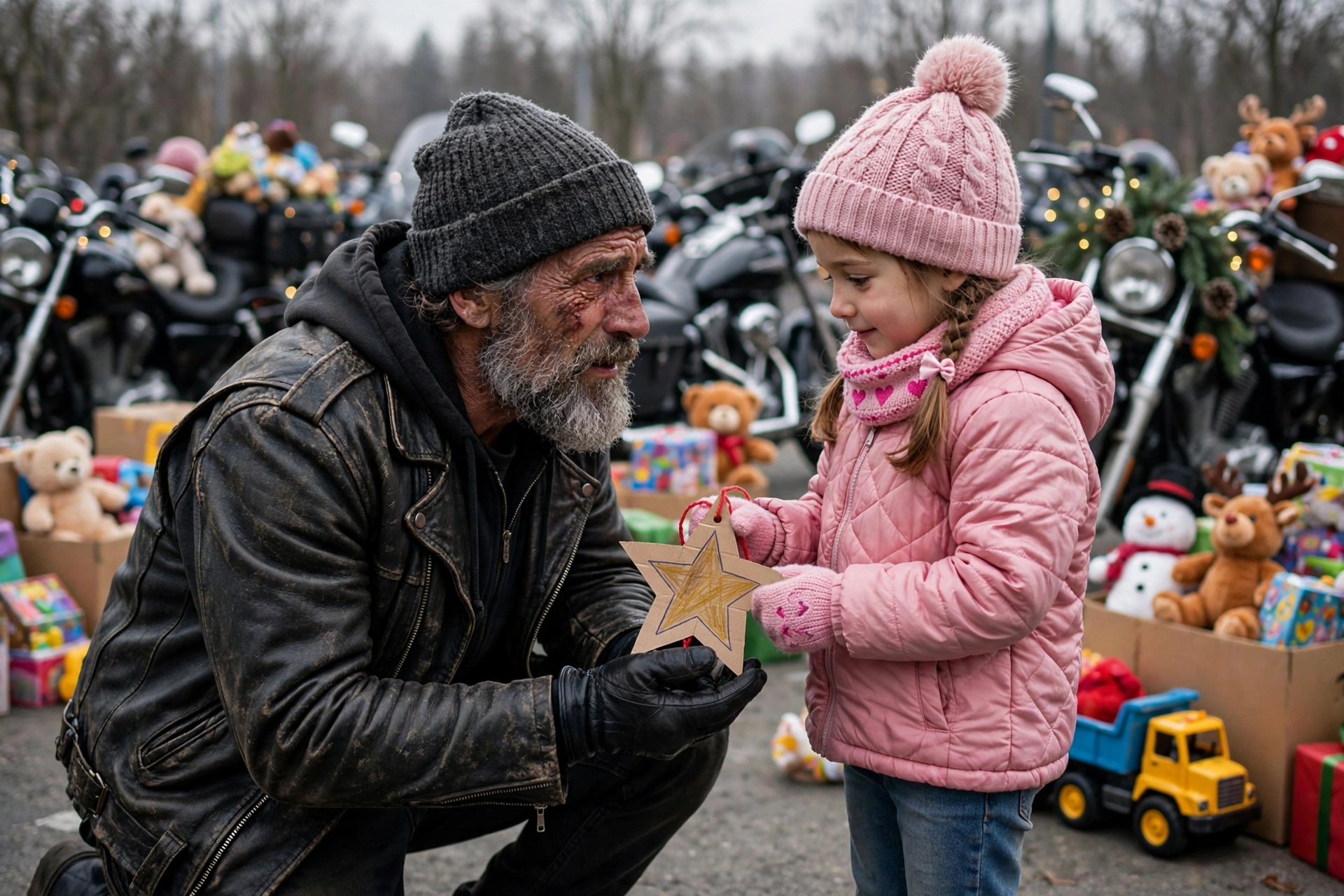
They called him Stoneface Ray, and not one person in three counties had ever seen him smile.
Ray Callahan was sixty-one years old, six-foot-three in his boots, with a beard the color of old iron and a leather vest covered in patches earned across forty years of riding with the Ironwood Riders. He had buried two brothers, one wife, and — though he never spoke of it — one dream he figured had died back in 1989. He didn’t do hugs. He didn’t do hospitals. And he sure as heck didn’t do feelings.
So when the club’s president, old “Bulldog” Hendricks, stood up at the monthly meeting in the back room of Dale’s Garage and announced that the Ironwood Riders would be leading this year’s Christmas toy run to St. Brigid’s Children’s Hospital, Ray just folded his arms and stared at the wall like the announcement had nothing to do with him.
“One more thing,” Bulldog said, and Ray could feel the whole room turn toward him. “We need one volunteer to ride point with the donated trike. Little red tricycle, custom-built for a special-needs kid. Goes straight to the hospital lobby, hand delivery, photo and all.”
Silence. Nobody moved. Nobody breathed.
“Ray,” Bulldog said. “I’m asking you.”
Ray’s jaw worked. “I don’t do hospitals, Bull.”
“Your sister did thirty years of nursing,” Bulldog said quietly. “Don’t tell me you don’t know what a kid’s smile looks like.”
That landed like a punch. Ray’s sister Marlene had worked the pediatric ward at St. Brigid’s her whole life, right up until her passing three years earlier. Ray hadn’t set foot in that hospital since her funeral. He’d sworn he never would again.
But Bulldog knew exactly which button he was pushing. “The trike was her idea, you know. Marlene started the donation fund before she passed. This is her trike, Ray.”
Ray looked down at his scarred knuckles. Then he gave one short, stiff nod. “Fine. One ride. Then I’m done.”
December came in cold and sharp, the kind of morning where your breath hangs in the air and the roads glitter with frost. Forty-some bikes rumbled out of the Ironwood clubhouse parking lot in a long thundering line, saddlebags stuffed with wrapped toys, teddy bears strapped to sissy bars like furry little passengers. Ray rode at the front, a trailer hitched behind his Road King, and in that trailer sat the cherry-red tricycle with oversized training wheels and a handlebar bell shaped like a star.
He hadn’t slept well. He’d dreamed of Marlene’s voice on the hospital intercom, paging herself, the way she used to do to make the kids laugh.
The convoy pulled into the St. Brigid’s lot at ten sharp, and the scene waiting for them nearly knocked Ray sideways. Kids in wheelchairs, kids with IV poles decorated like Christmas trees, kids with bandaged heads and brave, wide eyes — all lined up behind the glass doors of the lobby, pressing their noses to the windows, waving like mad when they heard the engines.
Ray killed his engine and sat there a moment, hands gripping the handlebars a little too tight. This was exactly why he didn’t do hospitals. Too many memories. Too much Marlene.
Bulldog clapped him on the shoulder. “Trike first, brother. That’s the deal.”
Ray unloaded the little red tricycle with hands that were rougher than they needed to be for something so small. He wheeled it through the sliding doors into the lobby, where a nurse with a clipboard directed him to a spot beside the big Christmas tree. A small crowd of children gathered, oohing and aahing, and Ray stood behind the trike like a stone statue, arms crossed, staring at the floor tiles.
“Excuse me, mister.”
The voice was small but steady. Ray looked down.
She couldn’t have been more than seven. Bald under a knitted purple cap — chemo, Ray understood instantly, his stomach twisting — with enormous brown eyes and a hospital gown covered in a pink bathrobe two sizes too big. She stood with the help of a walker, and she was smiling at him like he was the best thing she’d seen all week.
“Are you the motorcycle man?” she asked.
“That’s me, kiddo,” Ray said, his voice coming out rougher than he intended.
“I’m Willa,” she said. “Willa June Parker. I’m seven and three-quarters. Is that bike for me?”
Ray glanced at the nurse, who nodded, her eyes suspiciously bright. “It’s yours, Willa June Parker,” he said. “All yours.”
Willa’s face lit up like sunrise. She let go of her walker with one hand and reached out to ring the little star bell — ding, ding, ding — and laughed, a laugh so pure it cut straight through forty years of Ray Callahan’s armor.
“Thank you, motorcycle man,” she said solemnly. “Can I give you something? I don’t have money, but I have this.” She reached into her robe pocket and pulled out a paper medal — a circle cut from construction paper, gold crayon on the front, a red ribbon stapled to the back. In wobbly letters it said: BRAVEST.
Ray stared at it. “What’s that for?”
“For being brave,” Willa said, as if it were obvious. “The nurses say coming to the hospital is scary for grown-ups too. But you came anyway. My nurse Marlene — she used to tell me that the bravest people are the ones who come even when they’re scared.”
Ray’s throat closed. Marlene. Of course. She’d known this little girl. Maybe she’d even told Willa stories about her big brother the biker.
“Willa,” Ray managed, “did Nurse Marlene tell you about me?”
“She said her brother rode a motorcycle and he was grumpy but his heart was as big as Texas,” Willa said proudly. “She said if I ever met him, I should give him my bravest medal, because he needed it more than anybody.”
Forty years of Ironwood Riders toughness cracked right down the middle. Ray Callahan — Stoneface Ray, who hadn’t cried at his own wife’s funeral because he didn’t know how — dropped to one knee on that hospital lobby floor, and the tears came, hot and unstoppable.
“Hey,” Willa said softly, and she put her small hand on his bearded cheek. “It’s okay to cry, motorcycle man. Nurse Marlene said tears just mean your heart is too full to stay quiet.”
The lobby had gone silent. Nurses, parents, forty leather-clad bikers standing in the doorway — every one of them watching the toughest man in the county kneel before a seven-year-old girl and weep like a child himself.
Ray took the paper medal with shaking hands and pinned it crookedly to his vest, right over his heart. “Thank you, Willa June,” he whispered. “This is the finest thing anybody ever gave me.”
Then Willa did something nobody expected. She let go of her walker entirely, took two wobbly steps forward, and climbed — with the nurse’s help — onto that little red tricycle. She rang the star bell again and rode a wobbly circle around the Christmas tree while the whole lobby cheered and clapped.
Ray stood there laughing through his tears, clapping louder than anyone.
That Christmas, Ray Callahan rode home with a paper medal pinned over his heart, and he never took it off. He wears it still — faded now, the gold crayon worn pale, the red ribbon frayed at the edges — on every single ride.
He goes back to St. Brigid’s every month now. Not just at Christmas. Every month. He reads to the kids. He lets them sit on his bike and rev the engine. He tells them stories about Nurse Marlene, who he finally talks about without his voice breaking — mostly.
And every Christmas, he leads the toy run himself, riding point with a trailer full of donated bikes, and he tells every new rider in the club the same thing Bulldog told him:
“The bravest people are the ones who come even when they’re scared.”
Willa June Parker rang that little star bell all the way down the hospital hallway that day. She beat her illness that spring — Ray was there when she rang the real bell, the brass one by the nurses’ station, the one kids ring when they’re going home for good. She hugged him so hard his back cracked, and she whispered, “See? Bravest.”
Stoneface Ray smiles now. Ask anybody in three counties. They’ll tell you: all it took was one brave little girl, one paper medal, and a nurse’s memory to melt the toughest biker in the county — and remind him that the strongest thing a man can do is show up, tears and all.

