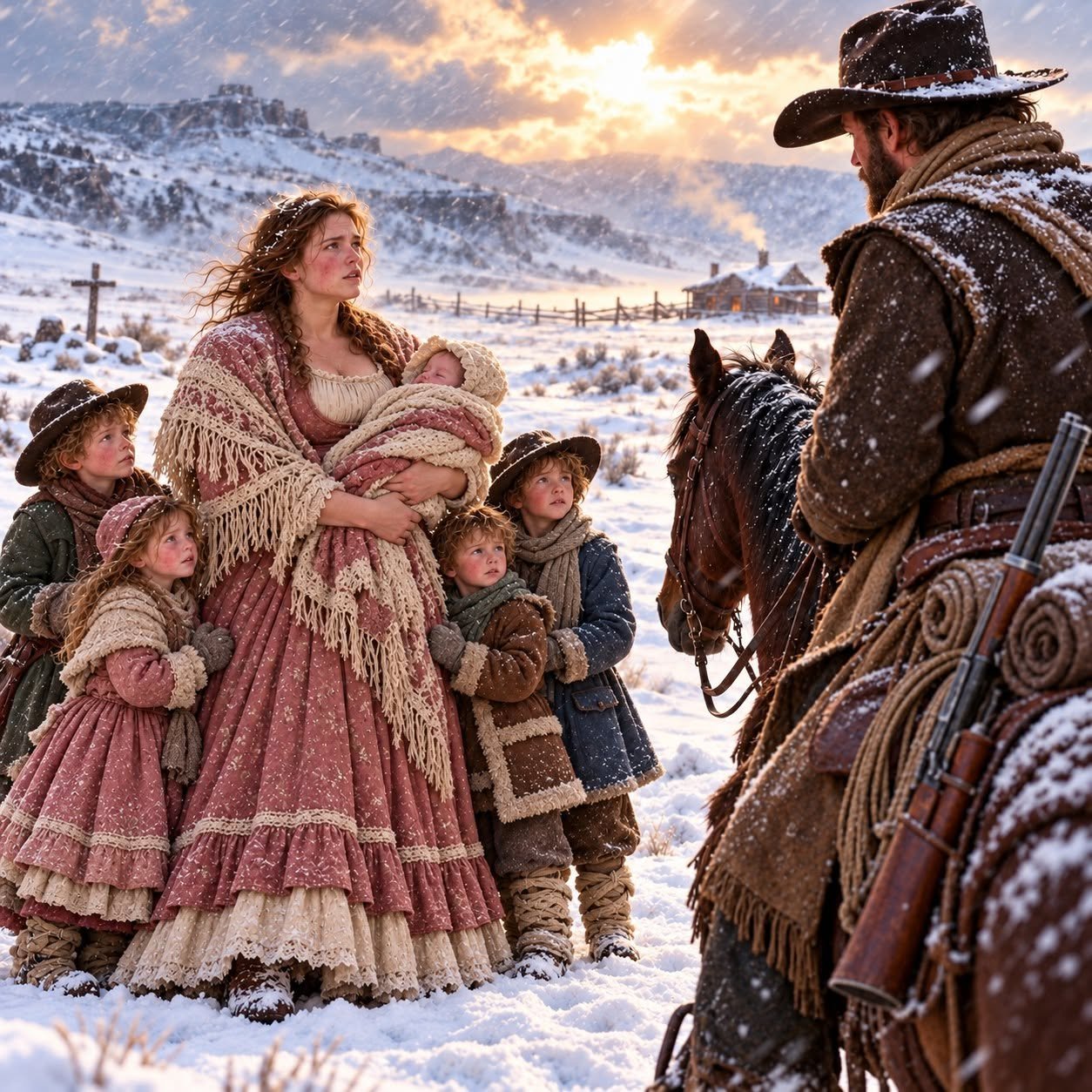
By the time Clara Hayes reached her mother’s grave, the five children behind her had stopped crying. That frightened her more than the storm.
Twenty-year-old Clara had no husband, no father, no money, and a baby brother whose lips were turning pale against her shoulder. The others stumbled barefoot through Wyoming snow with flour sacks wrapped around their feet. Three days earlier, Clara had promised her dying mother one thing: “I’ll keep them together.” Now she was beginning to understand that keeping them together might mean watching them freeze beside her.
Then, through the white wall of the blizzard, a horse appeared. The armed stranger riding toward them looked dangerous. But what he did next made Clara question everything she knew about survival.
Jonah Reed gave them water, one careful sip at a time. He offered his cabin, two miles through the storm. And then, as Clara stood swaying on her feet with baby Toby slipping from her arms, Jonah caught them both — and said the words that froze her blood colder than any wind: “Listen to me, Clara. If you come with me now, there’s something you need to understand before we reach my ranch.” She had never told him her name.
Clara’s mind raced as Jonah turned his horse toward the west. How did he know her name? Had he been watching them? Was the cabin even real, or was this some trap she was walking six children into? But the alternative was the snow. Toby’s breathing had gone shallow. Rose’s flour-sack wrappings were frozen stiff. There was no choice, and Jonah seemed to know it. “Stay close to my horse,” he said. “Follow the tracks.”
Samuel walked beside Clara, his young face set in a scowl he had worn since their mother died. “We don’t know him,” he muttered. “I know,” Clara whispered back. “But I know the storm better.” They walked. The wind screamed. Twice Clara nearly fell, and twice Jonah was there — not grabbing, just steadying, his hand firm on her elbow until she found her footing. He carried Rose the last half mile when the little girl’s legs finally gave out, and the child — who had feared every stranger since birth — fell asleep against his buffalo-hide coat. When the cabin appeared through the snow, Clara nearly wept. It was small but solid, smoke curling from a stone chimney, a barn standing dark behind it. Light glowed in one window like a promise.
Inside, the heat struck them like a wave. Jonah moved quickly — stoking the stove, pulling blankets from a chest, setting a pot of stew over the fire that had clearly been simmering for hours. As if he had been expecting company. As if he had known they were coming. The children collapsed onto the rag rug, too exhausted to be afraid anymore. Jonah fed them slowly — small spoonfuls of stew, warm bread, hot tea with honey. He checked Toby’s fingers and toes for frostbite with the gentle competence of a man who had done this before. Then he wrapped the baby in a wool blanket and placed him in Clara’s arms. “Eat,” he told her. She ate. She hadn’t realized how hungry she was until the first spoonful nearly made her cry. When the children were fed and the youngest ones were already asleep by the stove, Clara finally asked the question that had been burning in her chest for two miles. “How do you know my name?”
Jonah was quiet for a long moment. Then he stood, walked to a shelf above the fireplace, and took down a small tin photograph. He handed it to Clara. The image showed a younger Jonah standing beside a man with Clara’s own dark eyes and stubborn jaw. Her breath caught. “That’s my father,” she whispered. “Thomas Hayes,” Jonah said. “Best friend I ever had. We rode together for six years before he married your mother and settled down.” Clara stared at the photograph. Her father had died when she was twelve — thrown from a horse, gone before the doctor arrived. She remembered his laugh, his hands, the way he used to carry her on his shoulders. But she had never seen this photograph. Had never known about Jonah Reed. “After Thomas died, I wrote to your mother,” Jonah continued. “Offered help. She wrote back — proud woman, your mother — said they were managing fine. I sent money anyway, twice a year, through the general store in Laramie. She never spent a cent of it, I reckon. Probably saved every dollar for you children.” Clara’s throat tightened. She remembered the storekeeper in Laramie, the way he always seemed to have “extra credit” for the Hayes family. She had thought it was charity. It had been Jonah. “Three weeks ago, the storekeeper wrote to me,” Jonah said quietly. “Said your mother had taken fever. Said it looked bad. I saddled up that same day.” “You came for us.” “I came too late for her.” His voice was rough. “But I wasn’t going to be too late for you.”
Over the next days, as the blizzard raged outside, Jonah told Clara the rest. The cabin wasn’t just his — the land, two hundred acres of good grazing, had been purchased years ago with Thomas Hayes as a silent partner. The deed, locked in a strongbox under Jonah’s bed, bore both their names. “Your father always said if anything happened to him, this place was for his family,” Jonah said. “I’ve been keeping it for you. All these years. Waiting.” Clara couldn’t speak. All this time — through her mother’s long illness, through the hunger, through the desperate walk to the grave — there had been a home waiting for them. Two miles away. “Why didn’t you come sooner?” she asked at last. “Why didn’t you tell us?” Jonah looked into the fire. “Pride,” he admitted. “Your mother’s pride, and mine. She wouldn’t take charity, and I wouldn’t force it on her. I told myself I’d come when the children were older. I was wrong to wait.”
The storm lasted four more days. In that time, something shifted in the little cabin. Samuel, who had trusted no one since his father’s death, began following Jonah to the barn, asking questions about horses. Rose drew pictures of the cabin with six stick figures and one tall one. Baby Toby gained color in his cheeks. Clara watched Jonah with the children and saw what her father must have seen in him all those years ago — a man whose gruffness was just the shell over a heart too big for one body. On the fifth morning, the sky cleared to a blue so sharp it hurt. Jonah hitched the wagon and drove them all to town — to the land office, where he had the deed rewritten in Clara’s name, and to the general store, where he bought boots for six children and watched Rose spin in front of the mirror in her first real pair of shoes. That night, back at the ranch — their ranch — Clara stood on the porch and looked at the stars. Jonah came out with two cups of coffee. “You don’t have to stay,” Clara said. “The deed is mine now. You’ve done enough.” Jonah was quiet for a while. Then: “Thomas once told me that family isn’t blood. It’s who shows up in the blizzard.” He looked at her. “I’d like to keep showing up. If you’ll let me.”
By spring, the ranch had six children learning to ride, a garden planted in neat rows, and a new grave on the hill beside the old one — for Thomas Hayes, whose photograph now hung above the fireplace where his children could see his face every day. Clara never did learn exactly how Jonah had found them in that blizzard. He claimed he’d been riding out to check the line shack. She suspected he’d been watching the road for days, waiting, the way he’d been waiting for years. It didn’t matter. What mattered was this: on the day she had been most certain that love wasn’t enough, a stranger who knew her name proved that sometimes love arrives on horseback, wearing a buffalo-hide coat, carrying water in a tin cup — and asking permission first. Clara kept her promise. She kept them together. And in the end, she wasn’t alone in keeping it. The Hayes ranch still stands in Wyoming Territory. And on the mantel above the stone fireplace, beside the tin photograph of two young men, there is a flour sack — washed, folded, and kept. To remember how far they walked. And who walked with them.


