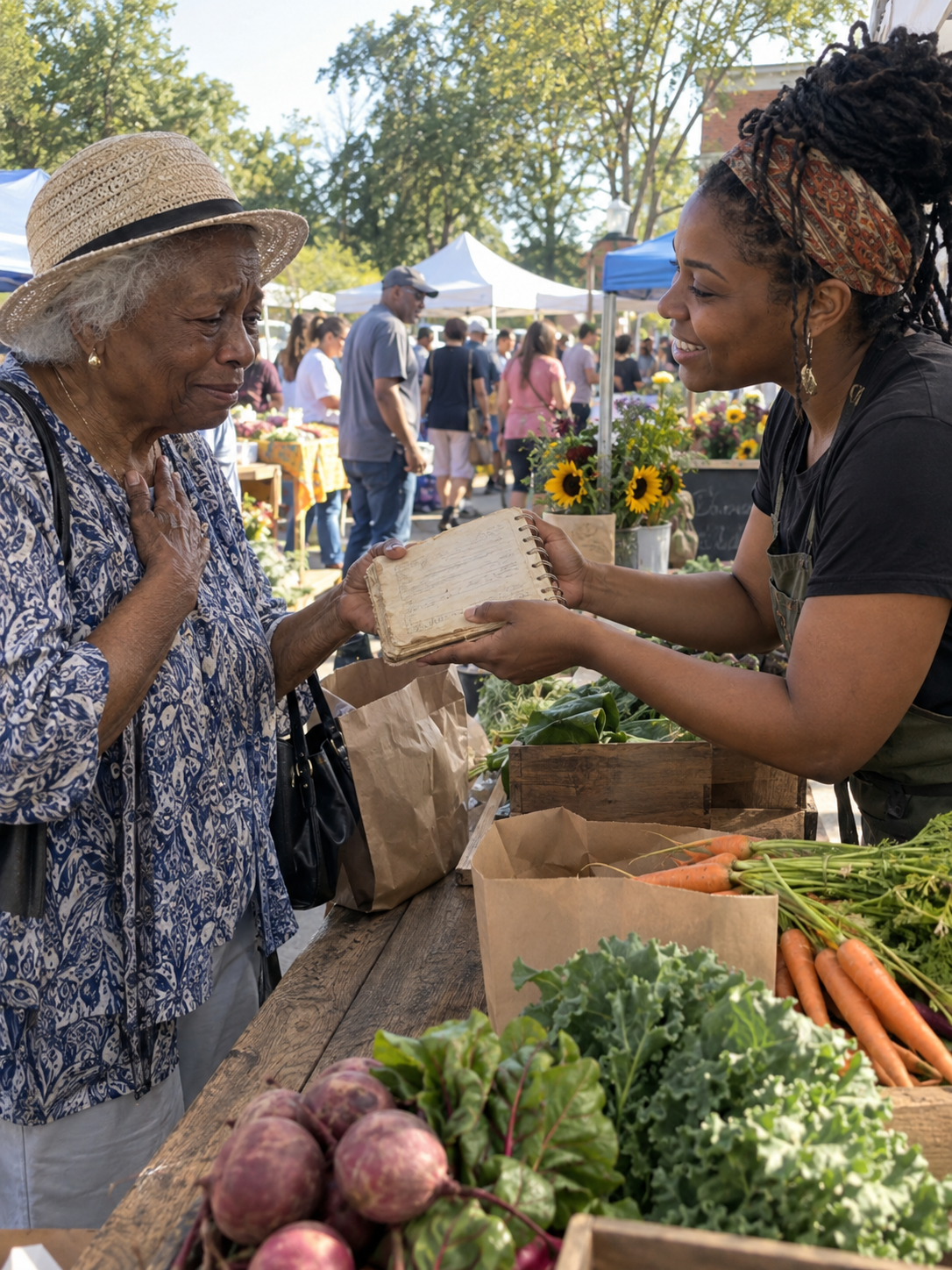
Evelyn Carter went to the Saturday market for tomatoes, peaches, and a jar of local honey. She moved slowly between the stalls, greeting vendors she had known for years. At seventy-eight, Evelyn enjoyed the market less for shopping than for the familiar conversations that made the neighborhood feel connected.
Near the center aisle, a young woman named Nia sold homemade breads and vegetables from her family garden. Nia noticed Evelyn before Evelyn noticed the notebook on the table. It was old, brown, and held together with a piece of faded ribbon.
Nia had found the notebook in a box of donated kitchen items. The box came from an estate sale in a nearby town. Inside were handwritten recipes for sweet potato pie, greens, cornbread, peach cobbler, and a Sunday stew with instructions written in careful blue ink.
At the bottom of several pages was the name “Lillian.” Nia had searched online and asked around, but there were too many people with that name. She kept the notebook in her kitchen for months because she believed it belonged to someone who would understand its value.
Evelyn reached for a jar of honey and saw the open page. She recognized the handwriting instantly. It belonged to her mother, Lillian, who had died ten years earlier. Evelyn had believed the notebook was lost when the family home was sold.
The first recipe was for biscuits. Lillian had written measurements in the margins and added reminders such as “do not rush the dough” and “save one for your father.” Evelyn knew the words because her mother had repeated them every Sunday morning.
Nia asked Evelyn to prove the notebook was hers. Evelyn did not become offended. She understood why Nia was careful. She recited the story behind nearly every recipe: which cousin disliked onions, which neighbor borrowed sugar, and why the peach cobbler was never served before the afternoon guests arrived.
Then Evelyn turned to the last page. Her mother had written a short note to the family: “Recipes are only half the meal. The other half is who sits at the table.” Evelyn had forgotten the note existed. She placed one hand over her heart.
Nia gave her the notebook without asking for money. Evelyn tried to pay for it, but Nia refused. She said the notebook had already spent enough time away from home. Evelyn insisted on buying every loaf of bread on the table instead, and together they carried the bread to a nearby senior center.
The story spread through the market that afternoon. Several older customers remembered Lillian. One man recalled eating her cornbread at a neighborhood fundraiser. Another remembered that she always packed extra food for anyone who arrived late.
Evelyn invited Nia to her house the following Sunday. She cooked the stew from the notebook, but she changed one ingredient because Lillian had taught her that recipes were meant to be lived in, not obeyed like rules. Nia brought bread from the market.
They spent the afternoon copying the pages. Evelyn explained the handwriting, the shortcuts, and the stories behind the measurements. Nia recorded the instructions in a new book, but she kept the old notebook open beside it so the original voice would remain part of the process.
By the end of the year, Nia began hosting a monthly community table. Older neighbors brought family recipes, and younger people wrote down the stories. Some dishes were cooked exactly as remembered. Others changed with every generation. No one argued about which version was correct.
Evelyn kept her mother’s notebook in a wooden box beside the kitchen table. She said it was not valuable because of the paper or the ink. It was valuable because it had reminded her that food can carry names, places, and voices across decades.
A lost notebook may seem like an object waiting to be found. But sometimes it is a family waiting to remember itself. Nia returned more than recipes that day. She returned a piece of a mother’s voice to the daughter who had been missing it.