The August sun of 1883 showed no mercy to Martha Higgins. It bore down on her little Nebraska farm with a fury that cracked the soil and wilted the corn, and behind her weathered farmhouse, Martha bent over a wooden washbasin, scrubbing her dead husband’s shirts with hands swollen from years of hard labor. At thirty-four, she was a big, strong woman — broad-shouldered, full-figured, with a kind round face that still carried the beauty her husband had once loved her for. But the town of Fairview rarely spoke of her beauty. They called her too big, too stubborn, too poor to ever marry again, and they said it loud enough for her to hear.
Her husband lay beneath a cottonwood tree at the edge of the property. Her savings had dwindled to almost nothing. And with winter coming, the fear sat in her chest like a stone every night when she blew out the lamp. That afternoon, as she wrung out a shirt, she heard wagon wheels grinding through the dust toward her gate.
Her brother-in-law Amos sat at the reins of a mule-drawn wagon, grinning like a man who had come to enjoy himself. Two riders trailed behind him, already chuckling. “Brought you a present, Martha!” Amos called out. She wiped her hands on her apron and told him that if it cost money, he could turn right back around. “Oh, this one’s free,” he said, and gestured grandly toward the wagon bed.
A giant of a man lay stretched across filthy straw, his massive shoulders nearly spanning the wagon. His dark hair was matted, his beard wild, and rough wooden splints bound his motionless legs. His name, Amos announced, was Colum — a mountain man a bear had mauled up in the ridge country, his spine ruined according to the doctors. The poorhouse wouldn’t take him. The town wouldn’t feed him. So the town council had decided, in their wisdom, that Martha — “such a strong, substantial woman” — could perform a Christian service and keep him. One of the riders snickered, “A useless man for a woman nobody wants,” and the others howled.
Martha demanded they take him somewhere he could get proper care. Amos only shrugged and said the ditch would have to do. Then he climbed into the wagon, hauled Colum up by the arms, and with Martha shouting at him to stop, heaved the helpless man over the side and let him crash into the dust of her yard. “Enjoy your new husband!” he yelled, and the wagon rattled away through the roar of their laughter.
Colum tried to push himself up with his powerful arms, sweat rolling down his face, but his legs lay dead beneath him. When he finally stopped struggling, he growled, “Leave me.” Martha looked from him to her farmhouse — the leaking roof, the dwindling pantry, the firewood nearly gone — and she knew taking him in might ruin them both. But then she saw his eyes fixed on the dirt, his jaw clenched in humiliation, and she recognized that look. She had worn it at her own husband’s funeral, when Amos had announced to the whole congregation that a woman of her size couldn’t possibly keep a farm running.
“Well, mister, I’ve got bad news,” she said, lowering herself beside him. “I ain’t letting you die in my radish patch.” When he told her he hadn’t asked her to save him, she answered that she hadn’t asked for his opinion — and with a strength born of pure stubbornness, she slipped her arms under his shoulders and dragged the enormous man, inch by agonizing inch, all the way to her porch.
The first days were dreadful. She settled him on an iron cot in the parlor and tended him — food, washing, fresh bedding, turning him when his body ached — and he hated every moment of his helplessness. He had survived mountain winters alone, hauled timber, crossed frozen rivers; now he couldn’t reach his own water pitcher. When he snapped at her one morning for scrubbing too hard, she dropped the cloth and told him to grow himself a new pair of working legs if he didn’t like it. Nobody had spoken to him like that since the accident. Everyone else had whispered and pitied him. Martha just treated him like an exceptionally troublesome man, and strangely, he found he preferred it.
On the fourth evening, a thunderstorm rolled across the plains, and Martha came in soaked and exhausted after securing the barn. She sank into her rocking chair and fell asleep before her eyes were even closed. Across the room, Colum stared at his water cup, desperately thirsty but unwilling to wake her. He stretched for it, his fingertips grazed the rim — and the cup toppled, splashing water across the floor. Martha woke. She looked at him, rose without a word, wiped the floor, and refilled the cup, placing it in his hand. “You spill this one,” she warned, “you’re licking it off the floor.” And Colum laughed — a deep, gravelly laugh that startled them both. It was the first time since the bear that he had felt anything besides anger. He felt alive.
After that, something shifted. Colum began studying the farm the way a general studies a battlefield — the broken fence, the crooked chicken coop, the woodpile Martha could barely split anymore. One afternoon he asked how much firewood she had, and when she said enough, he told her bluntly she had enough for September, maybe, and that winter would kill them both at this rate. She stormed off, but that night he lay staring at his useless legs and then at his enormous hands, and he remembered forty years of mountain survival. His legs were gone. But his hands were not.
The next morning, Martha found him sitting upright with a lump of charcoal and a scrap of paper. He had made a list of everything wrong with the farm — the paper wasn’t big enough, she said, and he almost smiled. Then he looked her straight in the eye and told her that if they were going to survive winter, she had to stop doing everything alone. “And you’re going to have to build me something,” he said. “A chair with wheels.” When she blinked, he leaned forward, his pale blue eyes burning. “Because I may not have working legs, woman — but I’ve still got two good hands.”
And so began the most remarkable autumn Fairview had ever seen. Together they built that chair from an old wagon seat and two mismatched wheels, Colum directing every cut of the saw from his cot, Martha sweating and swearing and doing exactly what he told her. The day he rolled himself out onto the porch for the first time, the grin on his face was so wide Martha thought it might split him in half. He could move again — not walk, but move — and that was everything.
From his wheeled chair, Colum became the busiest man in Nebraska. He sharpened every tool on the farm, mended the harnesses, rebuilt the chicken coop stronger than it had ever been, and showed Martha how to stack firewood so it would last through the coldest months. He whittled traps and snares from memory and set them along the creek, and within weeks there was rabbit and prairie chicken on the table. His great arms, which had once hauled timber through blizzards, now hauled her whole farm back from the edge of ruin.
Martha worked harder than she ever had — but for the first time in years, she was not working alone. In the evenings they sat by the fire and he told her stories of the high country, of avalanches and grizzlies and winters so cold the air itself seemed to freeze, and she told him about her husband, about the cottonwood tree, about the lonely years of the town’s laughter ringing in her ears. One night, as snow began to whisper against the windows, Colum reached across the space between them and took her hand. “You’re the strongest person I ever met,” he said quietly. “And I climbed mountains for forty years.”
But the winter tested them cruelly. In January, a blizzard buried the farm for nine days, and Colum’s old injuries flared so badly he could barely sit upright. Martha nursed him through it, spooning broth between his lips, and when he whispered that she should save the food for herself, she told him to hush — they had survived this far together and they would finish it together. When the storm broke, she found he had been secretly whittling all through the fever, and in his lap lay a pair of hand-carved leg braces, fitted with leather straps. “Mountain men don’t quit,” he said. “They adapt.”
Every day after that, Martha helped him stand. At first he could only bear his weight for seconds, gripping the porch rail while his face went white with effort. But the legs the doctors had called dead were not entirely dead — the spine was damaged, not severed, and months of stubborn, agonizing work began to wake them. By March he could stand for a full minute. By April he took three shuffling steps with the braces. And he never stopped working from that wheeled chair in between, because a man who had survived the mountains was not about to let a pair of weak legs define him.
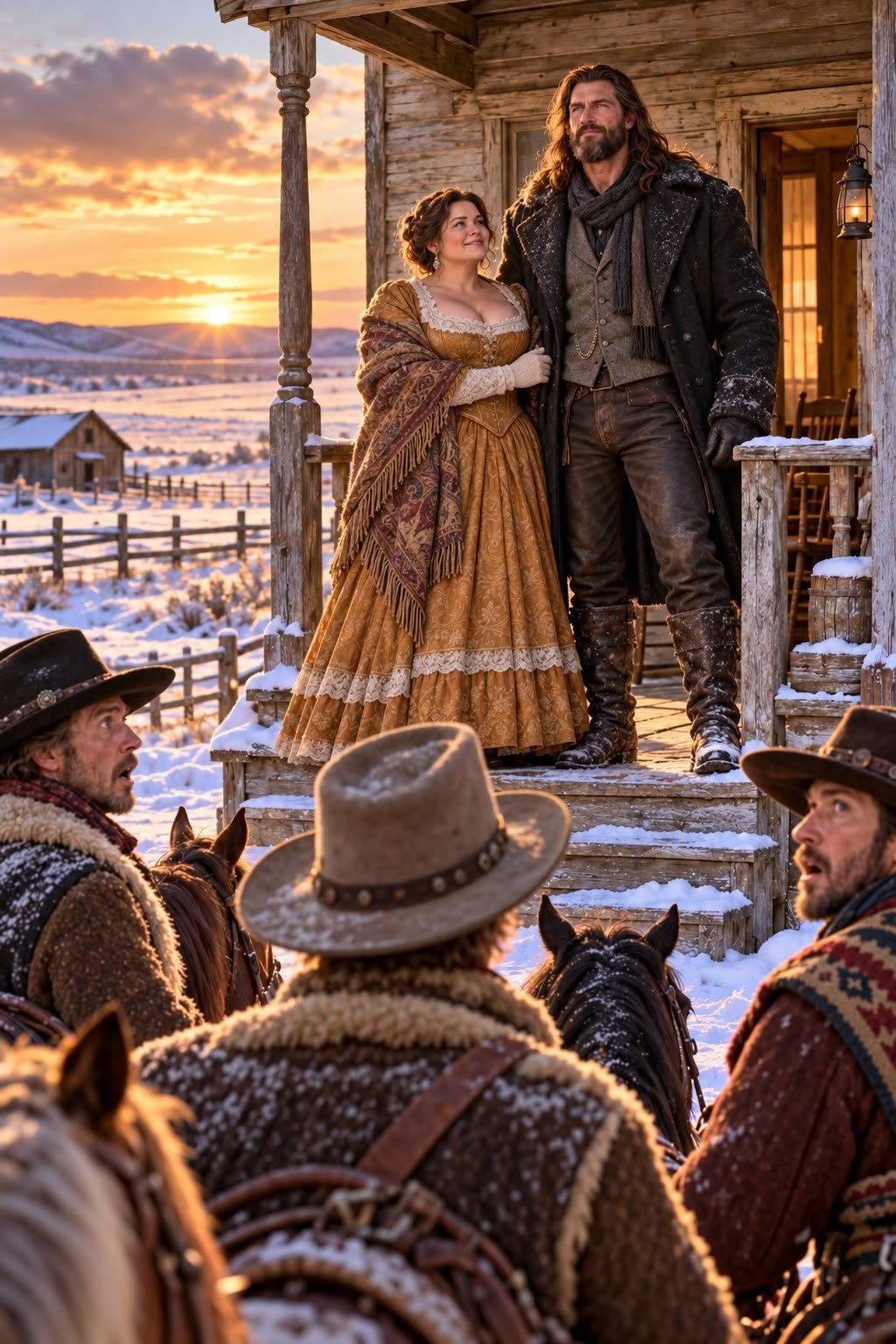
Four months after Amos had dumped him in the dust, the same riders came back down Martha’s lane — come, they said later, to see the wreckage, to have their joke confirmed. The first rider pulled his horse to a dead stop at the gate and sat staring. Because standing on the porch beside Martha, tall and broad in braces he had carved with his own hands, was Colum. Behind him stood a repaired farmhouse with a sound roof, a full woodshed, a mended barn, and smoke rising steady from the chimney. Martha’s garden was already turned for spring.
Amos himself rode up last, and the color drained from his face. Colum looked down at the men from the porch and said, in that deep mountain voice, “You boys came to laugh. Go on, then. Laugh.” Not one of them could. Martha stepped forward, took Colum’s hand in hers, and said, “Gentlemen, this is my husband. The town council gave him to me, remember? Best gift I ever got.” The riders turned their horses and left without a word, and within a week the whole of Fairview knew the story — and was thoroughly ashamed of itself.
That spring, half the town came to the farmhouse with hams and quilts and apologies that Martha accepted with grace and Colum accepted with a mountain man’s slow nod. The preacher married them beneath the cottonwood tree in May, with the whole county in attendance, and when Amos tried to slink away from the celebration, Colum called him over, clasped his hand, and said, “Thank you, brother. You meant it as a joke. God meant it as a blessing.” Amos wept like a child.
Martha and Colum lived forty more years on that farm, and he walked every one of them — slowly, with his carved braces, but on his own two feet. They say the town of Fairview never told another cruel joke after that winter, because everyone remembered the year the cruelest joke in Nebraska turned into the greatest love story the prairie had ever known.