The Deaf Girl Who Ran Three Miles to Save Thirty Bikers
Sophie Carter had been deaf since birth. People assumed that meant she missed things. The truth was the opposite. She noticed everything. And one Tuesday afternoon outside Red Mesa, Arizona, she noticed five armed men preparing to walk into a roadside biker bar where thirty people had no idea they were coming. She was thirteen years old, living with her mother in a faded trailer, and before that day, most people barely noticed her at all.
Teachers spoke while facing the whiteboard. Cashiers talked to her mother instead of her. Kids at school either stared at her hearing aids or pretended she wasn’t there. Home wasn’t much better. Her mother’s boyfriend, Wade, had moved in six months earlier. Sophie couldn’t hear him shouting, but she felt him — his anger shook walls, and cabinet doors slammed hard enough to vibrate through the floor. So she started taking the long way home from school. Three extra miles through the desert was better than reaching the trailer early. That afternoon, the long way saved lives.
She saw the van behind an abandoned tire shop. White. No markings. Parked where nobody normally stopped. At first she kept walking. Then sunlight flashed off something near the open side door. Metal. Sophie crouched behind an old dumpster. Five men stood around the van wearing dark clothes. One unfolded a map. Another pointed toward a building farther up the highway. The Broken Spur. Everyone in Red Mesa knew that place — a weathered biker bar where members of the Black Canyon Riders gathered every Tuesday. She had walked past it enough times to know the motorcycles. There were almost thirty outside that day. Then she saw the rifles.
She couldn’t hear what the men were saying. She didn’t need to. She watched them checking magazines, pointing at exits, looking at watches. One man traced his finger across the map, then toward the bar. Her phone was dead. The police station was farther away than the Broken Spur. Home was in the opposite direction. So she ran. Three miles. She ran until her lungs burned, her backpack slamming against her shoulders. She tripped once and scraped both palms on the pavement. She got up. Kept going.
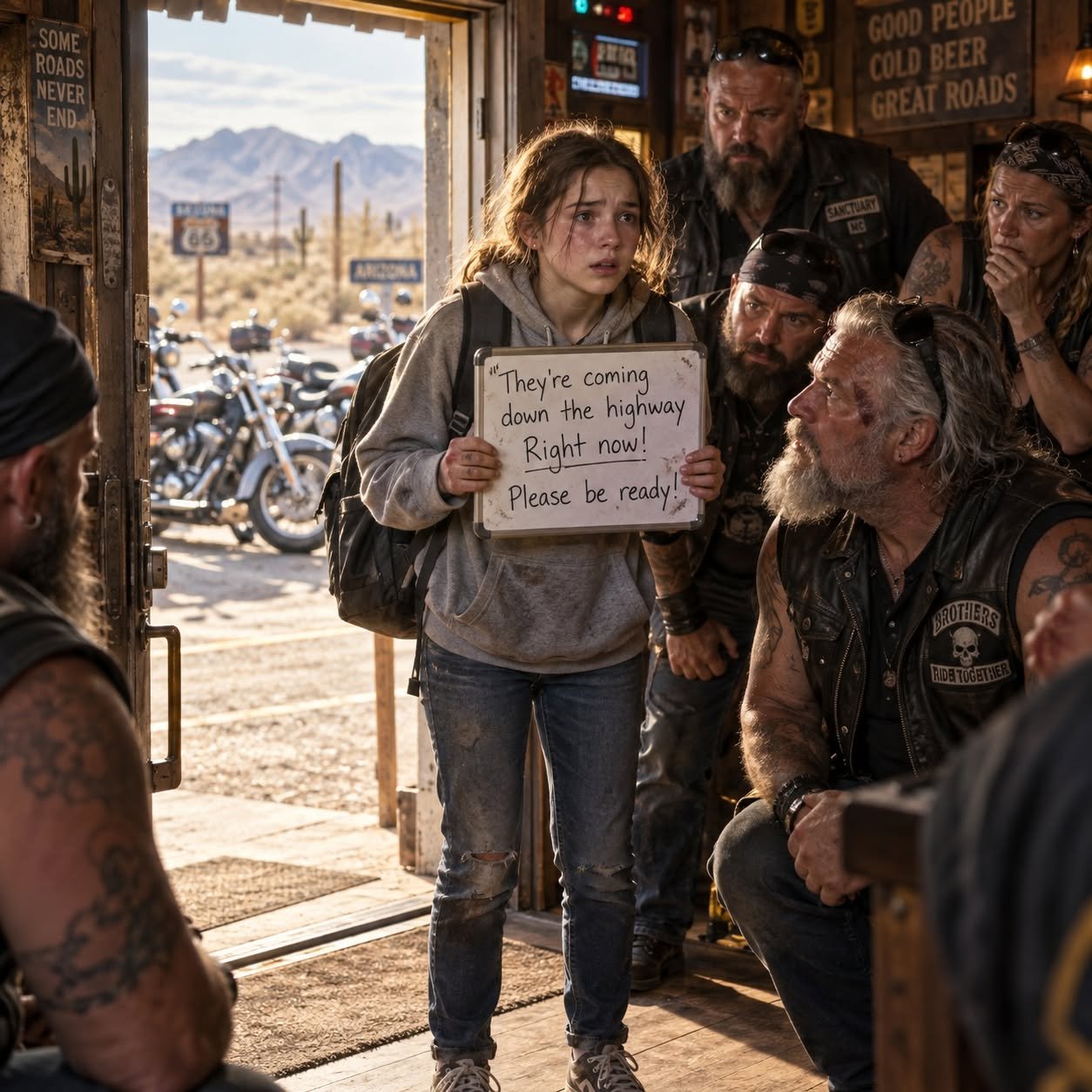
The Broken Spur appeared through the heat, motorcycles lined up in the gravel lot. Sophie reached the front door and shoved it open. Every face turned toward her. Thirty bikers. Huge men in leather vests. Tattooed arms. Beards. Scarred faces. For one terrifying second, she wondered whether she had made a mistake. Then a man stood from a table near the back — tall, maybe fifty, gray threaded through his dark hair, a scar running from his eyebrow toward his cheek. Later she learned his name was Jack Mercer. Everyone called him Hawk. His mouth moved. She couldn’t understand. So she ripped the small communication pad from her backpack and wrote: FIVE MEN. RIFLES. WHITE VAN. BEHIND OLD TIRE SHOP. THEY’RE COMING HERE. She held it above her head. Everything changed.
The Man Who Believed Her Instantly
Hawk didn’t laugh. He didn’t question whether a deaf thirteen-year-old knew what she had seen. He looked into her face once. Then he believed her. Men moved away from the windows. Someone locked the doors. Someone called the sheriff. Hawk crouched in front of her and wrote: How many? She held up five fingers, then wrote the location. His expression hardened. Minutes later, more bikers arrived, but Hawk made them stay inside. Nobody charged toward the van. Nobody tried to become a hero. They waited for law enforcement.
When Sheriff Lucas Warren arrived, he sat beside Sophie with a notebook instead of making her struggle to read his lips. She wrote everything — the van, the weapons, the map, the five men. The sheriff drove her back to the tire shop. The van was gone. Her stomach dropped. She thought nobody would believe her. Then Hawk pointed at the dirt. Fresh tire tracks. Sheriff Warren found three shell casings near the dumpster. Twenty minutes later, deputies stopped the van ten miles north. Five men. Multiple weapons. And a written list containing names of people inside the Broken Spur. She had been right.
When they returned, Hawk handed Sophie her communication pad. He had written: You saved lives today. She cried. Nobody had ever told her she mattered like that. That evening, Hawk offered her a ride home. He gave her a helmet and helped her onto his motorcycle. She couldn’t hear the engine, but she felt it — the vibration moved through her bones like a giant heartbeat. For once, silence didn’t make her feel separated from everyone else. It made her feel connected.
The Question Nobody Had Ever Asked
When they reached her trailer, Hawk noticed she didn’t get off immediately. He typed on his phone: Are you safe here? Nobody had ever asked her that. She lied. She nodded. Before leaving, he placed a small black patch in her hand — silver wings surrounding one word: GUARDIAN. He pointed at her, then at himself. His lips moved slowly enough for her to understand. “You’re not invisible anymore.” That night, Sophie slept with the patch beside her pillow.
The next morning, her mother woke her angrily. Police had visited. News about the attempted attack was everywhere. Then Wade stepped into her bedroom. His face looked different — not irritated, afraid. His lips moved slowly, and Sophie read every word. “Those men you got arrested were my guys.” Her body went cold. He stepped closer. “You have no idea what you’ve done.” She grabbed a notebook and wrote: They were going to hurt people. He tore the page from her hand, then leaned so close she could see the vein pulsing in his temple. “You better hope they stay locked up,” he said, “because if they get out, you’re the first person they’ll come looking for.” Sophie looked past him at her mother. Her mother turned her face away. And that was when Sophie finally understood: the men she had saved were strangers — but the danger had been living inside her own home.
The Patch She Refused to Take Off
Sophie did the bravest thing she’d done in a life full of brave things: she wrote it all down. Every threat Wade had made, every night she’d felt the walls shake, every time her mother had looked away. She folded the pages into her backpack and walked — not the long way this time, the direct way — to the sheriff’s station. Sheriff Warren read every word with his jaw tightening. By sunset, Wade was in custody, and a social worker was sitting with Sophie explaining words like “protective order” and “safe placement” while Sophie held the GUARDIAN patch so tightly its edges left marks in her palm.
Her mother chose Wade. That was the hardest sentence Sophie ever had to learn to read — not on lips, but in the way her mother packed a bag for Wade’s bail hearing instead of for her daughter. So Sophie went to live with her grandmother two towns over, a woman who learned sign language at sixty-four because, as she put it, “my granddaughter has things to say.” The trailer, the long walk home, the slammed cabinet doors — all of it fell away like a coat she’d outgrown.
Hawk visited the first Saturday. Then the second. Then every Saturday, because some promises are kept on two wheels and some are kept on foot. He brought members of the Black Canyon Riders, who taught Sophie to ride — a small dirt bike at first, fitted with vibration signals instead of a horn. She took to it the way she took to everything: completely, fearlessly, all in. The patch went on her riding jacket. Then a second patch appeared beside it, voted on unanimously at a club meeting Sophie was invited to attend: LITTLE SISTER.
Thirty Lives, One Voice
The five men from the van took plea deals. The list with the names from the Broken Spur became the centerpiece of a case that dismantled a small but vicious crew that had been terrorizing businesses along the highway for two years. At the sentencing, the judge did something unusual: he invited Sophie to the courtroom, and thirty members of the Black Canyon Riders filled the benches behind her, silent in their leather vests. When the sentences were read, Hawk leaned forward and wrote on a pad for Sophie to read: “You did this.”
Sophie is seventeen now. She still can’t hear the engines, but she feels them — thirty motorcycles rolling into Red Mesa every Tuesday, and one dirt bike with vibration signals keeping pace in the middle of the pack. She speaks at schools about noticing things, about running toward instead of away, about the day she stopped being invisible. She always finishes with the same story: about a man with a scar and gray in his hair who looked at a deaf thirteen-year-old girl holding a handwritten warning above her head, and believed her — instantly, completely, without a single question.
“People ask me what the patch means,” she tells the students, tapping the silver wings on her jacket. “It means somebody saw me. Really saw me. And once somebody sees you, you can never be invisible again — not to them, and not to yourself.” In the back of the room, the bikers nod. They’ve heard the story before. They’ll hear it a hundred times more. And every time, when she gets to the part about the three-mile run, Hawk wipes his eyes and pretends it’s the dust.