Signature: rIZyWQocNHO1nit/VuJ7IPm7kn6Yna8rZ0oO5OnFA3XLf/r2E8vIcFkZb5NGxLiXj3a3Dq0H1MS2lMWqjiQKNsRbLy5Ng4J5TcDRUTDWHK7Qz6hrrNkmjq34ViOXKmBPEviKQkbP+FjizYfT825r2Cr5wQo8niromcooNJsddIuysGWEjY/33SWPYcJEPyVDaPozcN+ycAiAjwA3+PDmTqdg6AeVJyvmHbusn1/df7E=
She Lost Her Own Baby in Julesburg — Then Gave Life to Somebody Else’s
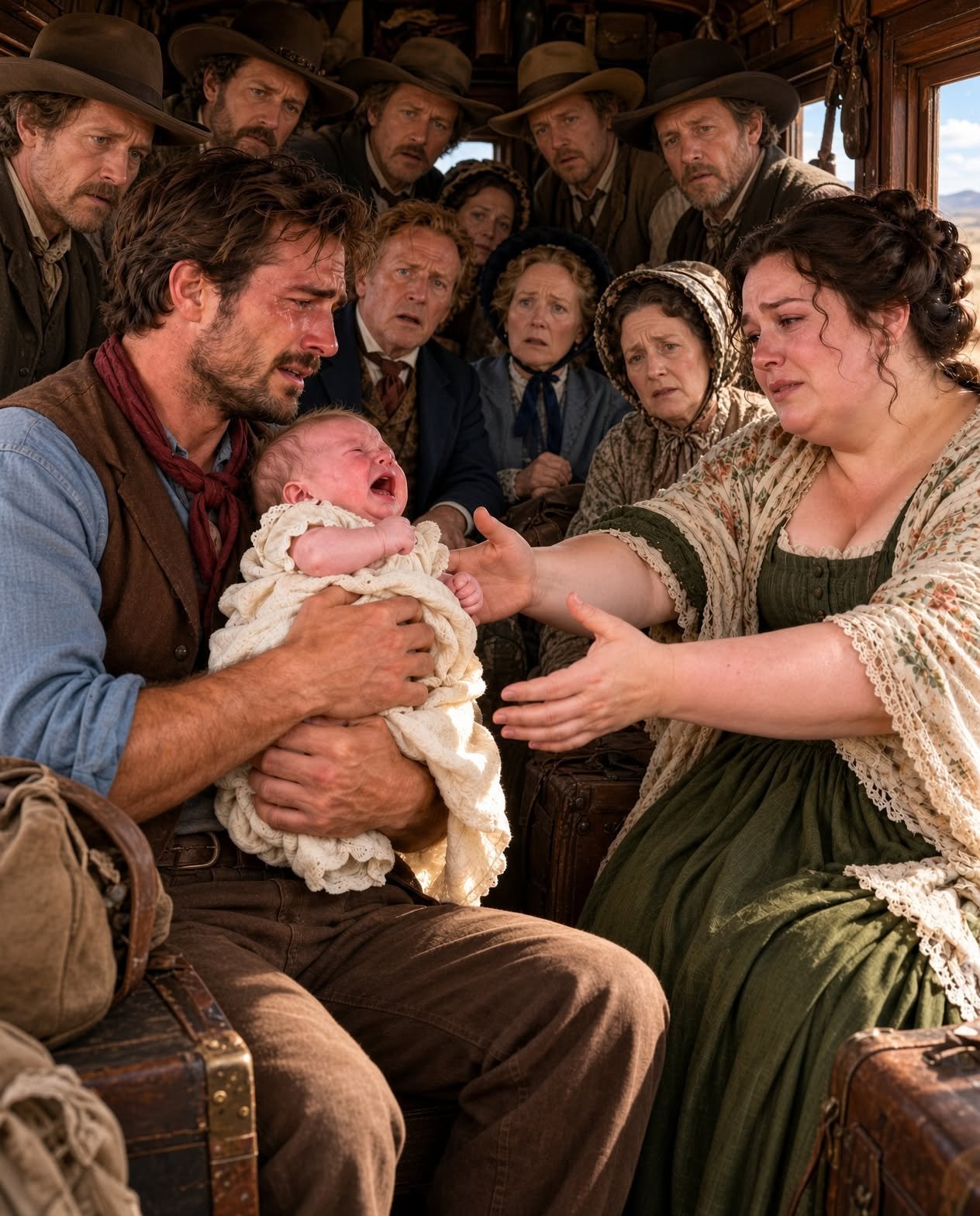
By the third day, the baby’s screams had become the only sound anyone inside the stagecoach could hear — even when he stopped crying. The stage thundered toward Fort Collins beneath a merciless morning sun, dust seeping through every crack, leather straps groaning overhead, the wooden cabin swaying violently from side to side. And above it all came the desperate cries of three-week-old Samuel Warren.
Caleb Warren pressed his son against his chest and whispered, “Please, son. Please.” These were hands that had branded cattle, built miles of fence, and driven thieves from his land. Now they trembled helplessly. The baby sucked twice at the bottle, then twisted away with a scream so sharp that Mrs. Henderson, the minister’s wife, flinched.
The other passengers were fraying. Pritchard, a traveling salesman, had moved from sympathy to advice to open irritation, pressing his fingers against his temples. Mrs. Henderson prayed silently and continuously — Caleb wondered whether she was praying for Samuel, or for the journey to end. Only the widow in the corner said nothing.
Eliza Moore had boarded at Julesburg three days earlier. She appeared about thirty, dark hair hidden beneath a plain bonnet, a deep gray dress made for mourning. She was a large woman, close to three hundred pounds, but she carried herself carefully, almost apologetically, as though trying to occupy as little space as possible. Yet whenever Samuel cried, something changed in her face: pain, recognition, the unmistakable expression of someone who had lost something precious.
Caleb had tried everything. Fresh milk from a dairy farmer at the last stop — refused. Three diaper changes, every pin and fold checked. Rocking until his shoulders burned. Nothing had truly worked since Margaret died, leaving him alone to learn fatherhood with a newborn who would not eat.
Then Samuel’s cries changed — thinner, ragged — and Caleb’s stomach tightened with fear. For the first time in three days, Eliza Moore moved. Her clasped hands separated. She leaned forward, pale beneath her bonnet, and asked quietly, “How long since he last fed?”
“Yesterday morning. A little.”
Eliza froze. One hand rose instinctively toward her chest. Then she slowly untied the ribbons beneath her chin and removed her bonnet. “I buried my daughter in Julesburg,” she said. Silence swept the coach. “She was two weeks old.” Her eyes glistened, but her voice stayed steady. “I still have milk.” She extended her trembling arms toward the starving baby. “Give him to me.”
The Gift No One Could Refuse
For a heartbeat, nobody moved. Pritchard stared. Mrs. Henderson’s lips parted. Caleb looked down at his starving son, then at the grieving widow waiting across from him — and did the hardest and easiest thing he had done in three days. He placed Samuel in Eliza’s arms.
Eliza turned modestly toward the window, arranging her shawl with practiced dignity, and within moments the screaming stopped. A silence fell over the stagecoach so complete that the creak of the wheels sounded loud. Then came a small, contented sound — a baby nursing, finally, hungrily, at peace.
Caleb Warren, a man who had not cried since the day they lowered Margaret into the ground, put his face in his hands and wept. Mrs. Henderson reached across and took his hand without a word. Even Pritchard looked away, suddenly very interested in the passing sagebrush.
When Eliza finally handed the sleeping baby back, her face was transformed. The apologetic carefulness was gone. She looked, for the first time in three days, like a woman instead of a shadow.
“Thank you,” Caleb whispered. It was the most inadequate sentence he had ever spoken.
Eliza shook her head. “Don’t thank me. For three days I have sat here listening to that child cry, and every cry was my daughter crying. You didn’t give me your son to hold, Mr. Warren. You gave me back the one thing I thought grief had taken forever.”
Four Hours That Changed Everything
The last four hours to Fort Collins passed like a different journey entirely. Samuel slept against his father’s chest, waking only to be fed again by Eliza — who insisted, with a firmness that surprised everyone, that the baby needed feeding every two hours until they reached a doctor. Pritchard, humbled, offered his own coat as a pillow. Mrs. Henderson shared her lunch of bread and cheese with Eliza, and the two women talked quietly about Julesburg, about daughters, about the strange mercies of the trail.
Caleb learned Eliza’s story in pieces. Her husband, a railroad clerk, had died of pneumonia the previous winter. She had traveled to Julesburg to stay with her sister for the birth — and buried her two-week-old daughter, little Grace, in the churchyard there three days before boarding the stage. She was traveling to Fort Collins with no plan at all, only a trunk, a ticket, and a grief so heavy she could barely lift her head.
“I kept thinking,” she told Caleb softly, while Samuel slept between them, “that my body was mocking me. All this milk, and no baby. I thought it was cruelty. Maybe it was preparation.”
At the Fort Collins station, the passengers scattered — Pritchard pressing Caleb’s hand with unexpected warmth, Mrs. Henderson kissing the baby’s forehead and promising to pray for him by name. Caleb stood on the platform holding Samuel, watching Eliza pick up her trunk with nowhere to go, and realized he could not let her walk away.
“Mrs. Moore,” he said. “I have a ranch outside town. A housekeeper’s cottage standing empty. I need — ” his voice caught — “Samuel needs someone who knows what he’s telling us when he cries. I can’t pay much. But you’d have a home.”
Eliza looked at him for a long moment. Then she looked at the sleeping baby. “I don’t want your pay, Mr. Warren,” she said. “I want to be where I’m needed.”
The Cottage by the Cottonwoods
The doctor in Fort Collins confirmed what Eliza had known in her bones: Samuel was simply starving, and a few more days without proper feeding might have killed him. “That woman saved his life,” the doctor told Caleb bluntly. “You remember that.”
Caleb never forgot. Eliza moved into the cottage by the cottonwoods, and Samuel thrived — gaining weight, laughing, growing into a sturdy, bright-eyed boy who called her “Liza” before he could say any other name but “Pa.” The ranch hands adored her cooking. The neighbors, who had watched Caleb struggle alone, shook their heads in wonder at the change in the place.
And slowly, the way a broken bone knits stronger at the break, two grieving people began to heal each other. Caleb would sit on Eliza’s porch in the evenings, and they would talk — about Margaret, about little Grace, about the children they had lost and the child they were raising. There was no rush, no pressure. Just two people who understood exactly what the other had survived.
On Samuel’s first birthday, the whole county came to the ranch. Eliza baked the cake. Caleb carved a wooden horse. And when the party was over and the boy was asleep, Caleb took Eliza’s hand on the porch and said, “Margaret would have liked you. I think she’d be glad it’s you.”
Eliza’s eyes filled. “Grace would have liked you too,” she whispered. “A man who wept for his son in a stagecoach.”
A Family the Trail Made
They were married the following spring, in the little church in Fort Collins, with Samuel — walking now, into everything — serving as the world’s most disruptive ring bearer. Mrs. Henderson traveled all the way from Denver to attend, and wept through the entire ceremony. Pritchard sent a silver rattle from Chicago with a note that read: “For the boy who taught a whole stagecoach what matters.”
Eliza and Caleb had three more children in the years that followed — two girls and a boy — and every one of them grew up hearing the story of the stagecoach: how their big brother Samuel was saved by a grieving widow’s gift, and how their mother came to the ranch with nothing but a trunk and a broken heart, and found a family.
Samuel grew into a fine man, a rancher like his father, and he never forgot what Eliza had done. Every year on his birthday, he rode out to Julesburg and laid flowers on a small grave in the churchyard — the grave of a two-week-old girl named Grace, the sister he never met, whose mother’s love had saved his life before he ever knew her name.
On the porch of the ranch house, in the evenings, Eliza would sometimes watch her children playing in the yard and think back to that swaying stagecoach, to the moment she had untied her bonnet and offered a starving baby the only thing she had left. She had boarded that stage believing her body was mocking her with milk for a child in a grave. She had stepped off it understanding the truth: love does not end at the churchyard. It waits, patient as sunrise, for someone who needs it — and then it pours itself out, and saves them both.