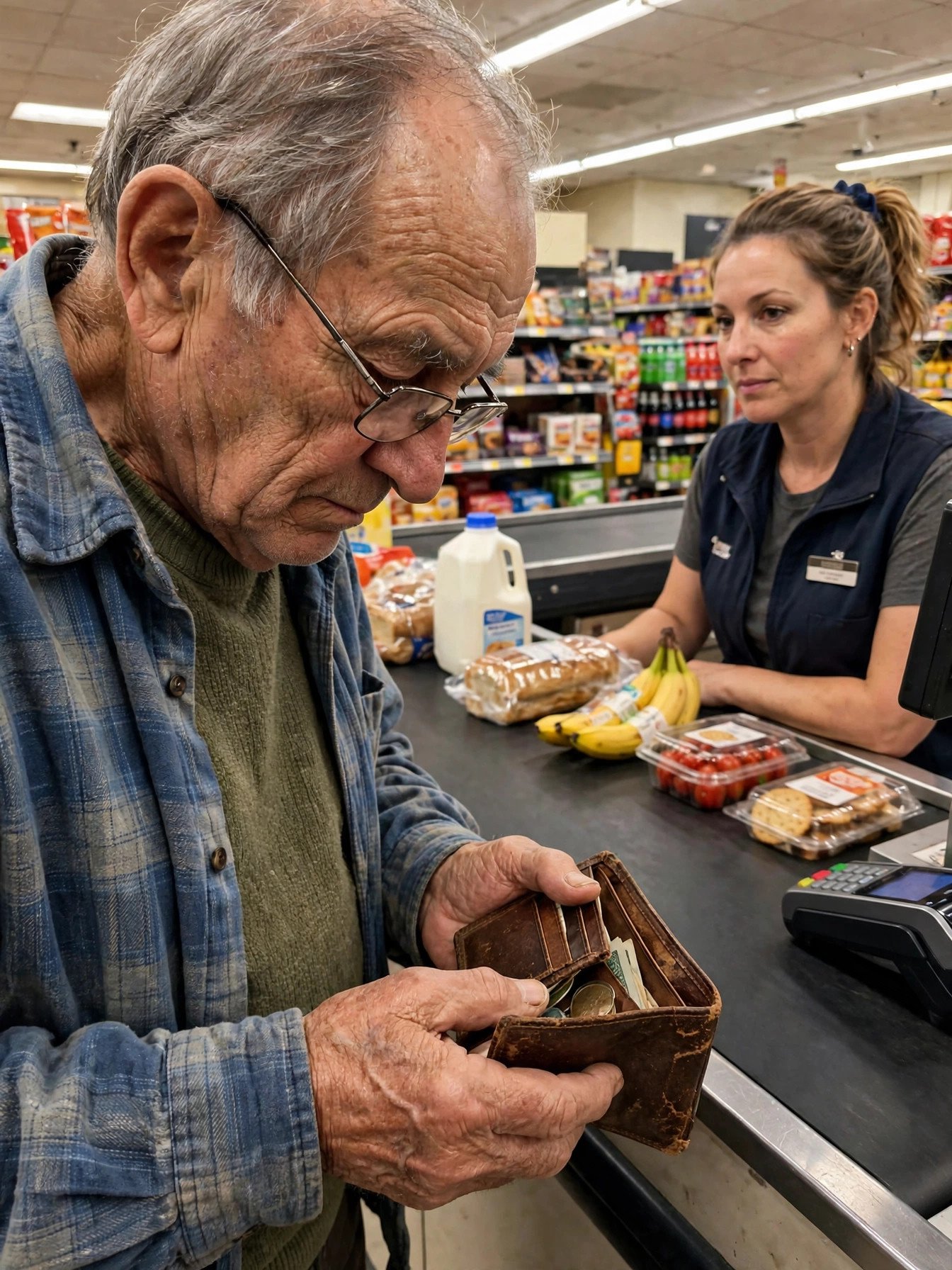
I am seventy-three years old. I have carried men out of burning helicopters and buried friends I could not save. I thought nothing could humiliate me anymore. Then a teenage cashier in a blue vest said, "Sir, it's declined," and I wanted the floor to swallow me whole.
It was a Tuesday — senior discount day at Miller's Market on Route 9, and I plan my week around four percent off a gallon of milk. My cart held bread, eggs, milk, and a frozen pot pie. The total was $12.41. I had $11.20 in my account — news the machine shared with everyone.
"Want me to run it again?" the cashier asked. Her name tag said Kelsey. She had the gentle voice of someone who had seen this before and hated it. My wallet was open on the belt. No backup card. No emergency twenty behind the license the way my wife, Donna, used to keep one. Donna died two years ago, and she took my backup plans with her.
Declined. The word flashed red. I started putting groceries back when a voice behind me said, "I got it." He was maybe sixteen — tall, skinny, hair that needed cutting. He had already tapped his phone on the reader before I could stop him. Twelve dollars and forty-one cents. Gone. Paid.
"Son, you didn't have to do that," I said. My face was burning. "I'm Frank Delgado. I live on Cedar Street. I'll pay you back Friday. I'm good for it."
"It's fine," he said, smiling like it truly was. He picked up his own basket — orange juice, a box of cereal — and stepped forward. That was supposed to be the end of it. A small kindness, over in thirty seconds.
I pushed my cart into the October air, embarrassment trailing me like a stray dog. I was loading my one bag into the trunk of my old Buick when I noticed him crossing the parking lot toward me, carrying a paper grocery bag. My stomach dropped. When a stranger follows you to your car, you pay attention.
"Hey, mister, wait up," he called. I closed the trunk slowly and turned. "I'm Marcus," he said, stopping a respectful distance away. He held out the bag. "My mom packed this when I texted her from inside. Soup, pasta, sauce. She said a man your age shouldn't count pennies for bread."
I stared at the bag. Nobody had given me groceries since Donna's church friends stopped coming around a year ago. "I can't take that," I said, though something in my chest was coming undone.
"You can," Marcus said. "And this too." He pressed a folded fifty into my hand before I could refuse. "That's from my grandpa's jar — for people who needed it more. He'd kill me if I let you walk out like that."
"Your grandpa sounds like a good man," I said, my voice cracking in a way I hated.
"He was a Marine," Marcus said. "Two tours. He died last March. I still carry his dog tags." He showed me — two dull metal ovals, worn smooth, stamped ROBERT T. HALE. The letters were fading, but the weight was not.
"Marines and Army," I said, handing them back. "We gave each other hell for fifty years, but we'd still take a bullet for each other."
He asked what unit I was in. When I said the 1st Cavalry, Vietnam, 1969, his eyes went wide. "Grandpa talked about guys from the Cav," he said. "He said you were the crazy ones."
We stood in that parking lot for twenty minutes. Cars came and went. The sun dropped behind the Miller's sign. He told me about his grandpa's stories — the ones he could barely remember and was terrified of forgetting. I told him about a night in the A Shau Valley when a nineteen-year-old medic named Torres kept us laughing while mortars walked toward our position. I had not said Torres's name in thirty years; it felt like opening a window.
When we ran out of parking lot, Marcus said, "Do you like football? Grandpa and I watched every Sunday. Maybe I could come by sometime — if you want."
That was four months ago. Marcus comes every Sunday at one o'clock, regular as church bells. He brings chips. I make the coffee the way Donna taught me, strong enough to stand a spoon in. During commercials he asks me things — about the Army, about Donna, about being young and sure the world made sense. I answer honestly. Some Sundays we barely watch the game.
Last month I paid him back the twelve dollars and forty-one cents in an envelope marked, "For the next person." He tried to refuse, and I told him his grandpa's jar needed refilling. He went quiet the way boys do when they are trying not to cry, and said, "He would've liked you, Frank."
People ask what the hardest part of getting old is. They expect the knees, the loneliness, the empty chair. But the hardest part was believing the world had finished with me — that I was done being useful. All it took to prove me wrong was a declined card, a sixteen-year-old with his phone out, and a folded fifty from a Marine's dresser jar.
I still shop on Tuesdays. And now I keep a twenty folded behind my license — Donna's old trick, back in service. Because you never know when the person behind you in line will need someone to say, "I got it." And when that moment comes, I intend to be ready.