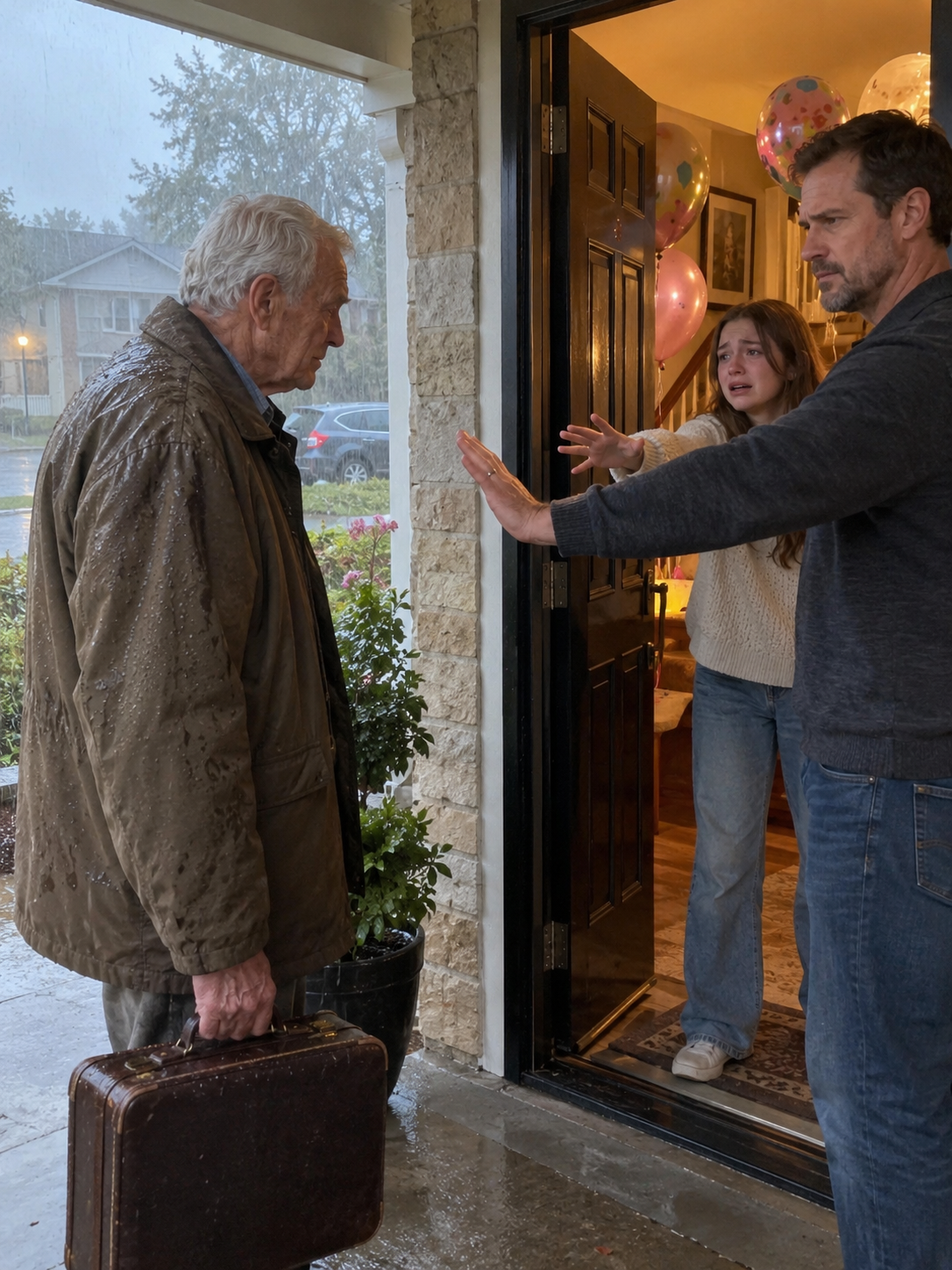
Harold’s coat was soaked when his son raised a hand in the doorway and told him to go. Birthday balloons floated behind the man’s shoulder. Inside, seventeen-year-old Lily reached past her father toward the grandfather she had spent the morning waiting for. Harold held an old suitcase without arguing.
It was Lily’s birthday, not his. Harold had taken the bus across town with a homemade present he had been working on for weeks. He had called the night before and been told to come at four. Rain began as he walked from the stop, but he was smiling when the porch light came on.
His son, Mark, saw the suitcase and believed Harold had come to ask to stay. Their last conversation had ended badly over the family house. Mark had said he could no longer manage his father’s bills. Harold had heard something else: that his son no longer wanted him around.
“We are having people over,” Mark said. “This isn’t the time.” Harold tried to say the case was only for Lily, but Mark kept talking. From the dining room came voices and the scrape of chairs. Lily noticed how tightly her grandfather held the handle.
“Dad, you invited him,” she said. Mark answered that he had not expected luggage. Harold’s hands shook as he lowered the case. He explained that it was his father’s old tool case, polished and repaired. Inside was something Lily had asked about months earlier.
Lily knelt on the threshold and opened it. The case contained a little wooden desk lamp with a painted blue base, the same one that had stood on Harold’s workbench when she was small. He had rewired it with a professional’s help and added a shade she had picked at a thrift shop.
Under the lamp lay a packet of letters. Each told a story about one of Lily’s birthdays, from the first year she learned to say his name to the year she helped him rebuild a birdhouse. He had written them because he was afraid details would fade before she was old enough to ask.
The guests had grown quiet. Mark looked at the case, then at his father’s wet sleeves. He had imagined another argument about money and had acted before listening. Lily did not let the discovery turn into a cheerful excuse for the way he had spoken.
“You made him stand outside in the rain,” she said. Harold tried to soften it, saying the bus had been slow and everyone was busy. Lily took the suitcase inside herself. She told Mark he could apologize without asking Harold to make the moment comfortable for him.
Mark finally stepped onto the porch. He asked his father to come in and admitted his assumption. Harold said he had not come to stay, but they did need a real conversation about the house. He did not want Lily’s birthday to carry the weight of that argument.
They found a dry sweater for Harold. Lily put the lamp on a side table and plugged it in. Its warm circle of light fell across a row of photographs and a cake waiting on the counter. The room did not suddenly become easy, but the guests began speaking again.
After the candles, Lily read only the first letter. It described how her grandfather had held her during a storm when she was two and told her that thunder was a sound the sky made when it needed to move. She laughed, though her eyes were wet.
Mark stood in the kitchen while Harold helped cut cake. He remembered the lamp from his own childhood and recalled how his father repaired things rather than replacing them. That memory did not settle their disagreement over finances. It did make him realize he had stopped asking what Harold wanted.
When the guests left, Mark offered to drive Harold home. Lily asked to come along. In the car, Harold said he would meet with someone who could help him understand his options for the house. Mark offered to attend if Harold wanted him there, and this time waited for an answer.
Harold said he would think about it. He was willing to discuss bills, repairs, and what support might help him stay independent. He was not willing to be treated as a problem dropped on a doorstep. Mark nodded and did not try to argue him out of that distinction.
At Harold’s building, Lily carried the suitcase upstairs. He told her she could keep it. She said the lamp was hers, but the case should come back with him whenever he visited. She wanted to have a reason to hear the stories behind every scratch on its handle.
Over the next month, Mark and Harold met twice at a small café. They went through numbers and brought in an adviser to explain choices. They did not agree on everything. Still, each meeting ended with a date for another, rather than a slammed door.
Lily placed the lamp beside her bed and read one letter each Sunday. She called Harold afterward to ask what he had left out. He always had another detail: the color of a ribbon, a song on the radio, the day she first insisted on holding a hammer.
For his next visit, Mark opened the door before Harold reached the porch. He apologized again, without a speech or an audience. Harold accepted the apology as a beginning. He hung his coat on the hook he had used for years and went to see where Lily had placed the lamp.
The old suitcase remained by Lily’s desk, full of letters she intended to keep. Whenever she switched on the blue lamp, it lit the wood grain where her grandfather’s hand had smoothed it. One birthday had become a memory of a difficult doorway—and of people learning to open it.


