His Harley Died in the Oregon Rain — What He Heard Screaming From the Abandoned Farmhouse Changed Him Forever
The two people I had come to save were looking at me with exactly the same terror as the men holding them.
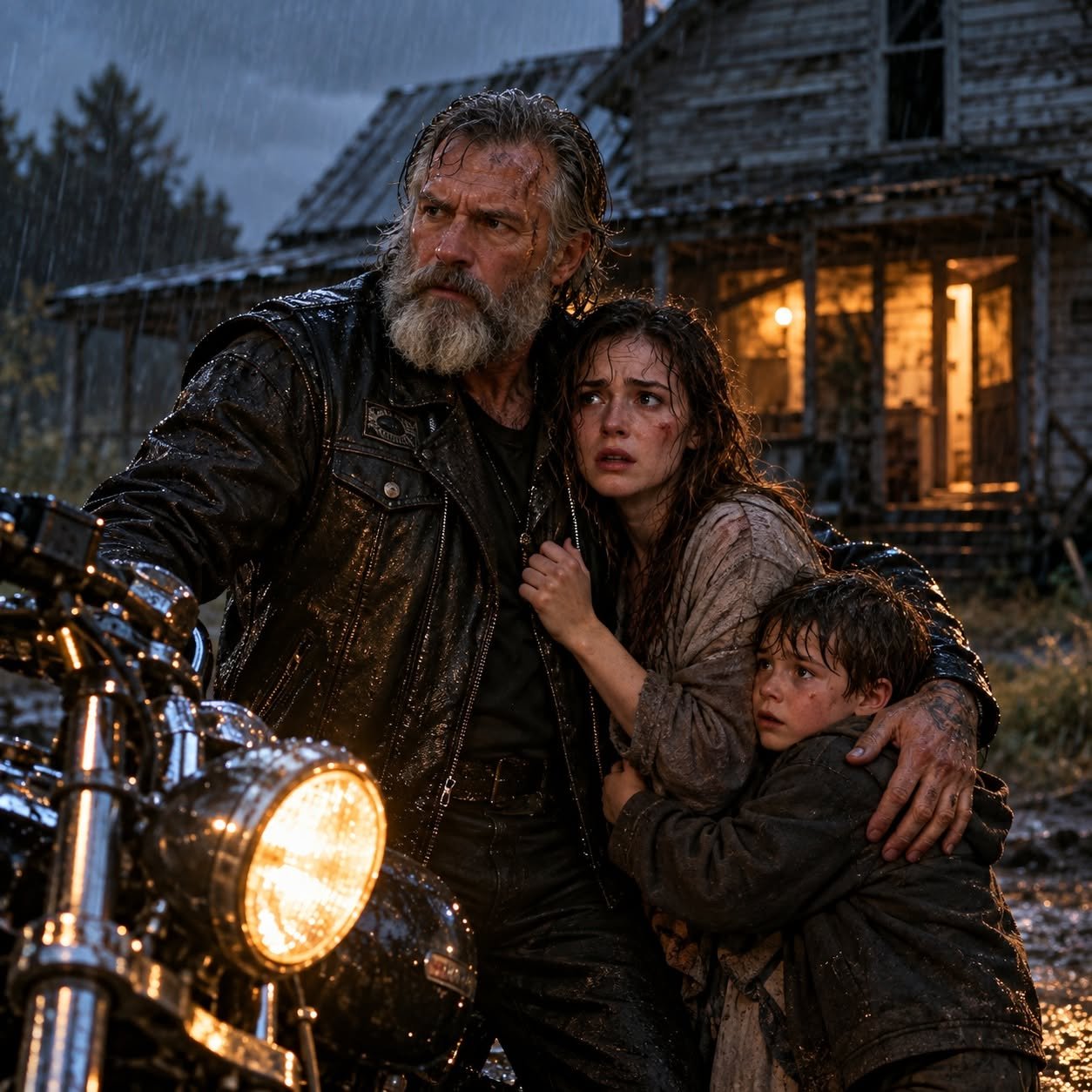
I understood why. Rain ran off my beard onto my leather vest. My knuckles were scarred. The wrench hung heavy in my hand. To a terrified mother and her little boy, I must have looked like one more monster coming down those stairs.
“Who the hell are you?” the man with the firearm shouted.
I took another step down. “Somebody’s worst decision tonight,” I said. “Let them go.”
The man with the metal bar moved first. He swung it at my head, and thirty years of bar fights and bad choices moved my body before my brain caught up. I caught the bar on the wrench with a clang that rang through the basement, twisted, and tore it out of his hands. He stumbled back into the wall.
The second man raised the firearm. Time did the strange stretching thing it does when your life is on the line. I saw the woman pull the boy flat against the wall. I saw the boy’s eyes, wide and fixed on me. And I thought about my daughter at nine years old, pretending to ride across the country on the back of my parked motorcycle.
I threw the wrench.
Not at his head — at his hand. It caught his wrist and the firearm clattered across the concrete floor, spinning under the table. He lunged for it. I lunged faster, and we hit the floor together, and then it was the kind of fight I had spent thirty years being good at and the last ten years trying to leave behind.
He was younger and quicker. I was bigger and meaner and fighting for two people who couldn’t fight for themselves. That turned out to matter more.
When it was over, both men were on the floor and staying there. I zip-tied their wrists with ties from my tool roll — every biker carries them; don’t ask — and kicked the firearm and the metal bar to the far corner.
Then I turned to the woman.
She flinched when I moved toward her. The boy pressed himself so hard against the wall I thought he might go through it.
“Hey,” I said softly, crouching down to make myself smaller. “Hey. I’m Cal. I heard you screaming from the road. My motorcycle died out there. I’m not with them. I’m not going to hurt you.”
She stared at me, breathing hard. Her wrists were raw where they’d been restrained behind the pipe.
“What’s your name?” I asked.
A long pause. Then, barely a whisper: “Jessie.”
“Jessie, I’m going to get those restraints off you, okay? Then we’re going to walk out of here together. Can you tell me his name?” I nodded toward the boy.
“Tommy,” she whispered. “He’s nine.”
“Tommy,” I said, looking at him directly. “I’m Cal. I know I look scary. I’m working on that. But I need you to be brave for about ten more minutes. Can you do that?”
He nodded, just barely.
I freed Jessie’s wrists — the restraints were cheap hardware-store cuffs, and my pick set made short work of them — and helped her stand. Her legs nearly gave out. I steadied her.
“What happened?” I asked. “Who are they?”
The story came out in pieces as we climbed the stairs. Jessie was twenty-four, a single mother from Eugene. Her ex-boyfriend had gotten mixed up with a theft ring operating out of the farmhouse — stolen goods, stripped cars, the chemical smell I’d noticed was a chop operation in the barn. When Jessie threatened to go to the police about what she’d seen, they grabbed her and Tommy off a grocery store parking lot that morning to keep her quiet.
“They said if I screamed, they’d … ” She couldn’t finish. She didn’t need to.
“You screamed anyway,” I said.
“Tommy screamed first,” she said, pulling him close. “I couldn’t let him think nobody would come.”
Somebody came. A fifty-eight-year-old outlaw with a dead Harley and a wrench.
We got to the highway in the pouring rain. Jessie held Tommy and shook. I flagged down the first vehicle with its lights on — a logging truck, thank God — and the driver took one look at us and called 911 on the spot.
The next few hours were a blur of state troopers, ambulances, and questions. Jessie and Tommy went to the hospital in Roseburg to get checked out. The two men from the basement went to jail, along with three more the troopers found in the barn. The chop operation got shut down that night.
A trooper took my statement. He looked at my vest, my record — because of course he ran it — and then he looked at Jessie holding Tommy in the ER waiting room, both of them alive because I’d walked down those stairs.
“Mr. Mercer,” he said finally, “I’m going to pretend I didn’t see the part where you threw a wrench at an armed man. You understand me?”
“Perfectly,” he said.
A tow truck got my Harley to a shop in Roseburg. Charging system, just like I’d diagnosed on the shoulder in the rain. The mechanic — a kid about twenty-five with grease under his nails — fixed it in two hours and wouldn’t take my money.
“Sir,” he said, “my sister heard the scanner last night. Everybody in three counties heard about it. The biker who saved the mom and the kid? I’m not charging you. My mom would kill me.”
I rode home the long way, through the Cascades in clearing weather, and I did a lot of thinking. About the line I hadn’t walked past in that basement. About all the lines I had crossed in thirty years. About the difference between the two, which turned out to be very simple: one line you cross for yourself, and the other you refuse to cross for somebody else.
Two weeks later, a letter arrived at my post office box. No return address, but I knew the handwriting was an adult’s trying to write neatly for a child.
Inside was a drawing. A motorcycle — a big, lopsided, wonderful motorcycle — with a stick figure in a vest standing next to it. Underneath, in careful block letters: THANK YOU FOR COMING DOWN THE STAIRS. — TOMMY.
And on a separate sheet, in Jessie’s handwriting: Cal — Tommy sleeps with that drawing under his pillow. He told his teacher that a biker saved us. His teacher asked if he was scared of you, and he said, “Not after he said his name was Cal.” We got an apartment through a victims’ assistance program. We’re safe. I don’t know how to thank you, so I’ll just say this: you told Tommy you were working on not looking scary. Don’t. The way you look is the reason those men were afraid of YOU for once. — Jessie
I read that letter three times. Then I called my daughter — not a birthday text, a real call. My hands shook the whole time it rang.
“Dad?” she said, surprised. “Is everything okay?”
“Everything’s fine, honey. I just … I saw something in the news. About Oregon. Did you see it?”
A pause. “The farmhouse? The biker who saved that woman and her little boy? Dad, that was … was that you?”
“It was me.”
She was quiet for a long moment. Then she said, “Dad, I’ve been so angry at you for so long. For the arrests. For missing things. For being … you.”
“I know, baby. You had every right.”
“But Tommy’s mom is my age,” she said quietly. “And I keep thinking — if that was me down there, I’d want someone to come down the stairs. I’d want it to be you.”
I had to pull over. I was on my bike, parked at a scenic overlook, crying into my helmet like a fool.
“Dad? Are you there?”
“I’m here,” I said. “I’m right here.”
“Good,” I said. “Stay there. Actually — can I come see you? Not a text. A visit. I want to hear the whole story. The real one.”
She came the next month. We sat on my porch, and I told her everything. She listened without interrupting, and when I finished, she said, “You know what I think, Dad? I think you spent thirty years learning how to fight so that one night, you’d know exactly how to use it.”
“That’s a generous reading,” I said.
“I’m feeling generous,” she said, and leaned her head on my shoulder like she used to when she was nine.
Tommy’s drawing is framed on my wall now, next to a photograph Jessie sent at Christmas: her and Tommy in front of their new apartment, both of them smiling, Tommy holding a toy motorcycle.
People ask me if that night in Oregon changed me. If I’m a different man now.
I tell them no. I’m the same man — same scars, same boots, same battered vest. I just finally figured out what the man was for.
All those years, I thought “not your problem” was wisdom. Turned out it was just fear wearing a leather jacket.
The night my Harley died in the rain, I almost kept riding past a scream. I didn’t. And that one decision — to stop, to listen, to walk down a basement staircase toward the worst thing I’d ever seen — gave a little boy his mother back, gave a mother her life back, and gave a fifty-eight-year-old outlaw the one thing thirty years of riding never had.
A reason to be proud of the man in the mirror.
Tommy still writes to me. His last letter said he wants to ride a motorcycle when he grows up. I wrote back: first you learn to be the kind of man people are glad to see coming down the stairs.
The riding part is easy. Coming down the stairs — that’s the whole job.