The dust hung golden over the Pine Hollow Fairgrounds that Saturday morning, and the air itself seemed to throb with the low thunder of five hundred motorcycles rolling through the gates. The Iron Psalm Riders had hosted the Riders for Relief charity run for eleven straight years, raising money for the county hospital’s children’s ward. Vendors lined the midway, the smell of grilled corn and hot oil drifted across the field, and a band was tuning up for the afternoon show.
Tommy “Tuck” Callahan was twenty-six, a third-year member of the Iron Psalm Riders, and still young enough to feel a little thrill every time he pulled on his cut. He had come early to help stake out the club’s tent, hammering pegs into the dry ground while the older members argued about the afternoon poker run route. His bike, a battered 2009 Dyna he was rebuilding one paycheck at a time, stood gleaming in a row of far finer machines. Tuck didn’t mind — the patch had never been about the chrome.
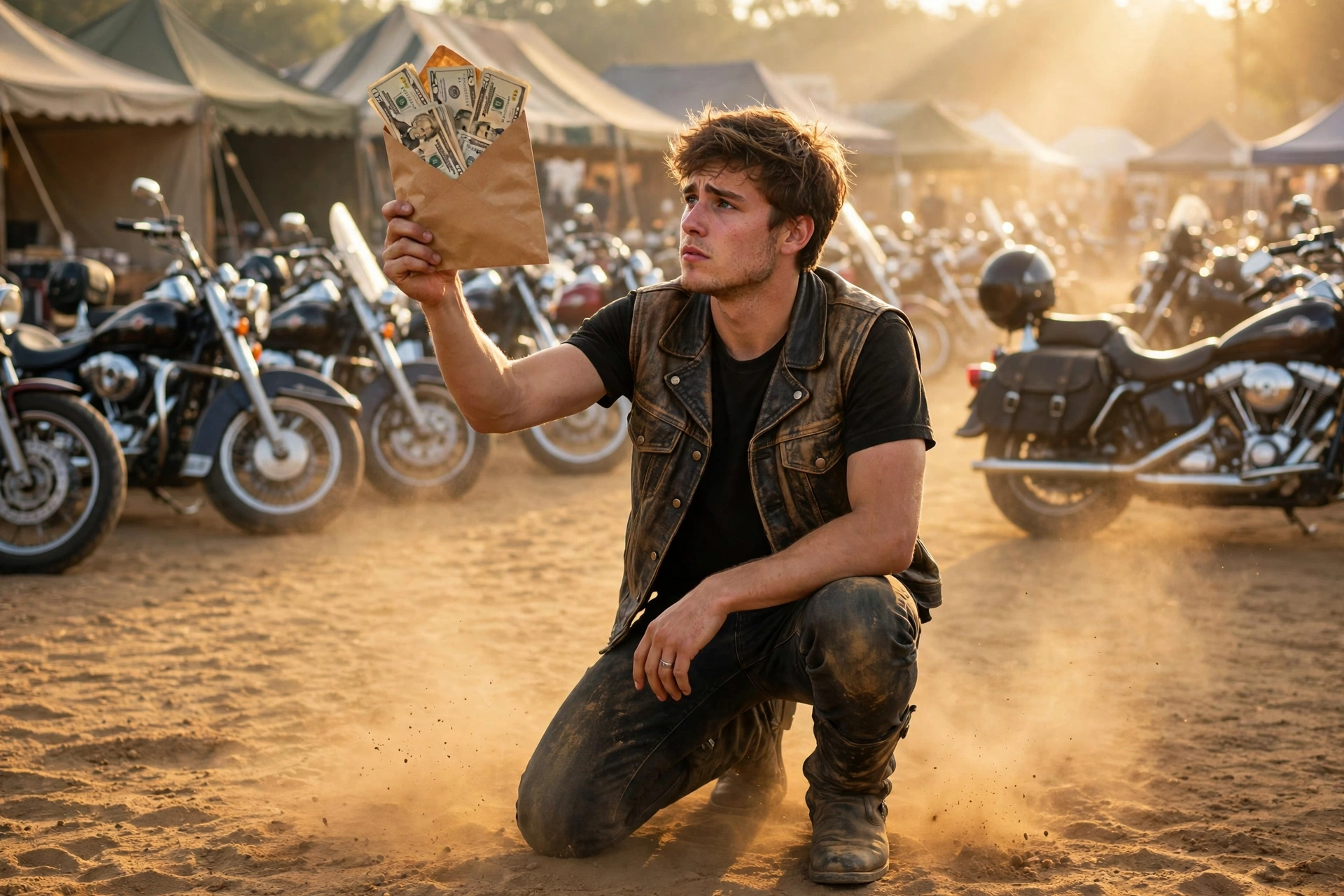
It was just past nine when it happened. Tuck was carrying a crate of bottled water from the supply truck toward the tent when his boot struck something half-buried in the dust near the fence line, where the grass gave way to gravel. He nearly tripped. He bent down and pulled free a thick brown envelope, heavy as a brick, its flap sealed with yellowed tape and creased as if folded and refolded a hundred times.
He stood there in the morning sun, turning it over in his hands. It was fat enough that the tape strained. He peeled back one corner, and his breath caught. Inside were stacks of bills, banded and bundled, more cash than he had ever seen in one place in his life. A quick thumb through told him this was years of savings — tens of thousands of dollars, sitting in the dirt.
For three long heartbeats, Tuck stood frozen while the rally roared on around him. Nobody had seen. He could slip the envelope into his saddlebag, ride home, and no one would ever know. The thought rose up unbidden, bright and shameful, and it scared him. He was still rebuilding that Dyna. His truck needed a transmission. That money could change his whole year.
Instead, he tucked the envelope inside his vest, zipped it shut, and walked straight to the club tent, his jaw set. The older members were there — Gideon Cole, the chapter president, a broad-shouldered man with a gray-streaked beard, Marv the road captain, and Deacon, who ran the charity books. Tuck laid the envelope on the table and said, plainly, “Found it by the fence. It’s full of cash.”
The table went quiet. Gideon counted and recounted: thirty-eight thousand, four hundred dollars in worn bills, plus a small slip of paper in shaky handwriting that read only, “For the surgeon.” No name. No address. Deacon did some quick math and shook his head. “Somebody’s life savings,” he said softly. “Somebody is out there right now having the worst day of their life.”
A couple of the younger hangers-on joked — finders keepers, the rally gods smiling on Tuck — but Gideon cut them off with a look that could have bent steel. “That’s not what this patch means,” he said. “Somebody dropped their whole world in the dirt, and we’re going to find them. That’s the end of the discussion.”
By ten the club had announced over the rally’s PA — saying nothing of the amount, only that a “very important envelope” had been found and the owner should come to the Iron Psalm tent with proof. They told the gate crews and the vendors. Gideon locked the envelope in the club trailer’s safe, with two trusted members guarding it and strict orders that nobody touched it.
The first claimant arrived within the hour. Loud and red-faced, he spun a story about a bank withdrawal that didn’t add up, and grew angrier when Gideon asked him simple questions. What bank were the bands from? What was written on the slip of paper? The man guessed — and guessed wrong, twice. The bills were held with plain rubber bands, not bank wrappers, and he had no idea about the note. Gideon showed him the gate with a politeness that somehow felt more dangerous than shouting.
Two more false claims came that afternoon, each one sadder than the last. By evening, as the bonfire was lit, the mood at the tent had turned heavy. Maybe the owner had already left. Tuck sat by the fire turning his empty coffee cup, wondering if he should have just kept walking past that spot by the fence — and hating himself for the thought.
Then, near eight o’clock, the gate crew radioed the tent. There was an elderly woman at the entrance, crying, and her husband was with her, and she kept saying the same thing over and over: “It’s gone. Frank, it’s gone. Our envelope is gone.” Gideon and Tuck walked up together, and what they saw stopped them cold. She was maybe seventy-five, in a faded church dress, clutching her husband’s arm. He was taller but stooped, his hands shaking so badly he could barely hold his gate pass.
Her name was Marla Ellison. His was Frank. They were from two counties over, and as Marla talked through her tears, the story came out in pieces. Frank was scheduled for heart bypass surgery on Monday morning at the county hospital — the same hospital the rally was raising money for. The surgeon required payment up front for the part insurance wouldn’t cover. So that week they had gone to the bank together and withdrawn everything they had in the world — thirty-eight thousand, four hundred dollars, forty years of careful saving, folded into a brown envelope.
Frank had been a rider himself once, back in the seventies, before the kids and the mortgage and the quiet years. When he heard about the rally on the radio that morning, he told Marla he wanted to see the bikes one more time before the surgery — “in case,” he said, and didn’t finish. They’d parked at the far fence. The envelope had been in the inside pocket of his old riding jacket. Somewhere between the fence and the food trucks, it had slipped out into the dust. They hadn’t noticed until they were nearly home.
Gideon listened to all of it without moving. Then he asked the two questions that mattered. “Ma’am, what was written on the slip of paper inside?” Marla looked up, confused. “Oh — Frank wrote ‘For the surgeon’ on a little piece of paper. His handwriting’s so shaky now.” And: “Sir, how was the money held together?” Frank’s voice was barely a whisper. “Rubber bands. The bank gave me wrappers but my hands — I couldn’t work the wrappers. Marla put rubber bands on.”
Every detail matched. Gideon put one enormous hand on Frank’s shoulder and said, “Sir, I believe we’ve been keeping something safe for you.” They walked the old couple to the club trailer, and when Gideon laid that creased brown envelope in Frank’s trembling hands, Marla made a sound Tuck would remember for the rest of his life — half sob, half prayer.
But the club wasn’t finished. That night, around the bonfire, Gideon told Frank and Marla’s story to the whole rally — with their permission. He held up the club’s own collection jar and said, “This couple came here today to look at motorcycles, and they almost lost everything. Tomorrow, this man goes under the knife. I say we don’t just give him back his money. I say we make sure he keeps it.” The jar went around the fire. Then around the midway. Then, at Gideon’s urging, through the whole fairgrounds.
By midnight, the rally had raised nearly forty thousand dollars more — vendors emptying tills, riders digging into wallets, a little girl donating her face-painting tips. On Sunday morning, in front of the main stage, Gideon called Frank and Marla up, returned their life savings to a standing ovation, and then handed them the second jar. “Your savings stay yours,” he said, his voice breaking. “The brotherhood’s got the surgeon.”
Frank’s bypass was a success. He was home within two weeks, and the first thing he did — against doctor’s orders — was shuffle out to the garage and polish his old riding jacket. The club visits him every month now, and every year since, the rally has opened with a collection for the Ellison Fund, which has helped eleven families pay for surgeries they couldn’t afford.
Tuck still rides that battered Dyna, though it’s nearly finished now. A reporter once asked him, at a later rally, why he hadn’t just kept the envelope when no one was looking. Tuck watched the sun come up over a field of motorcycles. “Because that’s what the patch means,” he said finally. “Anybody can pick something up. It takes a brotherhood to give it back.”