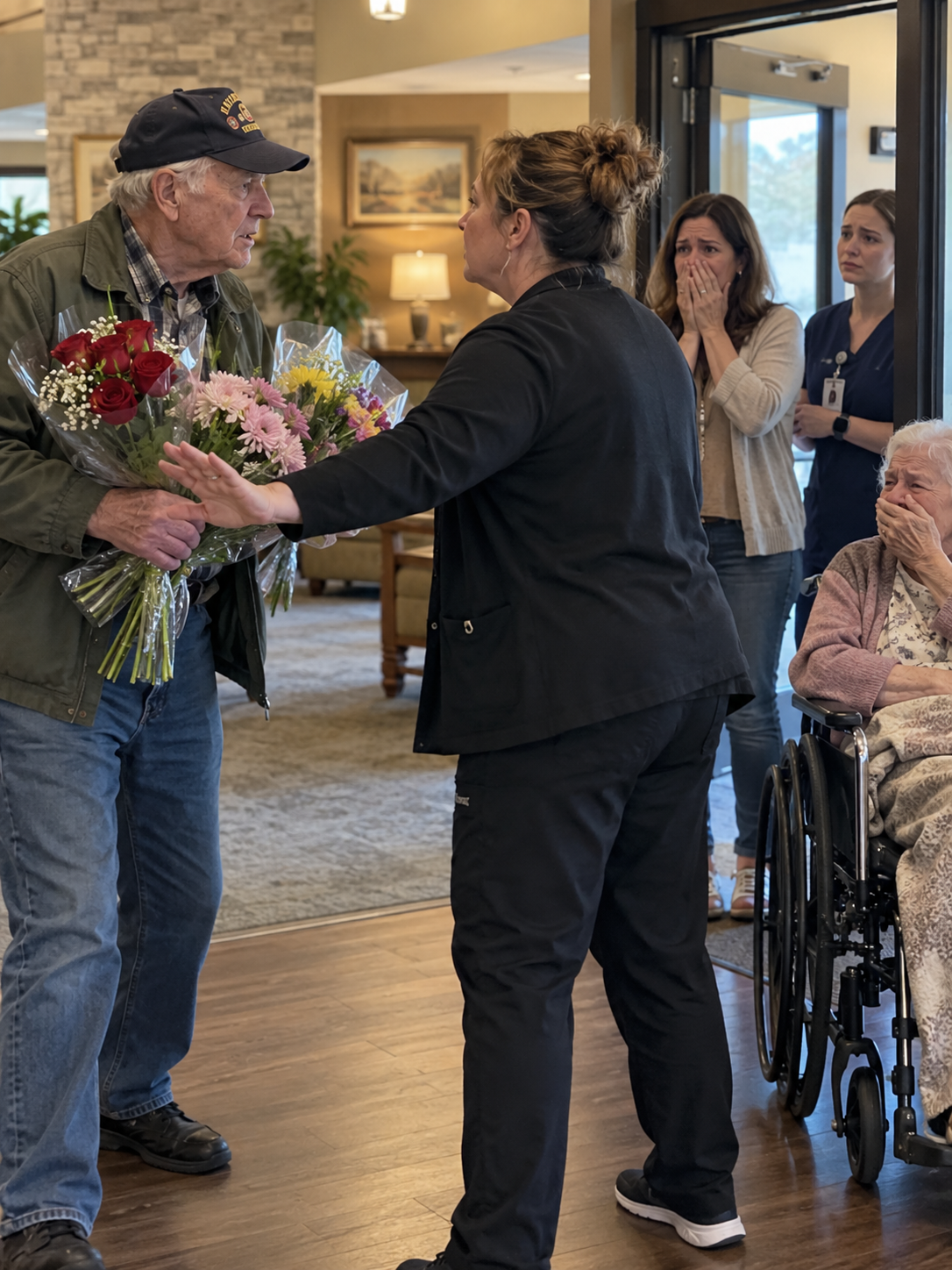
Walter Grant carried flowers through the care home’s front door and was stopped before he reached his wife’s room. A staff member told him his name was missing from the visitor list. His daughter and a nurse looked on from the hallway. Walter had visited every Tuesday for nearly a year.
At eighty-six, Walter wore his veteran cap because his wife Rose still recognized it before she recognized his face on difficult days. He bought whichever flowers were in season and arranged them in the same blue vase on her windowsill. Routine helped them both.
That morning Rose had asked their daughter, Beth, whether Walter was coming. Beth called him to confirm, then arrived early with clean clothes for her mother. A shift change at the desk had introduced a new visitor list, and Walter’s familiar name had been copied into the wrong column.
The staff member saw an incomplete record and asked Walter to wait. He said Beth was inside and offered to call her. The staff member replied that he could not enter and stepped in front of him. The flowers dipped in Walter’s hands as he backed away.
Beth appeared from the hall and identified him. Instead of checking the record, the staff member repeated that the computer did not show his authorization. A nurse named Alina came over and asked for the chart to be reviewed before anyone sent him away.
Walter remained by the lobby table. He had seen rules protect people he loved and did not object to verification. He objected to being treated as a stranger who should leave without anyone making a phone call. Beth could see he was trying hard not to raise his voice.
Alina found the signed visitor record in the previous system and checked it against Rose’s current care plan. Walter was authorized. The new list had been entered incorrectly during the transfer, leaving his name attached to an older document that did not appear at the front desk.
The supervisor corrected the record and apologized. Beth asked that the change be checked by the next shift as well. Walter did not move until Alina confirmed it had been updated, because he could not bear repeating the scene when he returned with flowers the following week.
In Rose’s room, the blue vase was empty. Walter put the flowers in water and turned it so the brightest blooms faced her chair. Rose looked at his cap, then at the vase. “Tuesday,” she said, as if the word were enough to place them both.
He sat beside her and read aloud from a book they had shared for years. Some passages were familiar; others seemed new to Rose each time. When she lost the thread, Walter asked about the garden they once kept behind their house. She remembered the stubborn yellow roses.
Beth watched from the doorway. She had been angry in the lobby, but she also understood why records mattered in a care home. What had frightened her was the ease with which a data entry mistake nearly took away a visit Rose had been anticipating all morning.
Walter asked Beth not to spend the whole afternoon arguing with the staff. She agreed, provided the supervisor would explain how the corrected list would carry over at the next shift. They met later, after Rose had rested, and reviewed the practical steps together.
The staff member who had stopped Walter came to Rose’s room to apologize. Walter said he appreciated the caution, but a verification rule needed a way to resolve uncertainty promptly. He could wait while someone checked. He could not accept being dismissed because a screen was incomplete.
Over the next few days, the home audited visitor records migrated from the old list. Several entries needed updates. Beth was relieved that her father’s experience prompted a wider review, even though she wished it had not required him standing in the lobby with flowers.
The following Tuesday, Walter arrived with daisies. The desk worker greeted him by name and checked the updated record without delay. He did not demand recognition. He wanted the visit to start with Rose rather than a debate at the front door.
Rose was sitting by the window when he entered. She smiled at the veteran cap and asked if he had brought the garden with him. Walter held up the daisies. “Only the part that would fit in my car,” he answered. Beth laughed from the corner.
They began a new habit of taking a small photograph each Tuesday. Sometimes Rose looked at the camera; sometimes she looked only at the flowers. Walter kept the pictures in a folder, with dates written carefully on the backs by Beth.
One afternoon Rose recognized a scarf she had knitted for Walter years earlier. She touched the wool, then asked whether the yellow roses had bloomed. Walter said the garden was gone now, but they could bring a potted rose for the windowsill if the home allowed it.
Alina checked with the care team and found a suitable place for the plant. Walter and Beth brought it together. Rose watched as they set it beside the blue vase. The ordinary decision took coordination, which was precisely why Walter had wanted the visitor record corrected rather than merely waved through once.
On another Tuesday, Walter entered with flowers and a book. His name was on the list, the vase was waiting, and Rose looked up when she heard his voice. He sat down before opening the book. For that afternoon, being there was the whole point.