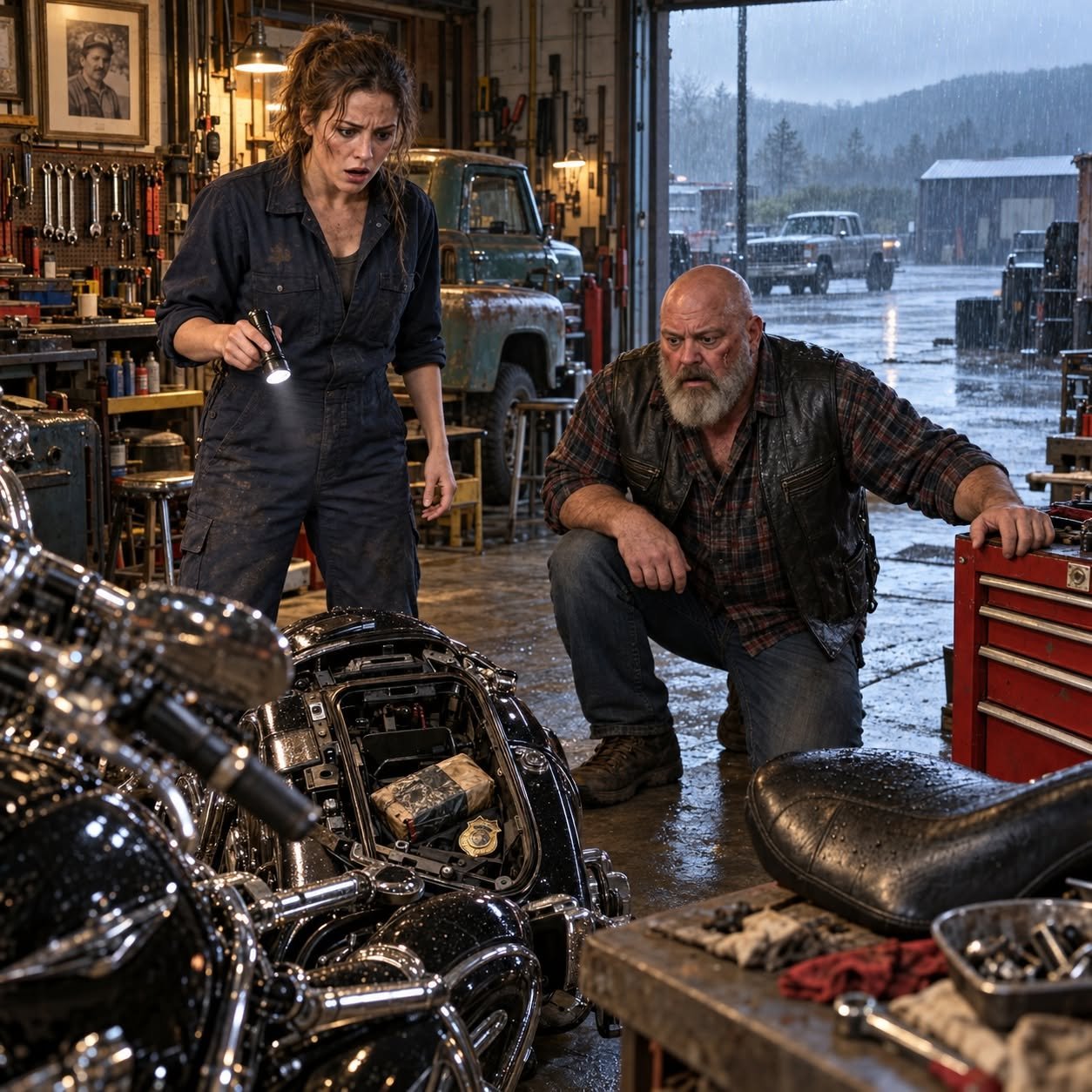
The man who walked into my garage looked impossible to frighten.
Ten minutes later, he was on his knees beside my father’s tool chest, staring at what I had found beneath his motorcycle seat.
“Don’t touch it,” he whispered.
For once, I had no intention of fixing the thing in front of me.
My name is Avery Collins. I was thirty-two, and that Wednesday afternoon, I needed four thousand dollars by Friday to keep Collins Auto and Cycle open.
My father had built the shop outside Altoona, Pennsylvania, thirty years earlier.
He taught me to diagnose an engine by listening before reaching for a tool.
He also taught me that when somebody said, “Where’s the real mechanic?” I should finish the repair before deciding whether to answer.
After cancer took him, I inherited the garage, its business loan, and a filing cabinet full of problems he had been too sick to handle.
I used my savings during his final months. Then I used credit.
By November, even our oldest customers were postponing repairs.
The lender’s representative called twice that morning.
I let the second call go to voicemail.
Outside, rain hammered the metal roof. Inside, I worked on an old pickup that wasn’t worth what its owner owed me.
Then a motorcycle pulled beneath the awning.
The rider was enormous. Shaved head, gray beard, a faded scar along one cheek. His black leather vest carried the patches of a club called the Black River Riders.
He entered without introducing himself.
“You work on bikes?”
“Yes.”
He glanced behind me.
“You got anybody else here?”
“No.”
His expression suggested that wasn’t the answer he wanted.
“My fuel line’s leaking. I need it handled.”
“Then you need to stop riding it.”
“I already stopped.”
He placed five hundred dollars on the tool chest.
“Can you do the job or not?”
I looked at the money.
Then at him.
“I can inspect it. I won’t promise a repair before I know what’s wrong.”
He studied me for a moment.
“Fair.”
We pushed the motorcycle into the bay with the engine off.
The smell of gasoline was strong enough that I immediately regretted bringing it farther inside.
I kept the bay open and told him to stay clear.
He took out a cigarette.
“Put that away,” I said.
His eyes narrowed.
I didn’t move.
After a moment, he returned it to the pack.
“Name’s Dean,” he said.
“Avery.”
I began the inspection.
The damage to the line didn’t look like ordinary deterioration. There was a clean edge where I expected cracking or wear.
“Has anybody worked on this recently?”
“No.”
“Anybody had access to it?”
He stopped watching the rain.
“Why?”
“I’m not sure yet.”
I removed the seat to check the surrounding area.
My flashlight caught something that didn’t belong among the factory components.
A wrapped package.
Unfamiliar electronics.
And, half-hidden beside it, a gold police shield.
I froze.
My father’s voice came back to me with such clarity that I nearly turned toward the office.
If you don’t recognize it, don’t start pulling things apart.
I backed away.
Dean approached, irritated by the silence.
“What now?”
I pointed without moving closer.
He looked.
The impatience left his face.
Then the color did.
He staggered backward, caught the tool chest, and lowered himself to his knees.
“No.”
I stared at the badge.
Three weeks earlier, Detective Owen Mercer had disappeared. His photograph was still taped inside the gas station across the highway.
The name on the shield was his.
“We’re leaving,” I said.
Dean caught my sleeve.
“Wait.”
I pulled free.
“There is something under that seat neither of us understands. We are leaving.”
“The badge—”
“I saw it.”
He looked at me with a kind of fear that made his size irrelevant.
“They’ll say we took it from him.”
“What?”
“I handle the club’s accounts. Mercer talked to me before he disappeared. Asked about money moving through some businesses.”
“Then tell investigators.”
“I was going to.”
“Were?”
He looked toward the bike.
“Somebody got there first.”
A faint electronic sound came from beneath the seat.
Neither of us waited to identify it.
We moved through the rear door and across the muddy yard.
From beyond the building, I called emergency services and described what I had found.
Dean stood beside me, shaking.
Then headlights swept across the front windows.
A black SUV stopped on the road.
Two men stepped out.
One carried a gun.
The other turned toward the security camera above my office door, and I recognized the face I’d seen beside the missing detective’s photograph every night on the news.
It was Mercer’s partner.
And he was coming into my garage.
“That’s Detective Paul Rennick,” Dean breathed. “Mercer’s partner. He’s the one Mercer was investigating.”
We ran.
Not away—there was nowhere to go in the muddy yard—but to my father’s old office, where I slammed the deadbolt and grabbed the shotgun Dad kept behind the filing cabinet.
Rennick’s voice came through the door, smooth and reasonable.
“Avery Collins? This is Detective Rennick. We got a call about a suspicious package. Open up.”
“You’re not here about a package,” I shouted. “You’re here about your partner’s badge.”
Silence.
Then: “Dean Kowalski is a dangerous felon. Step away from him.”
“Dean’s been standing next to me for ten minutes and hasn’t hurt anyone,” I said. “You’re the one with the gun.”
Dean was already at the back window, prying it open. “The package under my seat—Mercer planted it there. He told me if anything happened to him, the evidence would find its way to someone honest. He must have meant you.”
“Why me?”
“Because you’re the only mechanic in three counties who calls the cops instead of covering things up. He knew.”
We climbed out the window as Rennick started kicking the office door.
Dean’s bike was still in the bay—we couldn’t take it. Instead, we ran for my truck, parked behind the shop.
Behind us, glass shattered. Rennick was inside.
I floored it down the service road, rain blinding the windshield, Dean shouting directions to the county sheriff’s substation twelve miles out.
“What’s in the package?” I gasped.
“Ledgers,” Dean said. “Mercer was tracking money—drug money—being laundered through legitimate businesses. Rennick’s been on the take for years. Mercer confronted him. Rennick made him disappear.”
“And the electronics?”
“A tracker. Rennick’s been following my bike for a week, waiting for me to lead him to the evidence. He didn’t know Mercer already moved it.”
“Moved it where?”
Dean held up his phone. “To the cloud. Photos of everything. I sent them to the FBI field office in Pittsburgh twenty minutes ago, while you were calling 911.”
We reached the substation with Rennick’s SUV three car-lengths behind us.
What Rennick didn’t know was that Dean had also called his club president.
Six Black River Riders were waiting in the parking lot.
Rennick took one look at the wall of leather, the sheriff’s deputies pouring out of the building, and the FBI agents who’d arrived ten minutes earlier on Dean’s tip—and put his gun on the hood of his SUV.
It was over in seconds.
The package under Dean’s seat contained Mercer’s original ledgers, a USB drive with recorded conversations, and a letter Mercer had written the night before he disappeared.
Dean was fully cleared within a week. The FBI confirmed he’d been cooperating with Mercer for months, feeding him information about the money laundering from inside the club.
The Black River Riders, it turned out, had expelled the members involved in the scheme long before. Dean and the club’s leadership had been working with Mercer voluntarily.
Rennick was arrested on federal corruption charges, conspiracy, and the murder of Detective Owen Mercer—whose body was found, based on information in the ledgers, in a quarry outside town.
Here’s the part I didn’t expect.
The story made the local news. Then the state news. “Woman Mechanic Exposes Corrupt Detective.”
Customers started coming from two counties away. “You’re the one who stood up to that crooked cop,” they’d say.
A GoFundMe started by one of Dean’s club brothers raised $47,000 in a week—more than enough to pay off the business loan.
I tried to refuse it. Dean wouldn’t let me.
“Your dad taught half this town how to change their own oil for free,” he said. “This is just the bill coming due.”
I still have the $500 Dean placed on my tool chest that Wednesday afternoon.
I framed it. It hangs above the register.
Not because of the money—though God knows I needed it—but because of what it started.
Every time I look at it, I remember my father’s voice: If you don’t recognize it, don’t start pulling things apart.
He was right. But he also taught me something else, something I didn’t fully understand until that rainy afternoon:
When you find something wrong, you don’t walk away from it.
You call for help. You stand your ground. And you trust that the truth, once it’s out in the open, is stronger than any badge—real or stolen.
Collins Auto and Cycle is still open. Still mine.
And every bike that rolls through my bay gets the same treatment: honest work, fair price, and a mechanic who isn’t afraid to look under the seat.


