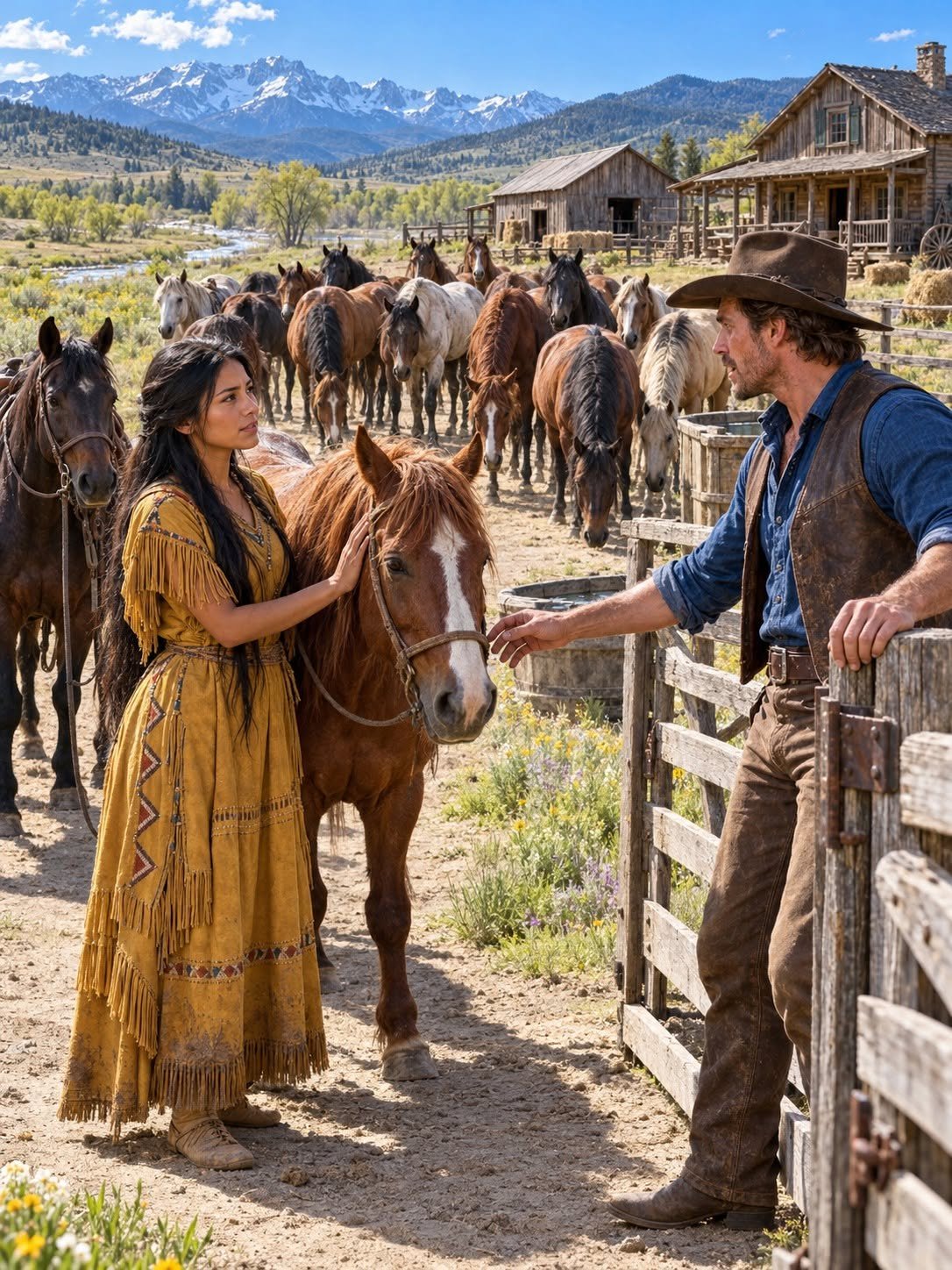
My name is Daniel Hayes, and I had spent weeks searching for my twelve missing horses when a woman I had never met appeared outside my ranch. She was Apache, riding slowly along the dusty trail, and behind her came twelve horses — my horses, every single one of them. I couldn’t believe what I was seeing. But what frightened me wasn’t how she had found them. It was what she told me afterward: someone else had been keeping my horses alive, someone who had disappeared years earlier, and that person knew my family.
It all began with a violent storm that swept across our valley one spring morning. The wind shook the barn, rain battered the windows, and the horses ran wildly across the pasture. I waited until the storm passed before checking the fences, and that’s when I discovered the damage — a section of fence had collapsed, and twelve horses were missing. I followed their hoofprints toward the rocky hills, across a dry creek bed, up a narrow slope, and into a valley where the tracks simply disappeared. I searched until darkness fell, then returned the next morning, and the morning after that. But there was nothing. No fresh tracks, no sound of horses, no sign they were alive.
Eventually my food and supplies ran low, and I had to return home. Those horses weren’t just livestock to me. I’d raised some since they were foals. I recognized their footsteps, their moods, even the sounds they made when something frightened them. Losing them felt like losing part of my family.
My father had taught me every one of their names before I was ten years old. There was Copper, the chestnut mare who nickered whenever she heard my step; and Domino, the paint gelding my father said had more sense than most men; and old Blue, twenty years old and still the boss of the pasture. I used to tell my father I would never sell a single one, and he would laugh and say a rancher who loves his horses that much is either blessed or doomed. After he died, I understood he had meant both. Weeks passed, and I began accepting that I’d never see them again.
A neighbor, Cal Whitaker, rode over one afternoon and offered to buy the ranch — “horses or no horses,” he said, naming a price that was an insult dressed as kindness. I told him the ranch wasn’t for sale. He shrugged and said a man without horses is just a man with empty pasture. I watched him ride away and thought about how wrong he was. The pasture wasn’t empty. It was waiting. Then one quiet morning, I heard hoofbeats outside. I stepped onto the porch, and an Apache woman was approaching on horseback, wearing simple traveling clothes, looking tired from a long journey. But my eyes moved immediately behind her. One horse. Three. Six. Twelve. My knees nearly gave out.
I hurried toward the gate. “They’re mine!” The woman dismounted with quiet grace. “My name is Mara,” she said gently. “I found them.” I walked among the animals, touching their necks, feeling their familiar shapes. They were thinner, tired, but alive. “Where did you find them?” “Beyond the northern ridge. In a hidden valley.” “I searched there.” She gave me a look that was almost pitying. “Not far enough.” Then her expression changed, and her voice dropped. “Daniel, someone was already caring for them.”
I went to each horse in turn, laying my hands on their necks, checking their legs the way my father had taught me. Copper pressed her forehead against my chest and sighed, a sound I felt more than heard. They were thinner, yes, and their coats were dull, but their eyes were clear. Whoever had kept them had done it with knowledge and care. “They trust you,” Mara said quietly, watching us. “That is how I knew they were yours.”
I stared at her. “What do you mean?” “There were water containers, ropes, and a shelter. Someone kept them together.” “Who?” She shook her head. “I never saw anyone.” The next morning, Mara agreed to show me the place. We rode through the same dry creek bed I’d searched weeks earlier, then followed a narrow passage between rocky cliffs that I had somehow missed every time — a cleft in the stone no wider than a wagon, hidden behind a rockfall. Beyond it lay a sheltered valley with a small spring, green and quiet as a held breath. I stopped, because near the water were empty containers, pieces of rope, and a shelter made from branches. Mara pointed toward the clearing. “This is where I found them.” Someone had clearly spent days — weeks — caring for those animals.
Then I noticed something beside an old tree: a wooden marker, weathered gray, with three letters carved into it. T. B. My chest tightened. “Thomas Bell,” I whispered. Mara looked at me. “You know him?” “He was an old rancher. A friend of my father’s.” Thomas had helped our family through difficult seasons when I was young — mending fences beside my father, sitting at our table at Christmas. Then he vanished from the region, and nobody knew where he’d gone. Inside the shelter, I discovered a weathered notebook, and its pages contained details about my horses — their names, their conditions, how much water they needed, which ones spooked at snakes. Then I found the final entry, dated only days before Mara arrived. “Someone will come for them.” I read those words twice. Thomas had been here, after all these years. He had saved my horses. But why hadn’t he returned them himself?
The entries went back weeks, each one dated in a careful hand. “Copper favoring left fore — rested her two days.” “Domino off his feed — found good graze near the east wall.” “Blue’s cough better.” He had even noted the weather, and the level of the spring, and once, in the margin: “They miss their boy. Horses know.” I sat on an overturned bucket in that branch shelter and felt my throat close, because Thomas Bell had loved my horses the way I did — and he had done it alone, in secret, expecting no thanks.
That evening, I studied his notebook beside the fireplace, and the careful handwriting told me more than the words did — this was a man who had loved animals the way my father had. The following morning, Mara accompanied me into town, where an elderly storekeeper remembered Thomas immediately. “Someone matching his description was seen near the northern trail,” he told us, “buying oats and salt, paying cash, gone before questions.” My heart began racing.
On the ride home, Mara was quiet for a long while. Then she said, “He stayed away because he was ashamed. My people know this kind of pride — it is a heavy saddle to carry alone.” I asked her why she had brought the horses to me instead of keeping them, and she looked at me as if the question surprised her. “They were never mine to keep,” she said. “And a man who is watched over in secret deserves to know it.” I rode the rest of the way home thinking about how much this woman I had just met understood about my life. We returned to the ranch before sunset, and as I approached the pasture, I noticed a man standing beside the fence — older, gray-haired, leaning against a wooden post. I stopped walking. “Thomas?” He turned slowly, and a familiar smile appeared on a face the years had carved deep. “It’s been a long time, Daniel.”
I hurried toward him. “You saved my horses.” He nodded. “Why didn’t you bring them home?” His expression softened, and he looked suddenly very old. “I wasn’t sure you’d remember me.” “How could I forget?” He looked toward the pasture. “People forget many things when life becomes difficult.” Then he reached inside his coat and removed a small wooden box, holding it toward me. “This belonged to your father.” I stared at it. Thomas’s voice grew quiet. “There’s something inside you should have received many years ago.” I took the box with trembling hands, and suddenly I understood that Thomas hadn’t returned simply because of my missing horses. He had come to give me something my father had left behind — something that had remained hidden for years, waiting for me long before those twelve horses disappeared.
We sat on the porch steps, and I opened the box. Inside lay my father’s brass pocket watch, still ticking after all these years, a folded deed, and a letter in my father’s hand. I read the letter twice before the words would settle. “Daniel,” it began, “if Thomas Bell ever comes back, give him this box, and give him my apology, because I owe him both.” The letter went on to confess what my father had carried to his grave: twenty years earlier, in a hard winter, money had gone missing from the ranch strongbox, and my father — frightened, ashamed of his own failing — had accused Thomas of stealing it. Thomas had sworn his innocence, but my father’s pride wouldn’t bend, and Thomas had ridden out that same night and never come back. “A month later I found the money,” my father wrote, “wedged behind the strongbox where it had slipped. I was too proud to ride after him. It is the great shame of my life. The deed enclosed is for the north pasture — it was always meant to be his share. See it done, son.”
I looked up at Thomas, and the old man’s eyes were wet. “You never stole,” I said. It wasn’t a question. “No,” he said quietly. “But I was proud too. I should have come back and made him listen.” He told me then what he had never told anyone: that he had lived in the hills for years, in a line shack nobody knew about, watching over the ranch from a distance the way a man watches over family he can’t claim. When the storm scattered my horses, he found them in the hidden valley and kept them alive, and when he saw Mara’s people passing, he let her find them — because he wasn’t sure he was welcome to come home himself.
That night, Thomas slept in the bunkhouse, and I lay awake listening to the wind and thinking about my father’s letter. In the morning, I hitched the team and drove Thomas to the old line cabin site myself, and we spent the day clearing it together — two men who had both been proud and both been wrong, working side by side without needing to say it. By supper, the cabin had a sound roof, and Thomas sat at my table, and the house felt the way it had when my father was alive: full.
I took my father’s watch from the box and pressed it into Thomas’s hand. “He wanted you to have this back,” I said. “And the apology — I’m giving it to you now, for him.” Thomas wept then, silently, the way old men do, and I put my arm around his shoulders and let him. As for the deed, Thomas shook his head. “The land’s yours, son. Your father paid his debt with that letter.” But he accepted something else: a cabin of his own on the ranch, rebuilt by my hands that summer, and a place at my table every night, and work he insisted on doing — because, he said, a man his age still needed to earn his supper, even if the wages were mostly pie.
Mara stayed three days, helping us settle the horses, and on the morning she left, she stood at the gate a long time. “Your father would be proud,” she told me. “Of the son, or the apology?” I asked. She smiled. “Both.” I watched her ride toward the northern ridge, and something in me hoped the hidden valley wouldn’t be the last place our paths crossed. Thomas watched too, and said nothing, but there was a look on his face I recognized — the look of a man who had spent too many years alone and was finally, carefully, letting himself hope again.
The horses recovered quickly under Thomas’s care. He knew each one by name within a week — he had learned them from his notebook, he said, the way a man learns family. The ranch thrived that year in a way it hadn’t in a long time, with Thomas’s lifetime of knowledge guiding my younger hands. In the evenings, he would sit on the porch with my father’s watch in his pocket, ticking against his heart, and tell me stories about my father as a young man — stories I’d never heard, stories that made my father human and young and forgiven.
On the last page of Thomas’s notebook, beneath his final entry, I added one of my own. He had written: “Someone will come for them.” I wrote beneath it, in my own hand: “Someone came for them. And stayed.” Some men disappear because they are lost, I thought, closing the notebook. And some disappear because they are waiting — waiting for the pride to die down, for the storm to pass, for twelve lost horses to lead them home. Thomas Bell had waited twenty years. He was home now, and so were my horses, and the hidden valley keeps its spring running still, for anyone with the patience to look far enough.


