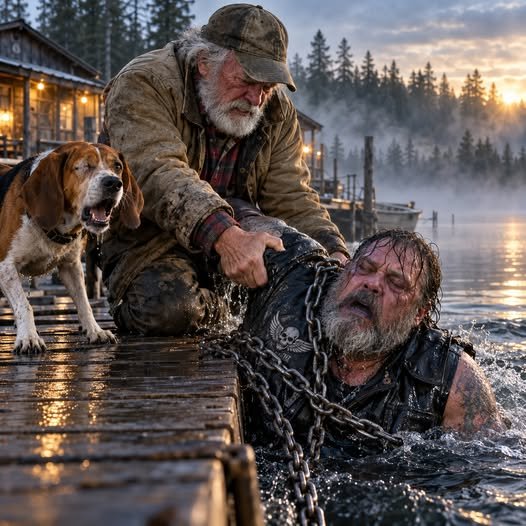
The dog started barking before Elias Boone ever saw the hand.
One second, North Pine Lake was nothing but fog and black water. The next, a man’s fingers broke the surface twenty feet from the dock, reached for nothing, and slipped under again. Wrapped around his chest was enough steel chain to drag a truck axle to the bottom.
Elias was seventy-one years old. His wife was three years gone. The bait shop she and he had built plank by plank was thirty days from the bank’s auction block. That morning he had figured the bank was the worst thing coming for him.
He was wrong.
His one-eyed hound, Roscoe, nearly threw himself off the dock, howling. Elias dropped his coffee, went flat on his stomach on the cold boards, and shoved both arms into the lake. The cold hurt like broken glass. His fingers found cloth. Then metal. Then a shoulder. He pulled until his back felt like it was tearing in two.
The man came over the edge hard. Big man, maybe fifty-five, gray in his beard, lips blue. Elias had no working phone. No ambulance close enough to matter. So he dragged the stranger inside Boone’s Bait and Marine, cut the chain off him with the old bolt cutters by the wood stove, stripped the soaked clothes away, and wrapped him in every blanket in the house.
That was when Elias saw the vest. Black leather. Red-and-white patch. A motorcycle club. The kind of colors folks in northern Wisconsin recognized even if they pretended they didn’t.
He stared for maybe two seconds. Then he went back to saving him. A drowning man doesn’t have a reputation. He has lungs.
The man woke near noon, coughing and shivering, and gave his name as Mason Vale. Everybody called him Rook. His club was hundreds of miles south, and he had ridden north on a mission: men were using his club’s name to frighten lakefront owners into selling cheap. A developer named Everett Shaw, owner of Shoreline Meridian Group, was buying up the shoreline through a hired thug named Ray Kessler, who had already visited Elias’s shop with a buyout offer and a smile that said everybody says no once.
Rook carried evidence that the recent fires, Carlson Marina and Maggie’s Lakeside Grill, were no accidents. Worse, Elias’s own loan note had been bought up by Lakefront Asset Services, handled by a man named Curtis Dean, who happened to play poker with Shaw every Thursday. Elias’s thirty days were not bad luck. They were a plan.
Rook asked for one thing: a dry jacket and the keys to his bike so he could get his proof to the county sheriff. Elias gave him coffee instead and told him to rest until his hands stopped shaking. Roscoe curled against the man’s leg and would not move.
That was when the trucks came. Three of them, pulling in hard, seven men, Ray Kessler in front with a red gasoline can sloshing in his hand. Kessler walked straight up the steps and started pouring gasoline across Elias’s porch, slow and easy, like he was watering plants. They hadn’t come to buy the shop. They had come to burn it. And this time they meant to make sure Elias was inside.
Elias stepped onto the porch with the bolt cutters in one hand. Rook dragged himself up behind him, barefoot, wrapped in one of Elias’s old quilts, standing on legs that barely held him. Kessler laughed. Then the sound rose up off the road.
It was not one engine. It was a dozen.
Every one of Kessler’s men turned pale. Because they knew that sound. A line of motorcycles came over the hill in formation, headlights burning through the morning haze, and at the front rode a man with a gray beard and a president’s patch, and right behind him rode two county sheriff’s cruisers, lights flashing. Rook had gotten a call out on the shop’s old landline while Kessler was monologuing, and his brothers had been less than an hour out, riding to find out why their man had gone silent.
Kessler dropped the gas can. One of his men reached for his waistband and thought better of it when every headlight in that line pinned him. The sheriff’s deputies moved in with cuffs while the bikers formed a quiet wall around the shop, engines idling, saying nothing at all. Sometimes the loudest thing a man can do is stand there.
Inside Kessler’s truck they found the rest of it: a ledger of payments from Shoreline Meridian Group, a list of properties, and matches that tied to the marina and the grill fires. Rook handed the sheriff his own folder, every page of it, the bank transfers, the Thursday poker photos, Dean’s signature on the note purchase. The sheriff took one look and said the state fire marshal and the attorney general’s office would want copies before supper.
Curtis Dean was arrested at his office that same afternoon, still holding a golf club. Everett Shaw was picked up at the airport two days later with a one-way ticket and a briefcase full of other people’s money. The scheme unraveled the way cheap rope does when you pull one strand, fast and all at once.
The fraud investigation voided the sale of Elias’s loan note. The bank that had sold it wanted no part of the mess, and in the end the original terms were restored, the foreclosure called off. Elias had thirty days of dread lifted off his chest in a single phone call, and he sat down on the porch steps and cried into Roscoe’s fur for a while.
The town did what small towns do. Folks who had been scared into silence started talking. The men who had torched Carlson Marina went down too, and the community raised money for the rebuilds. Somebody started a fund for Maggie’s Lakeside Grill, and the bikers, Rook’s whole club, rode in on a Saturday and spent two days swinging hammers and hauling lumber, and they wouldn’t take a dime for it.
Rook stayed at the shop for three weeks, sleeping on the cot in the back room, helping Elias restock shelves and patch the roof. He was quiet about the lake. Elias never asked him for the whole story of how he ended up in chains at the bottom of North Pine Lake. Some things a man tells you when he’s ready, and some things the lake keeps.
What Rook did say, one evening over coffee, was that his club had a rule about debts. A man who pulls you out of the water owns a piece of your life, and you pay it forward or you aren’t worth the patch. So when Elias’s old delivery truck finally died that winter, a flatbed showed up with a rebuilt pickup on it, no note attached. Elias knew anyway.
Spring came, and Boone’s Bait and Marine reopened with a fresh coat of paint and a new sign Elias carved himself. Half the county showed up for the reopening cookout. Rook rode in with twenty of his brothers, and they parked in a long shining row and ate hot dogs like regular folks, because that day they were.
Roscoe got a gift that afternoon. Rook knelt down, scratched the old hound behind his one good ear, and fastened a small patch onto his collar. It read HONORARY in red and white thread. Roscoe wore it like he’d earned it, which he had.
That fall, the state troopers sent Elias a letter thanking him for his help with the investigation. He framed it and hung it next to the newspaper clipping, though he never made a fuss about it. What mattered more to him was the way folks started stopping by the shop again — young fathers with kids asking about the dog in the vest patch, old-timers who’d known June buying coffee just to sit a spell. The bank note, cleared once the fraud came to light, was finally just paper in a drawer instead of a weight on his chest.
Elias still opens the shop every morning at six. Rook still rides north whenever the road allows, and there’s a stool by the wood stove with his name carved into it. Folks who come in for minnows sometimes ask about the framed newspaper clipping on the wall, the one about the developer and the fires and the arrests. Elias just smiles and says the lake gives back what you put into it.
He knows something now he didn’t know that foggy morning. The bank wasn’t the worst thing coming for him. The best thing was. It just arrived wearing chains, half-drowned, needing a blanket and a second chance. And all it ever asked of Elias Boone was the one thing he’d never run out of: a warm place by the fire, and a hand reaching back.


