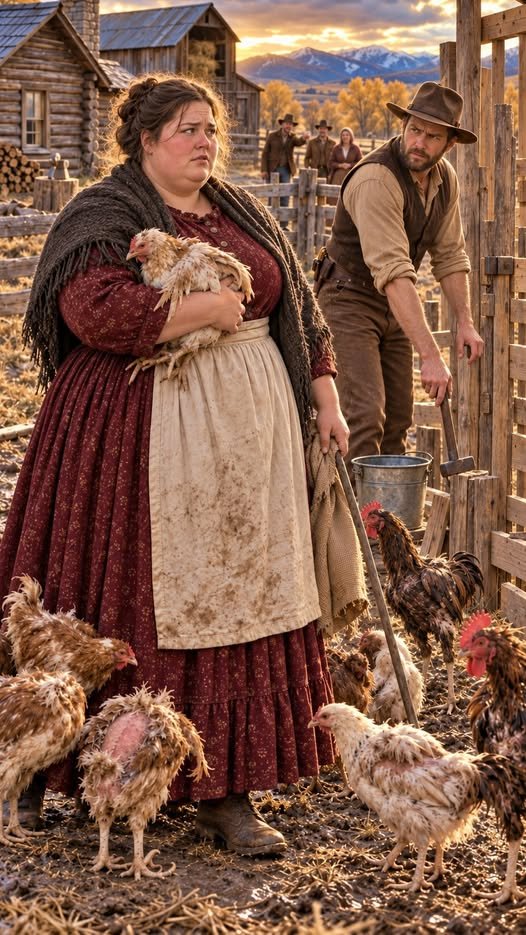
Milhaven laughed. The sound of it followed the broad, heavy-set homesteader woman all the way up the road that autumn afternoon in 1878, ringing out from wagons and porches while she herded eleven of the sorriest chickens Wyoming had ever seen toward her little cabin north of Clearwater Creek.
By then, she had learned that being poor and being a large woman on the frontier gave strangers twice as many reasons to underestimate her. She was thirty-one years old, big-boned and powerful, with thick arms and wide hips and legs made strong by years of hauling water, splitting kindling, and working her claim side by side with her husband. The women of Milhaven whispered about how much flour a woman her size must go through. The men joked that she needed a reinforced wagon bench. She had stopped answering them years ago. Answers were for people who were listening, and nobody was listening.
Her husband was thirty-four, a quiet man who had come home from the war missing two fingers on his left hand and carrying memories he almost never spoke of. Together they had claimed a patch of hard, beautiful country. They owned a cabin. A barn. A stubborn fence that leaned no matter how often he straightened it. And exactly twelve cents.
Twelve cents. That was the whole of their fortune when word came that old Harkin, three miles down the road, wanted eleven chickens gone before the cold set in. Nobody wanted those birds. Crooked feet. Missing feathers. Two half-starved roosters that fought everything that moved. One hen dragging a wing that hung wrong. They were, by every measure anyone in the county applied, worthless.
Milhaven stood in Harkin’s yard and looked at those eleven miserable creatures for a long time. Then she opened her cracked coin purse and counted out her twelve cents, every coin she had in the world. Harkin stared at the money. “Twelve cents?” he said. “All of them,” she said. He laughed. Then he took the money, because nobody else was offering anything at all.
By the time she had herded that ragged flock the three miles home, the whole road knew about it. Delbert Marsh shouted from his wagon as she passed, “Looks like somebody bought the ugliest supper in Wyoming!” Laughter rolled after her up the road. She kept walking, her skirts brushing the dust, the chickens straggling around her in a ragged parade.
Her husband stepped out of the cabin when he saw the flock circling her. He stared. “Twelve cents?” he said. “All of it,” she said. He looked at the half-finished pen. “The pen isn’t finished.” “I know.” “Cold front tonight.” “I know that too.” She waited for the anger, the reproach, the words she had heard other husbands say. Instead he picked up his hammer. “Then we’d better finish it.”
That night, by lamplight, they worked together. They spread warm stove ash beneath the lean-to for bedding, because ash keeps the cold from rising through the floor, something Milhaven’s mother had taught her long ago. They mixed corn mash, soft and warm. They gathered prairie thyme from the hillside and steeped it strong. And with hands gentler than anyone who laughed at her would have believed she possessed, Milhaven wrapped the injured hen’s wing in clean cloth, snug but not tight, and set the bird down where it was warm.
Near midnight, her husband stood at the window and studied the ridiculous flock settling into the lean-to, and he said, very quietly, “What happens if they live?” Milhaven looked at the eleven creatures the whole county had already written off. “I don’t know,” she said. And then she smiled, a small, private smile. “But I’d like to find out.”
The days that followed were an education in patience. She fed them warm mash twice a day and kept their water from freezing. She changed the ash bedding. She unwrapped the hen’s wing each morning to check the healing and wrapped it again. She talked to them while she worked, the way lonely people do, telling them about the garden she meant to plant and the winter coming down from the mountains. Her husband, without being asked, built a windbreak of pine boughs along the pen’s north side and fitted a low roost from a cottonwood limb.
Slowly, almost invisibly, things changed. The hen’s wing straightened. Feathers began to fill in on bare backs, first as pinpricks, then as soft new plumage. The roosters stopped fighting and started strutting. Legs that had been crooked stayed crooked, but the birds learned to move sure-footed anyway, the way living things do when somebody gives them a chance.
Then winter came down hard, the kind of Wyoming winter that kills the careless. And in the depth of that cold, something remarkable happened: the hens began to lay. Eggs in January. Eggs when no one else in the county had a single one. Milhaven gathered them each morning with cold-reddened hands, marveling, and her husband shook his head and said it beat anything he had seen in the war or out of it.
Word travels fast in a hungry winter. It started with a knock on the door. Delbert Marsh’s wife stood on the step, the same Delbert who had shouted about the ugliest supper in Wyoming, and her face was tight with embarrassment. Her youngest was sickly, she said, and the doctor had said eggs, fresh eggs, and there were none to be had anywhere. Could she buy some? Milhaven sold her a dozen for less than they were worth and sent her home with a jar of prairie thyme steeped in lard for the child’s chest. The child got better. Milhaven never mentioned it again, but Delbert’s wife did, to everyone.
By spring the flock was unrecognizable. Eleven healthy birds, glossy and alert, the hen with the once-broken wing leading her own brood of chicks across the yard like a general. The roosters crowed the sun up every morning. And the eggs kept coming, big and rich-yolked, the kind of eggs that made biscuits taste like a celebration.
That was when the wagons started stopping outside her gate. First one, then three, then a line on Saturdays. Men argued over places in line. Women who had whispered about her flour barrel now asked, humbly, what she fed them, how she had done it. And Milhaven, who had stopped answering people years ago, found that she did not mind answering now, because the questions had changed. She told them about the ash and the warm mash and the thyme. She told them what her mother had taught her and what the birds had taught her. She held nothing back. Knowledge, she had decided, was the one thing that multiplied when you gave it away.
Old Harkin came too, hat in his hands, and offered to buy the flock back for ten times what she had paid. Milhaven looked at him kindly and shook her head. “They’re not for sale,” she said. “But I’ll sell you pullets in the fall, and I’ll tell you exactly how to raise them.” Harkin took the pullets that autumn, and the next spring his own hens were laying through the cold, and he told the story at the trading post with a shake of his head, like a man describing a miracle he had witnessed with his own eyes.
The twelve cents became seed corn. The seed corn became a garden that fed them through the next winter. The egg money paid the store account down to nothing and bought her husband a new coat, the first he had owned since the war. The pullet money bought lumber, and the leaning fence finally stood straight.
Nobody in Milhaven laughed anymore. The whispers changed their tune. “That woman knows chickens,” people said, with respect. “That woman knows more than she lets on.” The men who had joked about her wagon bench now tipped their hats when she passed, and Delbert Marsh, to his eternal credit, was the first to do it, and the heartiest.
Years later, when the homestead had grown into one of the finest small farms in the county, with an orchard and a whitewashed barn and grandchildren underfoot, Milhaven would sit on her porch in the evenings and watch her hens come home to roost. Her husband would sit beside her, his gray head bent over his whittling, and sometimes she would think back to that autumn afternoon, the laughter on the road, the eleven ragged birds straggling around her skirts.
People had thought she was a fool to spend her last twelve cents on creatures nobody wanted. What they never understood was that she had not bought chickens that day. She had bought the one thing no one could take from her: the chance to find out what would happen if somebody simply refused to give up.
And what happened was this. The crippled birds lived. The laughed-at woman thrived. And Milhaven, Wyoming, learned that the most underestimated person in the room is very often the one who knows exactly what she is doing.


