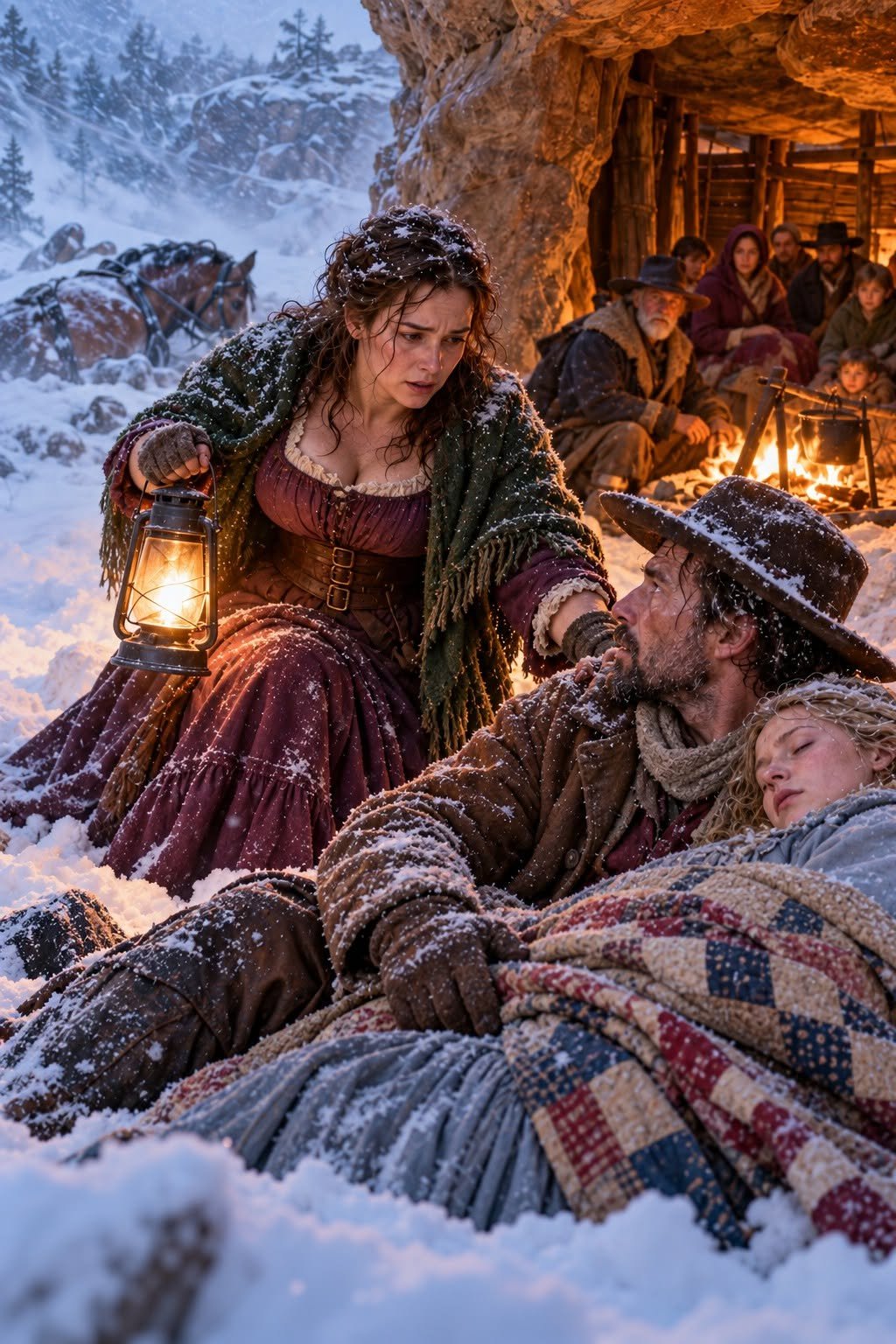
Montana Territory, November 1886. When Walter Calder threw his widowed sister-in-law Ruth out of her cabin just before a killing blizzard, he thought he was taking everything from her. Instead, she built something no deed could ever steal — a shelter that became the only warm refuge for thirteen stranded souls, including, in the storm’s darkest hour, the very people who had cast her out.
“Leave before the snow starts.”
Ruth Calder carried those five words with her as she walked into the white curtain of the coming blizzard, clutching everything she was allowed to take: one spare dress, a sack of cornmeal, three strips of dried venison, a hunting knife, and the iron fire poker her husband Thomas had forged their first winter together. Behind her, the door of her own cabin closed — closed by her brother-in-law Walter, at the insistence of his wife Margaret, who held up a folded document and declared the claim now belonged to Walter. “The papers are perfectly clear,” Margaret had said.
They were not. But Ruth would learn that later.
Three miles northwest, beyond a dry creek bed, a wall of red sandstone rose above the prairie. Ruth remembered sheltering there with Thomas during an autumn rainstorm years before — how quiet the cave had been while the rain lashed outside. If she could reach it, she might live. She reached it with numb fingers and trembling legs, and then she did what Thomas had always said she could do: she figured out how to keep the cold on the other side.
The first fire smoked her out. The second try taught her the cave’s secret — a thin crack in the sandstone above a natural shelf that drew smoke upward like a chimney. Nature had already built the one thing she couldn’t. Ruth boarded up the entrance with planks scavenged from a collapsed sheep shed, built the fire beneath the crack, and watched warmth spread across the stone. She had no cabin, no bed, almost no food. But she had a home.
Then came Samuel Briggs, his cabin storm-damaged, his sled loaded with dry boards and supplies. Ruth made her terms plain: nobody eats without helping. Together they braced timber and widened the sleeping area, and the cave grew warmer than either had imagined. Then the blizzard truly arrived, and through the whiteness came a woman carrying a small boy, then an overturned wagon’s passengers, then neighbors who had lost their roofs, two elderly sisters who followed the smoke through the storm, a ranch hand whose horse had bolted. By the following afternoon, thirteen people sat beside Ruth’s fire.
Thirteen people needed warmth. Thirteen needed food. And Samuel’s firewood might last only two more days. Ruth stood by the dwindling pile and said what no one wanted to say: “Then we find more wood.” Samuel warned her the storm would kill anyone who tried. Then a rifle shot cracked through the blizzard — a distress signal — and Ruth was already fastening a rope around her waist. “You stay and keep the fire alive,” she ordered. “I know these cliffs.”
She found the horse first, motionless beside a drift. Then a man kneeling in the snow, clutching a rifle, and an unconscious woman beside him. The lantern light revealed the frost-covered face, and Ruth stopped breathing. Walter Calder. The man who had thrown her out. The unconscious woman was Margaret.
“Please,” Walter whispered. “It’s Margaret. She’ll die out here unless you save her.”
Ruth stood there in the screaming wind, the rope cutting into her waist, and felt every moment of that morning on the porch come flooding back — the door closing, the snow starting, the papers Margaret had clutched like a royal decree. It would have been so easy to leave them. The storm would have done the rest, and no one would ever have known what choice she made in the dark.
She reached down and grabbed Margaret’s coat collar instead. “Help me carry her,” she shouted. “You lift, I guide the rope.”
The truth Ruth had learned long before that night, at Thomas’s bedside four months earlier, was simple: you cannot build a life on top of someone’s grave, and you cannot protect one with cruelty. Thomas had spent his last weeks writing letters, settling debts, and signing papers — real papers — at the territory land office in Helena. Ruth had carried them home in a tin box she kept under the floorboards. She had never opened it. She had been too busy grieving.
But Walter did not know about the tin box. When the clerk at Helena told Ruth, years later, how it all happened, the story came out plain: Walter had ridden to the land office with a document bearing what looked like Thomas’s signature and filed it the week after the funeral. Margaret had rehearsed the words “the papers are perfectly clear” the way other people rehearse hymns. What they didn’t know was that Thomas had filed the true deed first — signed, witnessed, and recorded — with Ruth’s name written beside his in the clerk’s careful hand.
All of that lay in the future, though. That night on the ridge, Ruth only knew that two people would die in the snow if she walked away, and that she had built a cave to keep people alive, not to watch them freeze.
“Drag her feet-first,” she ordered Walter. “Stay on the rope. Don’t stop for anything.”
They made the cave mouth just as Margaret’s breathing turned shallow. Inside, thirteen faces turned toward them in the firelight, and a silence fell that Ruth would remember for the rest of her life. The woman who had demanded she leave before the snow started was laid on the warmest blanket, beside the fire Ruth had built with her own hands.
Ruth went to work. She had no doctor’s training, but she had nursed Thomas through his final winter, and she knew what cold does to a body. She wrapped Margaret in blankets warmed by the fire, rubbed warmth into her hands and feet, and spooned hot broth between her lips drop by drop. Samuel watched her and said nothing, but later he would tell people it was the finest thing he ever witnessed — a woman saving the life of the woman who had taken her home.
For three days, Margaret hovered between living and dying, and Walter sat beside her without sleeping, his face hollow with something beyond frostbite. On the fourth morning, Margaret opened her eyes. The first thing she saw was Ruth, asleep sitting up against the sandstone wall, the iron poker still in her hand like a sentry. Margaret stared for a long time. Then she began to cry — not the tears of the woman who had clutched a document like a decree, but something quieter and older.
“I told him the papers were clear,” she whispered to Walter, when Ruth had stepped outside. “I told him Thomas would have wanted him to have it. I made him believe it.”
Walter’s voice was raw. “You said the signature—”
“I traced it,” Margaret said. “From one of Thomas’s letters. I practiced it for a week.” The confession came out in a rush, the way water breaks through a dam. “I was afraid, Walter. Afraid we’d lose everything in this country. Afraid we’d end up with nothing.”
She didn’t know Ruth had returned to the cave mouth and heard every word.
The storm broke on the sixth day. Blue sky poured over the white prairie like a held breath finally released. The thirteen — no, fifteen, with Walter and Margaret — emerged blinking into the glare, and one by one they set out for their homes, their ranches, their lives. The two elderly sisters pressed a silver locket into Ruth’s hand. The boy’s mother wept on her shoulder. The ranch hand promised her a saddle horse in the spring. Samuel Briggs stayed until the last traveler was gone.
“What will you do now?” he asked her.
Ruth looked at the cave — at the boarded entrance, the blackened chimney crack, the worn hollow where fifteen people had slept shoulder to shoulder. “I’ll go home,” she said.
Walter met her at the cabin door. He looked twenty years older than the man who had opened it to throw her out. “Ruth,” he said, “before you say anything — Margaret told me. About the papers. About the signature.” He held out the folded document, creased and soft from his pocket. “I burned the copy I filed. Or I will. Whatever you want done.”
Ruth took the document and, without unfolding it, dropped it into the fireplace Thomas had built. They watched it burn together.
Then Ruth went to the floorboards, pried up the loose plank, and lifted out the tin box. Inside were Thomas’s letters, his debts settled in full, and the true deed — recorded at the Helena land office, witnessed, legal, bearing Ruth’s name beside his. She laid it on the table where they had shared their meals.
Walter stared at it for a long time. “Thomas thought of everything,” he said quietly.
“He thought of you too,” Ruth said. And she told him what Thomas had said in his final week, when the fever had him and he talked the way dying men do — plainly. He had worried about Walter. He had said his brother was a good man being steered by fear, and that fear makes thieves of honest men. “He asked me to look after you,” Ruth said. “Both of you. If you ever needed it.”
Walter put his head in his hands. Margaret, standing in the doorway where she had once stood so certain, made a small sound like something breaking and mending at once.
Justice, in the Montana Territory of 1886, could have meant a great many things. Ruth could have ridden to Helena and had them both charged with fraud. She could have thrown them out into the snow the way they had thrown her out, and no jury in the territory would have blamed her. She thought about it — honestly, she did — on the long walk back from the creek that evening, with the poker in her hand and the cold settling in.
Instead, she made them a different offer.
“Here’s what’s going to happen,” she said, standing in the cabin that was hers by law and by labor. “You’re going to work. There’s a cave three miles northwest that needs to be a real waystation — timbered proper, stocked with food and blankets, so the next storm doesn’t nearly kill fifteen people. Samuel Briggs will show you how. You’ll build it, and you’ll maintain it, and every traveler who shelters there will know it was built by two people making amends.”
Walter looked up. “And then?”
“And then you can hold your heads up,” Ruth said. “The land office will get a letter from me saying the filing was a misunderstanding, corrected by the family. No charges. But understand this — the claim is mine. It was always mine. If you ever touch a paper of mine again, Margaret, I’ll ride to Helena myself.”
Margaret nodded, tears running down her face. “The cave,” she whispered. “We’ll build it well.”
And they did. By spring, the sandstone hollow had a proper timbered entrance, bunks along the walls, a stone chimney cut to replace the crack, and a cache of flour, beans, and blankets that Samuel kept stocked. Travelers called it Calder’s Rest. Nobody who slept there ever knew the whole story — only that it was warm, and dry, and free, and that a widow named Ruth had started it with her own two hands.
As for Ruth — she kept the cabin, the claim, and the life she and Thomas had built board by board. Samuel Briggs, who knew how to brace timber and how to keep quiet when it mattered, began stopping by on Sundays. He never rushed her. He just brought coffee, and mended the roof, and sat with her on the porch in the evenings, and in time — a good deal of time — Ruth found that the house Thomas had told her wasn’t four walls had room in it for laughter again.
Years later, when people in the valley told the story of the blizzard of ’86, they told it the way true stories get told: with the edges worn smooth and the heart of it shining through. They told of the widow who was thrown out before the snow, who turned a cave into a haven, who saved thirteen lives — and the two more that mattered most, the ones who had wronged her, and whom she chose, in the dark on a frozen ridge, to carry home.
Ruth never called it forgiveness. When Samuel asked her once, years after, why she hadn’t let the storm take them, she looked out at the prairie and said simply: “Because I knew how to keep the cold on the other side. And I wasn’t going to let it in — not into the cave, and not into me.”