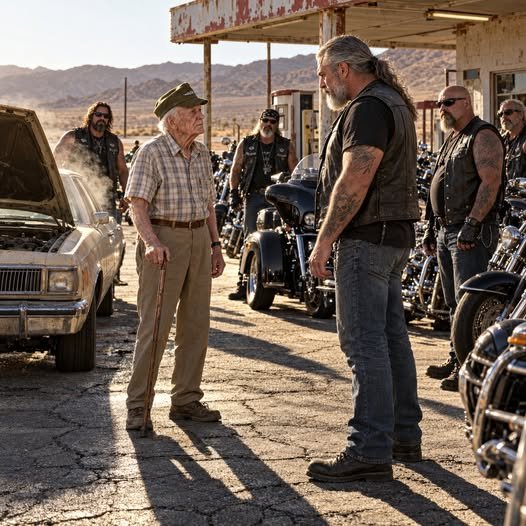
The July sun sat low over the Nevada desert, but it gave no mercy. One hundred eleven degrees, the radio said, and Leonard “Len” Harper believed every degree of it. The air conditioning in his old Mercury Grand Marquis had given up somewhere past the county line, and the vinyl seat burned through his shirt as he drove, both hands on the wheel, eyes fixed on the shimmering ribbon of highway ahead.
He was eighty-two years old, a Vietnam veteran of the First Cavalry, and he was driving to Las Vegas to say goodbye.
His friend Daniel Reeves was dying at Silver Pines Hospice. Cancer, the kind that did not negotiate. The nurses had told Daniel’s daughter that it would be days, maybe hours. When Len got the call, he did not hesitate. He packed a small bag, pinned his Combat Infantryman Badge to his shirt the way he had done every Veterans Day for fifty years, and pointed the Mercury east across the desert.
Fifty-nine years earlier, in a rice paddy outside a village whose name he could no longer pronounce, Daniel Reeves had dragged Len through enemy gunfire and saved his life. They had made a promise that day, blood and mud and shaking hands: if one of us goes first, the other one shows up.
Len was going to show up.
Forty-seven miles short of Las Vegas, the Mercury coughed, shuddered, and died. Steam poured from under the hood as Len coasted the old sedan into a rundown gas station that looked like it had been forgotten sometime in the seventies. He sat there for a moment, hands still on the wheel, and felt something he had not felt in a very long time. Helplessness.
Then he heard the engines.
Thirty of them. Big, rumbling V-twins, lined up in the heat like a wall of thunder. The Red Mesa Riders. Thirty men and women in leather vests and sun-faded bandanas, boots on the cracked pavement, watching the old man climb out of his dead car.
Their president walked over first. A big man with gray in his beard and kindness in his eyes. His name was Wade Kincaid.
Wade looked at Len’s shirt, at the blue Combat Infantryman Badge pinned over his heart, and something changed in his face. His own father had served in the First Cav. His father had died in Vietnam in 1967, when Wade was just a boy.
“Sir,” Wade said quietly, “my dad wore that same badge.”
Len told him where he was going and why, and how far he still had to be. He told him about Daniel, about the promise made in a rice paddy fifty-nine years ago. Wade listened without interrupting, the way men who understand war listen to each other.
Then Wade turned to his riders and said, “We’re taking this man to Las Vegas.”
What happened next, Len would tell people for the rest of his life, and nobody would ever quite believe it.
They put Len on the back of a three-wheel touring bike, settled him in like he was made of glass, and handed him a spare helmet. Thirty engines roared to life at once, and the sound rolled across the desert like a storm coming. A tow truck was called for the Mercury. The Red Mesa Riders formed a column around Len, two by two, and they rode.
Eighty-two years old, on the back of a motorcycle, with thirty bikers around him and the desert wind in his face. Len laughed out loud. He could not help it. For the first time since the phone call about Daniel, he felt something other than grief. He felt carried.
The sun dropped lower, painting the mountains purple and gold. Traffic on the highway parted for them the way water parts for a ship. Drivers slowed and stared. A trucker leaned on his horn, not in anger but in salute, his fist raised out the window. Children pressed their faces to car windows. Nobody had ever seen anything like it, and nobody ever would again.
They thundered into Las Vegas as the neon was waking up, thirty headlights blazing down the boulevard, and rolled up to the quiet entrance of Silver Pines Hospice. The sound of those engines dying, one by one, was the gentlest silence Len had ever heard.
Wade walked him to the door. “Go on, sir,” he said. “We’ll be right here.”
Inside, the air was cool and soft with the smell of flowers. A nurse led Len down a quiet hallway, past rooms where families sat holding hands, past a window where the last of the daylight was fading. She stopped at a door and touched his arm.
“He’s been asking for you,” she whispered. “We didn’t know if you’d make it.”
Daniel Reeves lay in the bed, thin as a shadow, his breathing shallow. His eyes were closed. Len pulled a chair close, took his old friend’s hand in both of his, and said the words he had driven four hundred miles to say.
“I’m here, Daniel. I showed up.”
And Daniel opened his eyes.
The nurse later said it was the medication wearing off, or a final surge of strength, or one of those mysteries that medicine cannot explain. But everyone in that room knew what it really was. Daniel had been waiting. He had held on, past pain and past reason, because he knew Len was coming.
“Lenny,” Daniel whispered, and smiled. “You look terrible.”
They laughed, both of them, the way only old soldiers can laugh at the edge of the grave. And then they talked. They talked about the rice paddy and the gunfire, about the boys who never came home, about Daniel’s daughter and Len’s grandchildren. Daniel asked about the Mercury, and Len told him about the thirty bikers, and Daniel laughed until he coughed, and said that was the most Len thing he had ever heard.
“I kept my promise,” Len said, his voice breaking. “You carried me then. I carried you now.”
“You carried me the whole way, brother,” Daniel said. “All fifty-nine years.”
Outside, in the parking lot, the Red Mesa Riders stood in a loose circle in the warm Nevada night. Hospice staff came out with cups of coffee. Families from other rooms came out too, drawn by the rumble that had shaken the building, and when they heard why the bikers had come, some of them wept. One woman, whose own father was dying upstairs, hugged Wade Kincaid and would not let go.
Wade told them about his father, about the First Cav, about the badge. He said he had been a boy when the telegram came in 1967, and he had spent his whole life wondering what kind of men his father had served beside. “Tonight,” he said, “I found out.”
Just before midnight, Daniel Reeves squeezed Len’s hand once, smiled like a man who had finally been given permission to rest, and slipped away peacefully. Len sat with him for a long time afterward, holding his hand, telling him it was all right to go. The promise was kept. The debt was paid. The brother was home.
When Len finally walked out into the parking lot, the riders were still there. Every one of them. Nobody had left.
Wade put a hand on Len’s shoulder. “I’m sorry, sir.”
Len nodded. He could not speak yet. He did not need to. Wade understood.
They would not let him drive home alone. That was decided without a single word of discussion. The Mercury was already on its way to a shop in town, where one of the riders’ cousins would rebuild the engine at cost and refuse, absolutely refuse, to take a penny for the labor. In the morning, two of the riders would drive Len home themselves, and the rest would ride alongside, because that was simply what you did.
But that night, they stayed. Someone produced sandwiches. Someone else found folding chairs. The hospice staff brought out blankets. And under the wide desert sky, with the lights of Las Vegas glowing on the horizon, thirty bikers and one eighty-two-year-old veteran sat together and told stories until dawn.
Len told them about Daniel carrying him through the gunfire. Wade told them about his father. A rider named Rosa talked about her brother, who served two tours and came home different. A quiet man called Preacher, who had been a medic, talked about the ones he could not save. Nobody rushed. Nobody looked at a watch. Grief was honored there that night, in the open air, the way it should be.
Before they parted, Wade gave Len a Red Mesa Riders patch. Not a full member’s patch — Len laughed and said he was a little old for prospecting — but an honorary one, stitched with the words “Brother of the Road.” Len pinned it next to his Combat Infantryman Badge, and the riders cheered.
He keeps his promise still.
Every year, on the anniversary of Daniel’s passing, Len rides on the back of Wade’s three-wheeler at the head of a column of Red Mesa Riders, and they make the trip to the veterans’ cemetery where Daniel Reeves rests. They stand at the headstone, thirty engines silent, and Len tells Daniel about the year. About the grandchildren. About the Mercury, still running. About the road.
And every year, Wade stands beside him, the son of a First Cav soldier standing with the men his father served beside, the circle finally closed after all these years.
Daniel Reeves carried Len Harper through gunfire in 1967. Fifty-nine years later, thirty strangers carried Len across the desert so he could hold his friend’s hand at the end. That is what brotherhood is. It does not end at the grave. It does not end with the war. It rides on, engine after engine, heart after heart, as long as there is someone left to show up.
Len showed up. And he was not alone.


