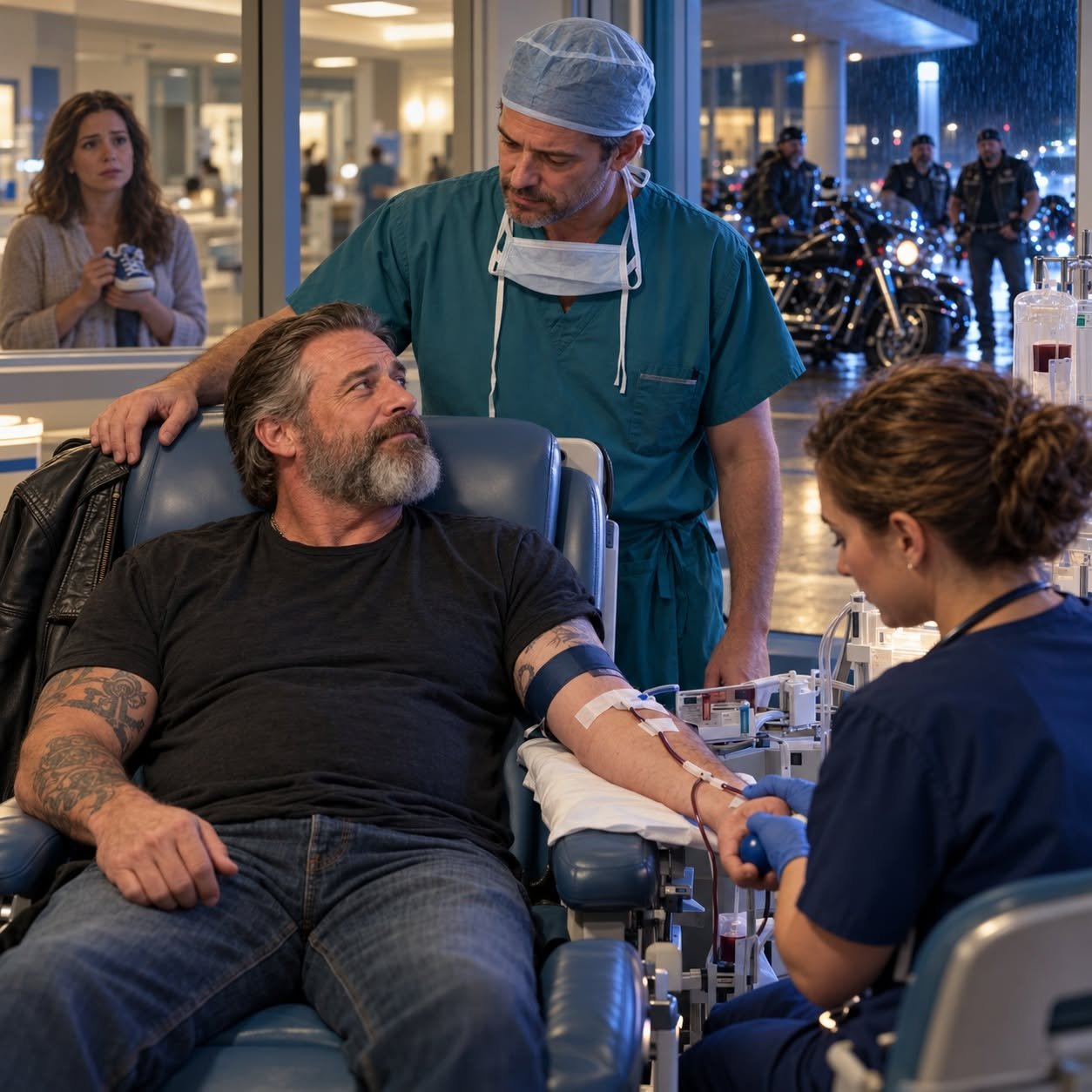
It was the kind of night Westhaven Medical Center would talk about for years — not because of the highway pileup that had flooded the emergency department, but because of the thunder that came after it: a thunder of motorcycle engines, rolling into the hospital parking lot on a mission no one expected.
The man who started it was Daniel Keane, a leather-clad biker most people would have crossed the street to avoid. And the man who called him was Dr. Andrew Mercer, the trauma surgeon who had saved Daniel’s life five years earlier — a debt Daniel had never forgotten, and was about to repay in a way no one could have predicted.
It began with a seven-year-old boy named Ben Walker.
Ben wasn’t supposed to be at the hospital that night. He had simply been crossing the street to Mrs. Ellis’s apartment — she watched him when his mother, Julia, worked her evening shift. A car struck him and kept going, leaving behind nothing but a blue sneaker with a strip of reflective silver across the heel, which Julia clutched in her hand as she stood in the emergency department, explaining over and over that her son wasn’t part of the interstate crash, as if somebody might otherwise put him in the wrong line.
Ben needed surgery urgently. But there was a problem far harder than the surgery itself: his blood.
Ben carried a rare blood profile — one of those cases where ordinary blood-type labels don’t tell the whole story. Matching him safely meant accounting for additional factors that very few donors carry. The hospital had some compatible units on hand, and more were being rushed upstairs. The regional blood center was searching its wider network and arranging transport from a specialist reserve hundreds of miles away. They could begin.
But nobody could promise the next supply would arrive before Ben needed it.
Dr. Mercer knew exactly how thin the margin was. He also knew a name.
Five years earlier, Daniel Keane had arrived at Westhaven after a roadside shooting, and Mercer had operated through the night to save him. During Daniel’s long recovery, testing identified his unusual blood profile, and the blood center had asked whether he would join its rare-donor program. He agreed. And before discharge, he gave Mercer a telephone number.
“If you ever need somebody to show up,” he said, “try that one.”
Mercer put the number in his phone. Then forgot it was there.
Now, standing outside the operating suite with a child bleeding on the table, Mercer dialed a number he had not thought of in half a decade. The blood center couldn’t reach Daniel on his listed number — but Mercer’s phone had a different one.
Daniel answered on the third ring. No greeting beyond a rough, “Yeah?”
Mercer told him who he was. A pause. Then: “I remember you.”
Then Mercer explained about Ben — a seven-year-old boy, a rare profile, a hospital running out of options. He made no promises that Daniel would be eligible to donate that night; that decision belonged to the blood collection team. They just needed to assess him.
Daniel asked one question: “How soon do you need me?”
“I’m coming,” he said. “What’s the kid’s name?” “Ben.” “All right.”
Then he hung up — and did something Dr. Mercer had never asked him to do. Daniel Keane led the Blue Ridge Riders, a motorcycle club with members across several counties. And when Daniel called for help, he didn’t call one friend. He called everyone.
A handful of riders became several dozen. Then more. They offered blood, transportation, contacts — anything useful. Messages traveled faster than the rain.
But nobody had explained the purpose of the gathering to the police captain managing traffic outside a crowded emergency department. By the time the first motorcycles entered the hospital grounds, security was preparing to restrict access. Officers took up positions at the doors. The administrator called Mercer in the operating room: was this connected to patients already here?
“They’re responding to our request,” Mercer said. “I’ve told them.” “Tell them again.”
He couldn’t leave Ben. His colleague couldn’t leave either. So their charge nurse, Denise, went downstairs with the donor coordinator — and what she walked into is now part of hospital legend. Daniel stopped where an officer directed him. Removed his helmet. Held up his donor identification. Behind him, rain ran from leather jackets onto the pavement.
He didn’t move closer. He simply pointed toward the hospital.
“Somebody called me about a boy.”
The coordinator confirmed his name. They let him through.
For the first time that night, Dr. Mercer felt something loosen inside his chest.
Then the blood bank physician called the operating room with news that tightened it again. Daniel had passed the initial assessment — but one donation would not cover what Ben was likely to need. And the distant supply from the specialist reserve was delayed by the same weather and highway closures that were filling the emergency department. Mercer looked at the clock. Then at the child on the table.
The man he had called had come. And it still might not be enough.
That was when Mercer asked those men for one more miracle.
He didn’t go downstairs himself — he couldn’t leave the operating room. But he asked the blood center to walk the line of waiting riders with a request: anyone willing to be tested for the rare profile Ben needed should step forward. Not a guarantee, not a promise — just a chance.
No one hesitated.
One by one, men and women who had been waved at the doors as a potential threat sat in donor chairs and rolled up their sleeves. Some gave blood that night to be banked for others. And a few — a small, improbable few — turned out to carry the same unusual profile that made Ben so hard to match.
It was the kind of luck you don’t plan for: rare-donor profiles cluster in families and, sometimes, in the tight-knit communities that keep the same habits, the same company, the same loyalty for decades. The Blue Ridge Riders had ridden together for years. A handful of them shared more than a patch on their jackets.
By the time the operating team called for more blood, it was coming down the elevator — fresh from donors who had arrived on Harleys, escorted past security by a police captain who now stood at the donor entrance personally waving riders through.
In the operating room, the numbers steadied. The bleeding was controlled. And in the waiting room down the hall, Julia Walker held her son’s blue sneaker and watched the monitors with eyes that had not blinked in hours.
The surgery succeeded. Ben stabilized. And by morning, when the distant reserve shipment finally arrived, it sat unopened in the blood bank — the reserve that had crossed a state line in the rain was no longer needed, because a parking lot full of strangers had already given everything a little boy could need.
Julia met Daniel Keane in the corridor outside the pediatric ICU that morning. He was still in his rain-darkened leather, helmet under his arm, and he looked — by every account — like the last man on earth a frightened mother would expect to thank.
She thanked him anyway. Through tears, holding his hand in both of hers, she told him her boy was alive.
Daniel didn’t say much. People who were there say he nodded, looked down at the floor, and said, “Your boy’s a fighter, ma’am. We just showed up.”
But the story didn’t end in that corridor.
In the weeks that followed, something unexpected happened at Westhaven Medical Center. The Blue Ridge Riders signed up — all of them — as regular donors in the rare-donor program. The blood center, stunned by the discovery, set up a permanent screening station at the club’s annual rally. Hospital staff who had watched security footage of that rainy night started a tradition: whenever a trauma case needed blood that was hard to find, somebody would say, “Call the riders.”
The police captain who had nearly turned them away wrote Daniel a letter. He kept it framed in the clubhouse.
And Dr. Andrew Mercer — who had saved Daniel Keane’s life five years earlier, never knowing that the life he saved would one day save a child’s — says he learned something that night about debts, and about the people the world is quickest to judge.
“Every life I save is a seed,” he told a reporter months later, standing in the parking lot where the riders had gathered. “That night, I found out what one of those seeds had grown into. And it looked like thunder.”
Ben Walker went home two weeks later, wearing a new pair of blue sneakers — with reflective silver strips across the heels, chosen by his mother. On his first evening home, Julia says, he asked about the motorcycles.
“Mom,” he said, “did the bikers really come for me?”
“They did, baby,” she told him. “They really did.”
Somewhere across the county, engines rumble down the highway on a Saturday afternoon — dozens of riders in formation, patches catching the sun. They ride for the road, the way they always have. But now they ride for something else, too.
They ride for Ben. And for every child waiting on the other side of a phone call that begins, five years later, with: “How soon do you need me?”

