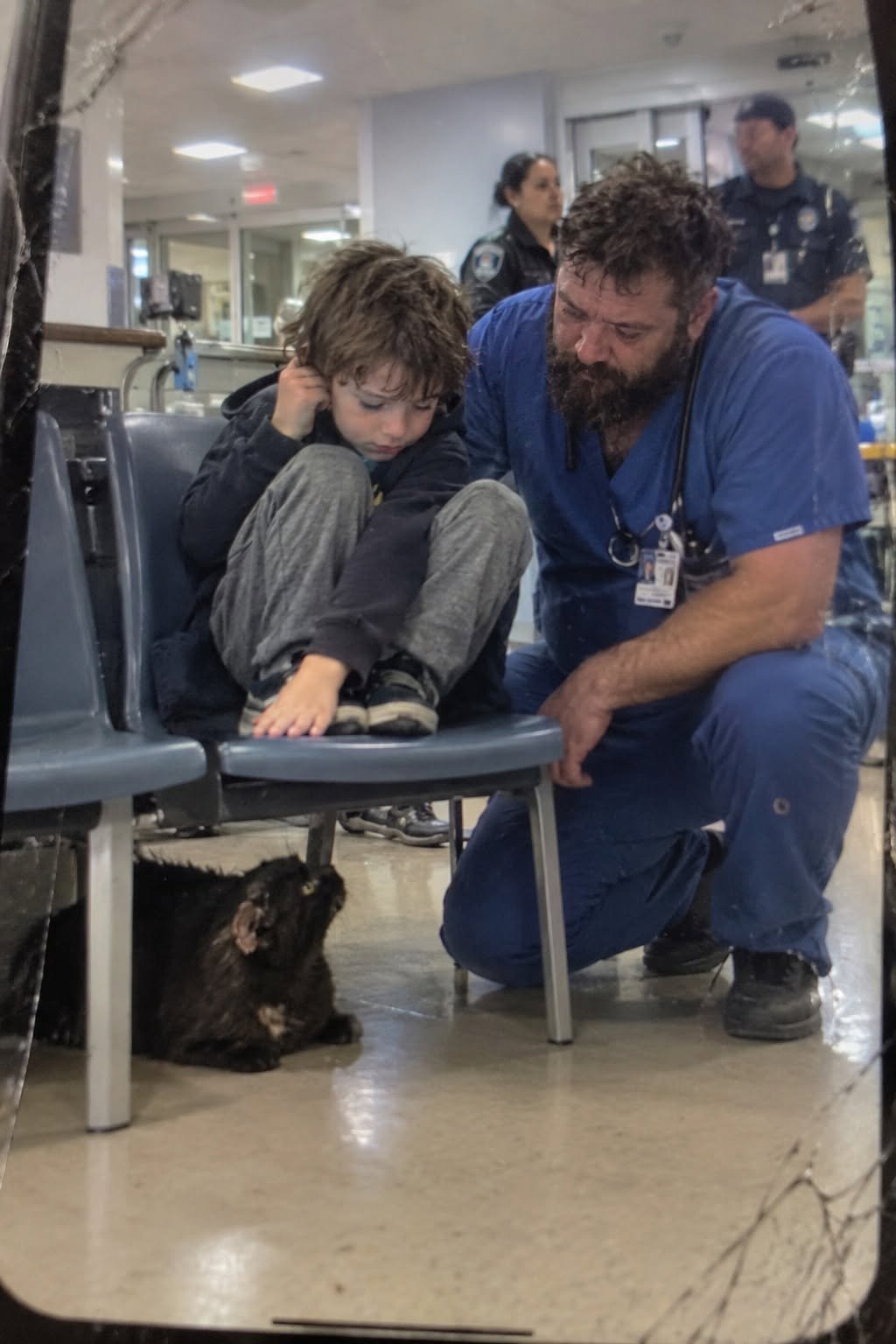
The hospital social worker tried to drag the screaming 9-year-old boy to an emergency shelter, until a scarred feral cat and an exhausted ER nurse did the unthinkable.
“We’re done. He breaks everything. He’s your problem now.”
The woman slammed a crumpled piece of paper onto the triage desk, turned on her heel, and marched out the emergency room doors into the freezing night. She didn’t even look back at the nine-year-old boy shivering in the plastic waiting chair.
The paper was a medical release form. The boy, Leo, had just been abandoned by his fifth foster family.
The emergency room at 2 AM is a sensory nightmare. The harsh fluorescent lights buzzed loudly, sirens blared outside, and medical carts crashed against the walls. For anyone, it’s stressful. For a child with severe autism and sensory processing issues, it’s sheer torture.
Leo pulled his knees tightly to his chest. He clamped his hands over his ears, rocking violently back and forth. Then, he started to scream—a raw, panicked sound of a terrified kid whose brain was completely overloaded.
I’m Arthur, the night-shift charge nurse. I’m a big guy with a thick beard and eyes that always look tired from seeing too much trauma. People think I’m intimidating. But looking at this little boy, my heart just shattered.
Security guards were already walking over, looking annoyed. They treated his panic attack like a disruption that needed to be silenced. I held my hands up, rushing over to stop them. But before I could reach him, the hospital doors burst open again.
Two animal control officers ran in, holding heavy-duty capture nets. Slipping wildly on the polished floor ahead of them was the hospital’s infamous “parking lot monster.”
He was a massive, feral black cat with a torn ear and patches of missing fur. He had survived behind the dumpsters for years, completely untouchable and fiercely aggressive. Tonight, he was cornered, terrified, and looking for a place to hide.
The massive cat darted under the row of plastic chairs, pressing his back against the wall. He ended up directly underneath the exact chair where Leo was sitting and screaming.
The entire waiting room froze. The guards backed away. We all thought the same terrifying thing: this frightened, cornered wild animal was going to lash out at the thrashing child. I braced myself to dive in and take the scratches.
But then, the impossible happened.
Leo stopped screaming. He slowly uncovered his ears and looked down into the shadows. The giant, scarred cat looked up, his ears pinned flat, teeth bared in a silent hiss.
Leo didn’t pull away. He simply reached his small, trembling hand down into the dark.
Someone in the waiting room gasped. An officer yelled at the boy to stop. But Leo ignored them, gently placing his hand right on top of the feral cat’s scarred head.
We waited for the attack. Instead, the cat’s tense muscles melted.
The fierce creature closed his yellow eyes and pushed his head into the boy’s palm. A deep, rumbling purr echoed off the floor tiles. The cat crawled out, hopped heavily onto the seat next to Leo, and curled his battered body directly into the boy’s lap.
Leo wrapped his arms around the black fur. The cat’s heavy purring vibrated through the boy’s chest, and Leo’s erratic breathing slowly matched the rhythm. The panic vanished. Two abandoned, terrified creatures had found perfect safety in each other.
The spell broke when the hospital social worker hurried out, stating she needed to call an emergency group home to collect the boy. Simultaneously, the animal control officer stepped forward with his snare, saying the cat was a menace and had to be taken away to be put down.
Leo gripped the cat tighter, his eyes wide with renewed terror. The cat stood up on his lap and hissed violently at the officer.
I didn’t even think. I stepped directly in front of the child and the animal, using my large frame to block them.
“That’s my cat,” I lied to the officer, staring him down. “He slipped out of my car. If you touch my pet, I’ll have you fired for theft.”
The officer looked confused but backed down. Then I turned to the social worker. I told her the boy was now a patient under my medical observation for extreme psychological distress, and moving him to a crowded group home was medically unsafe. She reluctantly gave me until the end of my shift.
I knelt down, keeping my voice low. I asked Leo if he and his friend wanted to come to the quiet staff breakroom for some jello. Leo gave a tiny nod.
For the rest of the night, they slept peacefully on the breakroom sofa, the giant scarred cat draped heavily across Leo’s chest like a gargoyle guarding a treasure. By sunrise, I knew I couldn’t let them go back out into a world that didn’t understand them.
I called the legal department, filled out an insane amount of paperwork, and argued with supervisors. Because I was a licensed medical professional, they finally agreed to a temporary emergency foster placement.
Months passed, and Leo slowly started to heal in my quiet home. We officially named the cat Gargoyle. Whenever Leo felt overwhelmed, Gargoyle would climb onto his lap, providing deep pressure therapy that grounded the boy entirely. The night-shift nurses became Leo’s village, bringing him noise-canceling headphones and anatomy books.
But six months later, an estranged uncle appeared. He had never visited Leo, but he suddenly wanted custody after discovering the state stipend for adopting a child with special needs.
On the day of the hearing, the uncle’s lawyer painted me as a reckless lunatic. He argued that a single night-shift nurse who let a boy sleep with a feral street cat was an unfit parent. He demanded the boy be placed with “real family.”
I felt a cold dread. The system heavily favors biological relatives. I was about to lose my son.
Then, the courtroom doors swung open.
Walking down the aisle was Leo. And right by his side, wearing a bright red “Emotional Support Animal” vest, was Gargoyle.
The opposing lawyer shouted objections, but the judge raised her hand, silencing the room. She stared in shock as the boy and the massive cat walked straight up to the bench.