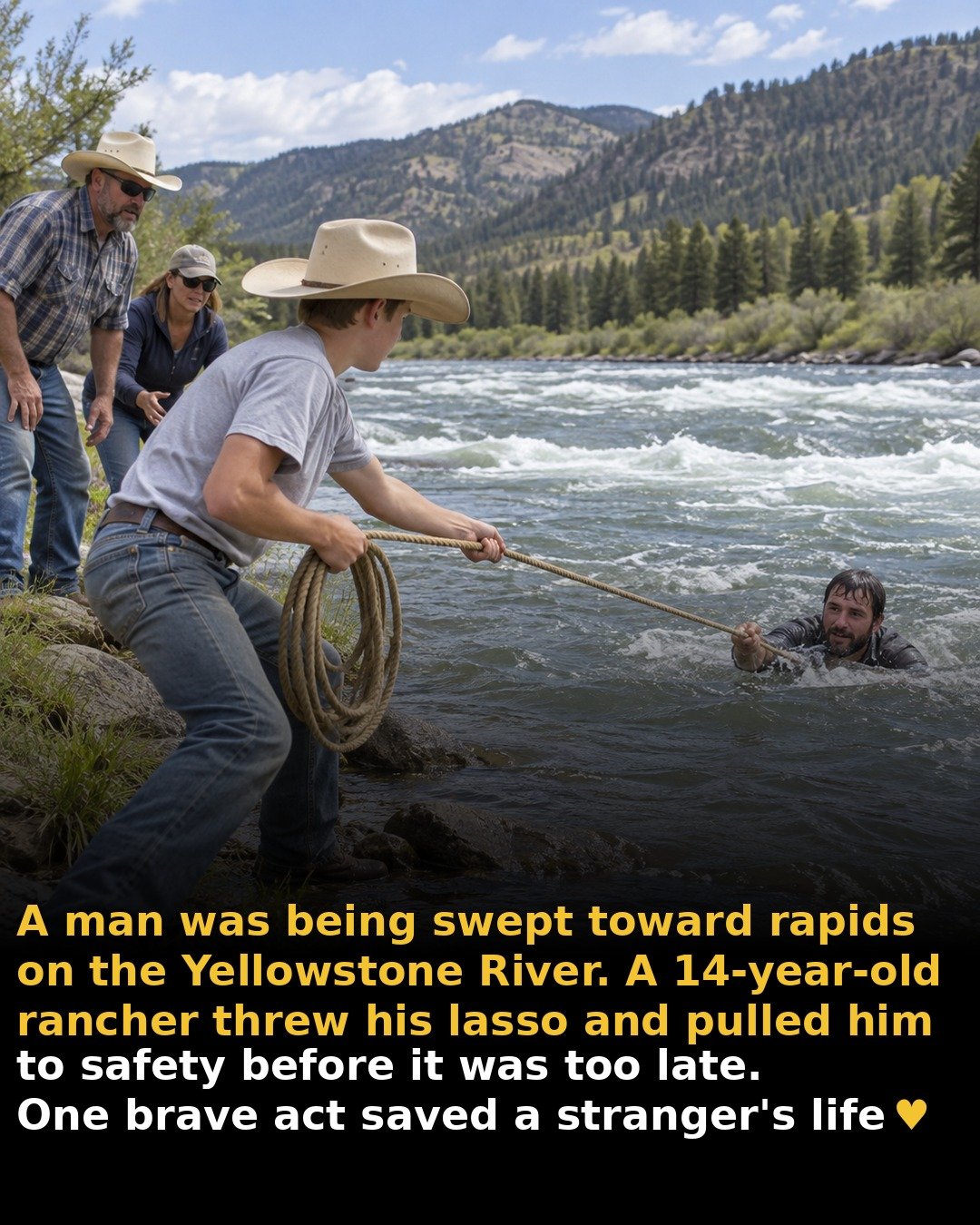
A 14-Year-Old Used a Rodeo Lasso to Pull a Drowning Man From the Yellowstone River.
Jory Thomas was spending a July 4th weekend near the Yellowstone River in Montana when a family outing suddenly became an emergency.
A raft and paddleboard struck a bridge pier, sending four people into the river. Three reached shore, but one man was swept downstream while clinging to a cooler. The current was moving him toward rapids and logjams.
Jory had spent the summer practicing with a lariat and a roping dummy. He took his rope and waded chest-deep into the current. On his first throw, he caught the man around the arm and neck, allowing a bystander to help pull him toward safety while emergency responders moved in.
His father had already called 911, and a sheriff’s deputy arrived within minutes. Jory later told his family that he thought he had saved a life. The sheriff agreed, saying the boy’s action was decisive in a situation where seconds mattered.
The rescue was shared because it combined a skill learned on a Montana ranch with the courage to use it when someone was in real danger. Jory had not trained to become famous; he had practiced until the skill was ready when the moment arrived.
The story is not an invitation for people to enter dangerous water without training. It is a reminder that preparation can give people options in a crisis—and that bravery often means making a clear decision while everyone else is still trying to understand what is happening.
Stories like this often stay with people because they are built around a simple human decision: someone notices another person’s need and chooses to respond. The act may take a few minutes, a small amount of money, or a willingness to stop and listen. But to the person receiving help, that moment can become a turning point.
The most important part is not always the size of what was given. It is the dignity with which it was given. Whether the gift is a meal, a pair of shoes, a safe path through the snow, a repaired lawn, or the chance to retire, kindness tells people that their lives are visible and that they still matter to the community around them.
Sources:
Image note: This is an original illustrative recreation created for storytelling. It is not the original photograph from the reported event.