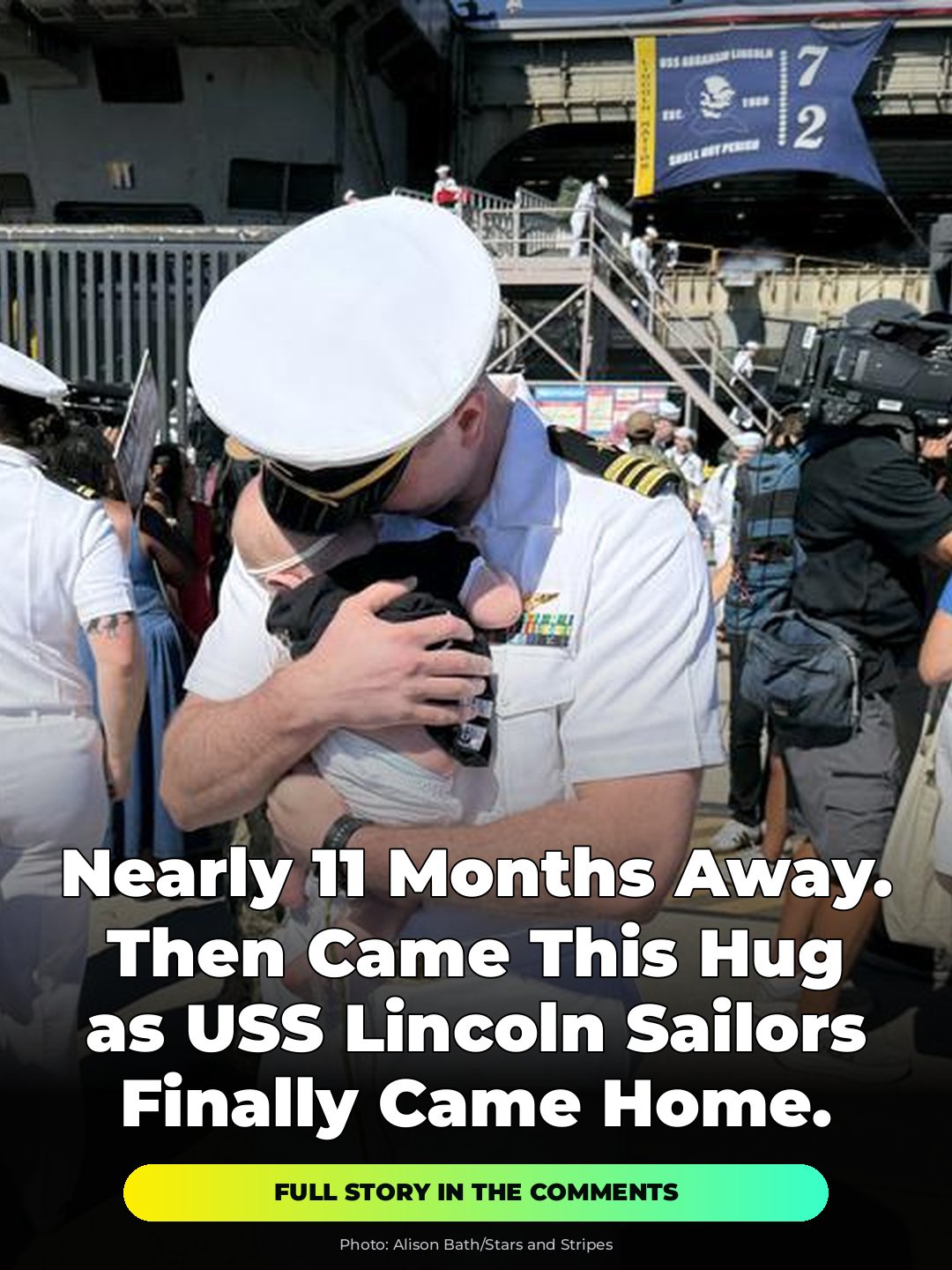
In one photograph from the USS Abraham Lincoln's homecoming, a sailor holds a baby close. The aircraft carrier, the deployment, and the thousands of people involved all narrow to that small embrace. After nearly eleven months away, the ship's return offered something no screen or message could provide: the chance to hold a loved one again. For some sailors, it also meant holding their children for the very first time. The photographs taken in San Diego on October 8 show why the arrival mattered beyond the end of a mission. A ship was reaching its homeport, and families were reaching a moment they had spent months waiting to experience together. [1] [4]
USS Abraham Lincoln, identified by the hull number CVN 72, returned to Naval Air Station North Island in Coronado on Thursday, October 8, 2026. Official Navy photographs recorded the reunions in San Diego and described the carrier's return following operations in the U.S. Fifth and Seventh Fleet areas. The vessel serves as the flagship of Carrier Strike Group 3. Those details locate the homecoming within a major naval deployment, but the people waiting ashore had much more personal reasons to watch its arrival. A parent, spouse, sibling, or friend was coming back. Nearly eleven months of separation were finally giving way to the possibility of standing beside one another again. [2] [9]
The welcome extended beyond the pier. Times of San Diego reported American flags and welcome-home signs along Shelter Island, with boats on the bay also displaying flags as the carrier passed. Near the dock, families carried flowers and balloons and rang cowbells. The different ways of welcoming the ship gave the occasion a public, communal character. People could watch the same carrier while waiting for very different individuals aboard it. The scale of the gathering also makes the smaller reunions more striking: the crowd could celebrate together, but each family still had its own person to find. What looked like one large event was made up of many separate waits reaching their conclusion. [3]
For 122 new fathers from the ship and its air wing, the arrival had an additional significance. Lt. Cmdr. Tyler Barker, the Lincoln's public affairs officer, said they would meet children born while they were deployed. Navy Times reported his remarks and described fathers among those stepping ashore to embrace their babies. Barker also acknowledged that the mission's demands could not make up for missed birthdays, anniversaries, and other family milestones. That acknowledgment gives the number its human meaning. These sailors were returning to children whose lives had already begun in their absence. The reunion could start their time together in person, while the months they had missed remained part of the family's story. [4]
One of those fathers was Brent Ledbetter, an air traffic control center officer. His son was born shortly after he reported to the Lincoln and was already about ten months old by the homecoming. Ledbetter told NBC News that he wanted to hold and play with him; Navy Times also reported his excitement about the boy already crawling. The activities he looked forward to were the ordinary parts of being together. That is what makes the account so affecting. A baby can grow through an extraordinary amount of change during one deployment. Coming home gave Ledbetter the chance to participate directly in that growth, beginning with the simple experience of holding his son. [4] [5]
Misty Scott made a long journey of her own. The Coronado News reported that she drove from Missouri to welcome her daughter, Emmaleigh, after months of limited communication. Misty described the separation as stressful and the reunion as a relief. The distance she traveled underscores how much the occasion mattered to her. Coming to California meant she could be there when her daughter returned, rather than hearing about the homecoming afterward. Her account represents a parent's part of the deployment: waiting for news, living with separation, and looking forward to the moment when her child would finally be within reach. [6]
Emmaleigh Scott was twenty, and this had been her first deployment. She worked on the Lincoln's flight deck fueling aircraft, The Coronado News reported. The young woman who had carried out that demanding assignment was now reunited with her mother. That connection between a sailor's work and a family's relationship is central to a homecoming. The uniform identifies a person trained to do a particular job, while the welcome recognizes a daughter someone has missed. Emmaleigh's return brought those parts of her life together again after an unusually long separation. The deployment was over; mother and daughter could be together. [6]
Another mother, Ashley De La Fuente, traveled from San Marcos, Texas, to see her son Christopher, a firefighter aboard the Lincoln. KPBS found her among the families arriving early at North Island. She had brought a sign and told the station the wait was worthwhile. Her journey adds another individual face to the gathering. For a parent who has already waited through the deployment, the final hours at the pier are part of getting close enough to welcome a child home. Christopher's work aboard the ship and Ashley's trip to California came from different responsibilities, but the return gave both journeys a shared destination. [7]
The deployment had lasted much longer than originally expected. Capt. Daniel Keeler told KPBS the Lincoln left for a planned six-month western Pacific patrol before receiving a new mission and entering major combat operations in the Middle East. The return came after more than ten months away. That change helps explain the weight of the homecoming: an expected period of separation had become a longer one. A return date matters to families because it shapes the time they anticipate spending apart. When the mission changes, the people waiting at home must keep waiting too. October 8 finally gave the extended deployment a concrete ending. [7]
The Navy describes Abraham Lincoln as its fifth Nimitz-class aircraft carrier, named for the nation's sixteenth president and homeported in San Diego. An aircraft carrier has an identity visible well beyond the people who serve aboard it: its name, number, and size make it recognizable as it enters the bay. Yet the name of the ship is only the beginning of the homecoming story. The people leaving it belong to families and communities across the country. Misty Scott's drive from Missouri and Ashley De La Fuente's trip from Texas illustrate that reach. The carrier returned to a California homeport, bringing people back to relationships that extended far beyond the waterfront. [8]
The relief also followed a difficult period aboard the ship. Stars and Stripes reported food and water shortages, disrupted mail service, long workdays, and concerns about exhaustion and morale. The newspaper said logistical problems were eventually addressed, while families had continued raising concerns about their loved ones. Those reports belong in the account because they help explain why the return carried such emotional weight. They also show why celebrating the crew's work and acknowledging the strain are compatible. The sailors' families could feel proud of the service performed and relieved that the deployment had ended. Their welcome did not require treating the separation as easy. [9]
The strike group's work received formal recognition just before the homecoming. On October 7, Pete Hegseth presented the Abraham Lincoln Carrier Strike Group with the Presidential Unit Citation, an award for extraordinary heroism by a unit in combat. Stars and Stripes reported the presentation aboard the carrier as it approached San Diego. The citation marked the military's recognition of the group's performance. The following day's reunions provided a different kind of welcome, rooted in the relationships waiting ashore. An award can recognize what a unit accomplished; a family can welcome back the particular person whose presence it has missed. Both forms of recognition were part of the Lincoln's return, each addressing a different part of the deployment. [10]
Rear Adm. Robert Loughran, the strike group commander, also recognized the people who had stayed home. Speaking at the pier, he credited the support of families and friends as essential to the deployment and acknowledged the burden they carried. His remarks, reported by Stars and Stripes, placed the waiting families within the story of the mission. They had spent the deployment apart from their service members, continuing to provide support across that distance. The gathering at North Island made that contribution visible. Families were there to celebrate the returning sailors and Marines, and the commander's acknowledgment recognized why their own long wait deserved attention as well. [9]
For Army Pvt. Grayden Monroe, supporting his sister Gaige meant offering a connection to ordinary life. He told Stars and Stripes that he avoided focusing their conversations on the Lincoln's work or news coverage, instead talking to her as he would on a normal day. Gaige returned aboard the carrier, and a family photograph showed the siblings together afterward. His account offers a specific example of how someone at home tried to help across the distance. He could not end her deployment, but he could keep their familiar relationship present while it continued. The reunion let the brother and sister share that connection in person again. [11]
Families spoke of pride alongside their concern. Lidia Fierro came with her daughter Scarlett to welcome her son Dustin; Scarlett translated for her Spanish-speaking mother. Kristen Haro waited for both her son and daughter, who served aboard the carrier. Stars and Stripes described the families' mixture of relief, exhaustion, and pride. Their accounts show the range of relationships gathered on the pier. One homecoming could bring back a son, a daughter, or two children from the same family. Behind the common celebration were particular people and particular reasons to be grateful they had returned. [11]
For Alma Solano Velez's family, the plans included a meal. The Associated Press reported that her husband had requested foods he had missed, including oxtail, barbecue chicken, broccoli, and shrimp empanadas. Their daughter had turned four during his absence, and he looked forward to seeing her. The account brings the homecoming down to a family's immediate plans: being together and preparing familiar food. Those details give the return a life beyond the pier. The public welcome would end, and time together at home could begin. [12]
That time together may need room to unfold. Military OneSource's guidance on returning from deployment explains that reunion and readjustment can involve excitement, uncertainty, and changes in household routines. It encourages realistic expectations and patience rather than assuming everyone immediately resumes life exactly as it was before departure. This is general guidance, not an assessment of any individual Lincoln family. It helps place the celebrated first embrace within the longer experience of coming home. A reunion provides the opportunity to reconnect; the days that follow provide time to do it. Families can enjoy the return while allowing one another space to rest, talk, and become familiar with routines that may have changed during the separation. [13]
Children can have their own pace in that process. Military OneSource advises parents to expect mixed feelings after a deployment, ease back into routines, and avoid imposing major changes immediately. A child who has grown during a parent's absence may need time to become comfortable with that parent's presence again. For families welcoming a baby born during the deployment, shared time is also the beginning of getting to know one another directly. These possibilities do not diminish the joy of the arrival. They explain why the small moments after it matter: playing together, taking part in a meal, or joining a bedtime routine. The first meeting opens the door to a relationship built through repeated time together. [14]
Support can continue after the flags and signs are put away. Military OneSource describes installation family-support services and resources for parenting, school connections, and the changes associated with deployment. Their availability recognizes that families have needs throughout the experience, including after service members return. The wider community can also take a practical lesson from the Lincoln's welcome: appreciation need not end when the ship is no longer in the headlines. Respecting a family's time, listening when someone wants to talk, and making room for rest are ways to extend that welcome. The celebrations at North Island were a visible expression of support. The days that follow offer quieter opportunities to remain supportive of the people who came home. [15]
Capt. Daniel Keeler gave the return a particularly meaningful perspective when he said, “Every single sailor and Marine that left on this deployment is going home.” Stars and Stripes reported the remark as families welcomed the Lincoln back. For the crowd ashore, those words were accompanied by people they could finally see and embrace. The homecoming held pride, relief, and the knowledge of time spent apart. It also held beginnings: fathers meeting children, relatives reunited, and families able to make plans together again. After nearly eleven months, the carrier's arrival became thousands of personal returns. The photograph of a sailor holding a baby captures one of them—a long period of waiting followed, at last, by the chance to hold someone close. [1]