The Fifteen-Year-Old Runaway Who Found a Kidnapped Girl in the Storm — and the Biker Father Who Never Stopped Searching
I was fifteen years old when I found a little girl crying beside a flooded creek in the middle of a freezing Oregon storm. She was six. Her shoes were pink. Her hands were blue from the cold. And the first thing she whispered when she saw me was: “Please don’t let them take me again.”
My name is Mason Reed. At that point in my life, nobody was looking for me. Not really. My mother had died the year before after spending most of my childhood losing battles with addiction. After that, I entered foster care. The first placement lasted three months. The second lasted six weeks. The third belonged to a man named Earl Watkins. Earl smiled whenever social workers visited. He kept fresh cookies on the counter and family photographs on the wall. But after the county car disappeared down the driveway, he became someone else. So I ran.
For seven months, I lived in the Cascade foothills outside a logging town called Pine Crossing. I slept beneath a shelter made from cedar limbs and blue plastic tarps. I stole crackers from gas stations when I was desperate. I drank creek water through an old camping filter I found in a dumpster. Most important, I learned one rule: stay invisible. Invisible kids don’t get sent back.
That October night, rain hammered the forest so hard it sounded like gravel hitting metal. I was curled inside my shelter when I heard crying. At first I thought it was an injured animal. Then I heard a child say: “Daddy.” Every survival instinct told me to stay where I was. Instead, I stepped into the storm.
I followed the sound nearly half a mile. Lightning flashed over the trees. That was when I saw her. A little blonde girl huddled beneath a huge cedar, soaked through, her knees pulled against her chest. “Hey,” I said softly. She screamed and tried to crawl backward. I immediately raised both hands. “I’m not going to hurt you.” “Don’t take me back.” “I won’t.” “My name’s Mason. What’s yours?” She hesitated. “Ellie.”
I took off my hoodie. It was the driest thing I owned. I wrapped it around her. “What happened?” Her teeth were chattering so hard I could barely understand her. “Men took me.” My stomach tightened. “What men?” “They put me in a van.” She started crying again. “The van got stuck. They were yelling. I opened the door and ran.” “Where’s your family?” “My daddy was at the picnic.”
Then I noticed the tiny black leather vest under my hoodie. There was a patch on the back. A silver mountain. A black motorcycle wheel. And the words: BLACK RIDGE RIDERS. I knew that name. Everybody in Pine Crossing did. The Black Ridge Riders were a motorcycle club with a clubhouse outside town. They organized toy drives every Christmas. They paid funeral costs for veterans. They also had a reputation that made people lower their voices when talking about them. Their president was Cole Mercer. Big man. Gray beard. Supposedly scared of nothing.
And his daughter had disappeared that afternoon from a charity barbecue. I had heard sirens earlier. Had even seen search helicopters before the storm grounded them. I stared at Ellie. “You’re Cole Mercer’s daughter?” She nodded. Fear hit me from both directions. If the police found a homeless runaway hiding with a missing six-year-old, what would they think? If the bikers found me first, would they believe my story?
Then a flashlight beam appeared through the trees. Voices followed. “Ellie!” But the voice didn’t sound worried. It sounded angry. Ellie grabbed my arm. “That’s them.” I picked her up. And ran. I knew those woods better than anyone searching them. I knew where the ground turned to swamp. Where old logging trails disappeared. Where fallen trees created tunnels beneath their roots.
For nearly an hour, we hid and moved. Three men searched behind us. Sometimes their lights passed so close I could see rain shining on their jackets. Ellie stopped talking. That worried me. “You awake?” “Yes.” “You have to stay awake.” “I’m cold.” “I know.” I carried her toward an abandoned forestry dispatch station I had explored weeks earlier. There was an emergency phone inside. Old yellow receiver. Hardwired line. I prayed it still worked.
We reached the building after midnight. The roof leaked. Half the windows were broken. But it blocked the wind. I lifted the receiver. Dial tone. I nearly cried. Then I dialed 911. Nothing. The storm had knocked out the main line. I slammed the phone down. Ellie reached inside her little vest. “My daddy gave me this.” She held out a metal tag on a chain. A phone number was engraved on the back. Under it: IF FOUND — CALL BLACK RIDGE.
I stared at the number. Calling the police scared me. Calling a biker clubhouse scared me more. But Ellie’s lips were turning pale. So I dialed. A deep voice answered. “Yeah?” “I have Ellie Mercer.” Silence. Then: “Who is this?” “My name is Mason.” “Where is she?” “I found her in the woods. The men who took her are following us.” The voice changed completely. “Where are you?” “Old forestry station near Black Creek Road.” “Listen carefully, kid. Lock the door. Stay with her.” “How long?” “Not long.” The line went dead.
I looked at Ellie. “Your dad knows.” She smiled for the first time. Then the window beside me shattered. Glass sprayed across the wooden floor. A flashlight blasted through the opening. “Well, look what we found.” Three men stood outside. Ellie screamed. The front door shook under a heavy kick. I grabbed an old fireplace poker from the wall and stepped in front of her. I was fifteen. Hungry. Exhausted. Barely 130 pounds. The man outside laughed. “Move away from the girl, kid.”
The door cracked. Another kick. A hinge tore loose. Then something strange happened. The floor began vibrating. At first I thought it was thunder. The men outside stopped. The vibration became a rumble. Then a roar. Not from the sky. From the road. I looked through the broken window. Headlights filled the forest. Dozens. Then hundreds. Motorcycles poured through the rain, their lights stretching down the mountain road farther than I could see. The three kidnappers went completely still. And the man standing nearest the door whispered the only words I had ever heard from an adult that sounded more frightened than I felt: “Oh God… her father found us.”
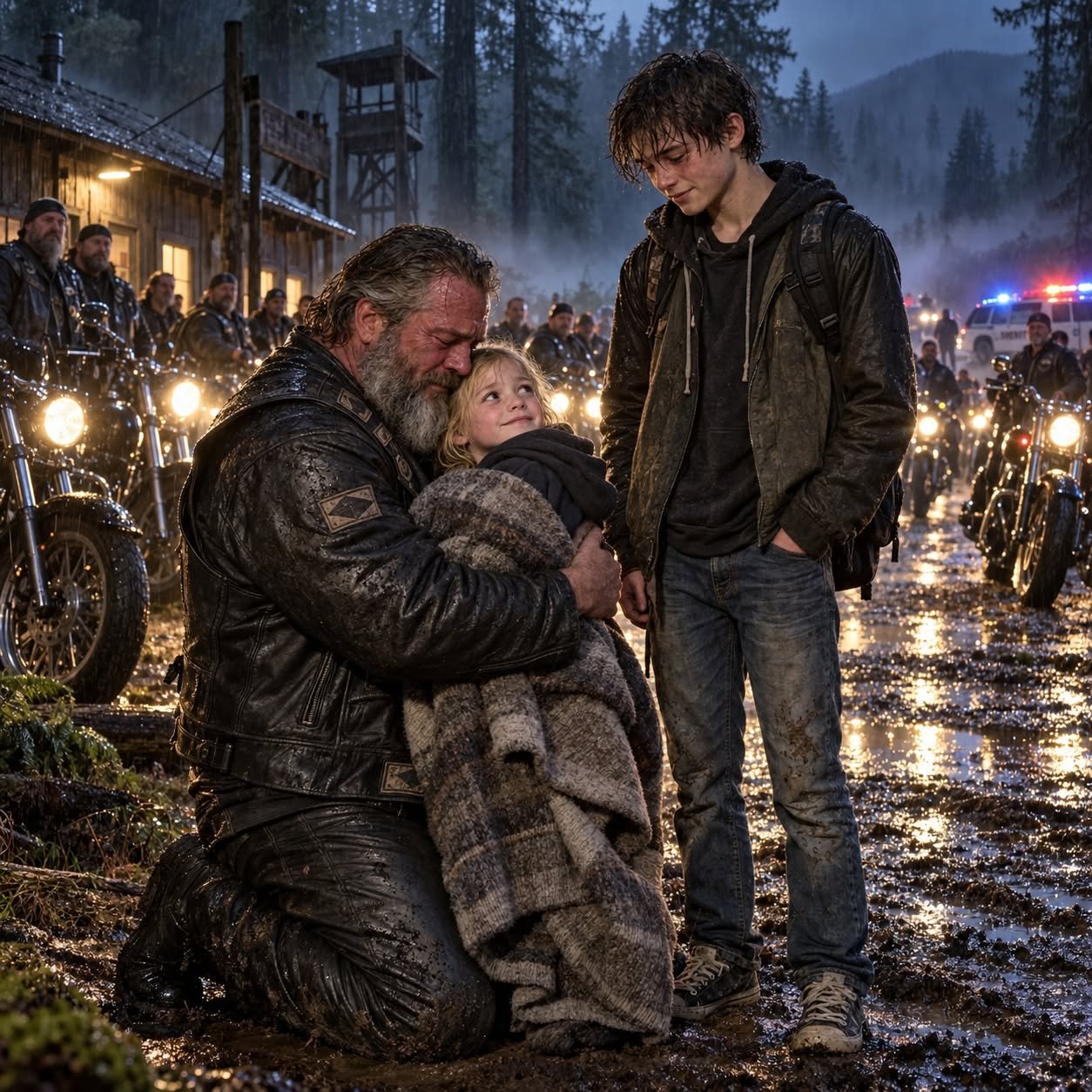
The kidnappers ran. They didn’t get far. The Black Ridge Riders had the road blocked in both directions, and behind the bikes stood two county sheriff’s cruisers with lights painting the wet trees red and blue. Cole Mercer was the first man off a bike. He moved through the broken doorway like a storm himself — and then he stopped, because his six-year-old daughter ran to him and wrapped her arms around his neck so hard he had to catch the wall to stay upright.
Then Cole Mercer did something nobody in that forest expected. He walked to me — a scrawny, mud-covered runaway holding a fireplace poker — and he put one hand on my shoulder, and he said: “You kept her alive. Say the word and I’ll owe you the rest of mine.” I didn’t say anything. I had spent seven months being invisible, and I had forgotten how to accept being seen.
The kidnappers turned out to be three men from a rival outfit who had grabbed Ellie at the charity barbecue hoping to pressure the Black Ridge Riders. They were arrested that night and all went to prison. Ellie was checked by doctors, warmed up, and home in her own bed before sunrise. The storm that had grounded the helicopters couldn’t ground a father’s promise.
What happened to me was the part I never saw coming. A social worker found me at the station before dawn. I figured I was going back into the system, and I had about twenty minutes to decide whether to run again. Then Cole Mercer walked in and told her he was filing for emergency guardianship of Mason Reed, that his wife had already made up the guest room, and that Ellie had asked for me by name four times since waking up.
I argued with him. I told him I was a runaway, that I stole crackers, that I was trouble. He listened, nodded once, and said: “Son, you carried my daughter through a freezing forest for two hours while grown men hunted you. You’re not trouble. You’re family now. The paperwork just hasn’t caught up yet.”
The paperwork caught up. It took months — home studies, court dates, the whole machinery of it. I started school in Pine Crossing that January. I was behind, but the teachers stayed late, and Ellie sat at my kitchen table every evening doing her own homework “so I wouldn’t feel alone doing mine.” She was six. She had already figured out more about people than most adults ever do.
Spring came to the Cascades. The Black Ridge Riders held their annual charity ride, and for the first time, they let a sixteen-year-old ride in the back of the pack on a bike Cole had rebuilt with me, bolt by bolt, all winter. Ellie rode in the support van, waving a little flag out the window. When we rolled through Pine Crossing, Ellie leaned out and shouted, “That’s my brother!” to anyone close enough to hear. I almost had to stop the bike. Almost.
I’m older now. I finished school and work as a forestry technician — the same woods I once hid in are the ones I protect now. And every October, when the first storm rolls over the Cascades, the Black Ridge Riders ride out to Black Creek Road, lay flowers by the creek, and ride home together. The whole county can hear us coming, and nobody lowers their voice anymore. They just wave.