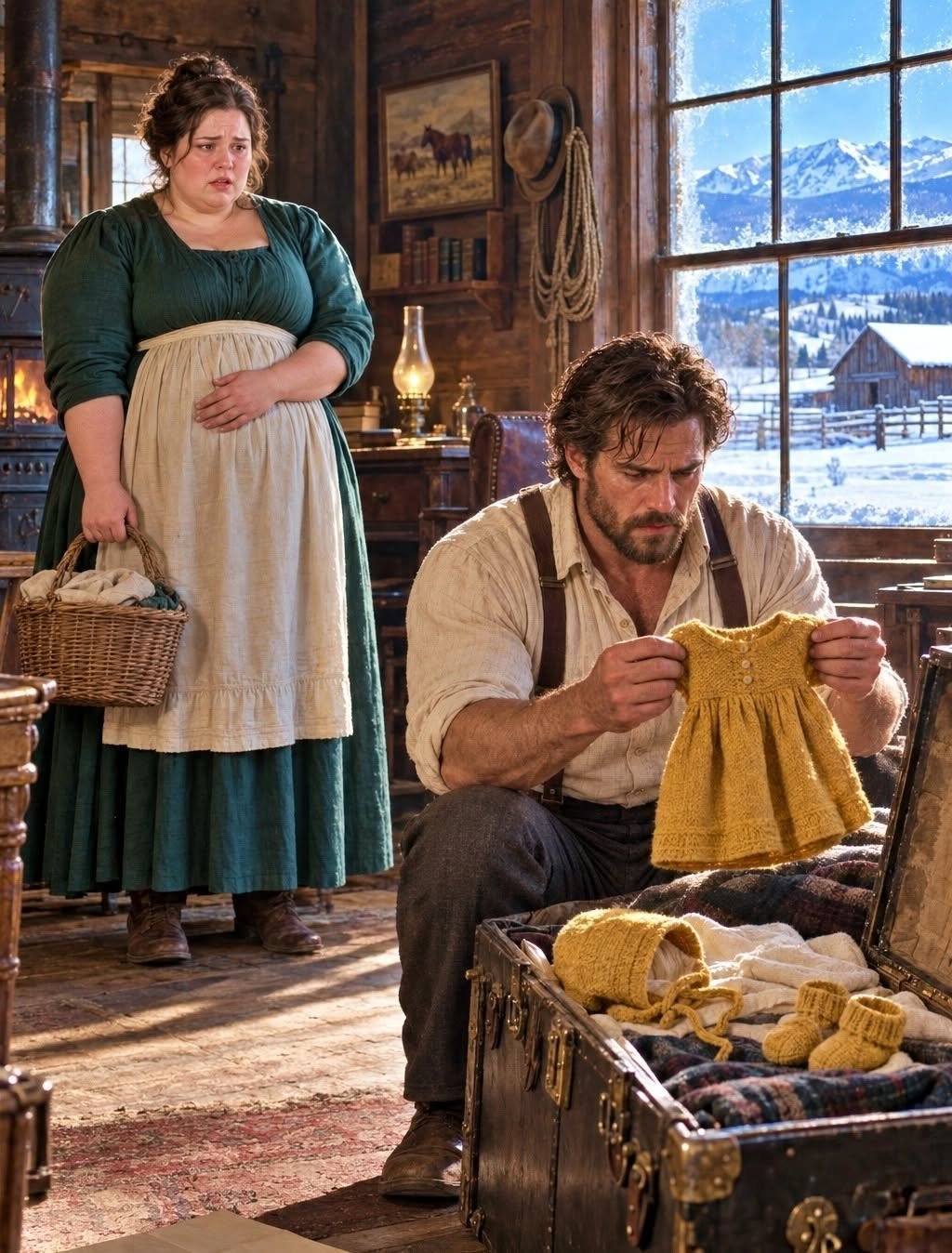
The Trunk Full Of Tiny Yellow Baby Clothes
July of 1888 had trapped Eliza Hart and Jackson Thorne alone in the main house of the Thorne ranch outside Laramie, Wyoming. Rain hammered the windows. The fire burned low. And two lonely people, tired of pretending they needed no one, crossed a line neither had planned to cross. By morning, the storm had passed — and so had Jackson’s courage. He buried himself in work. She buried herself in hers. Neither spoke of that night again.
Weeks later, Eliza discovered that the night had left them with something neither could ignore: she was carrying Jackson Thorne’s child. She did not tell him. At first she told herself she was waiting for the right moment. Then she saw a bank letter lying open on his desk, and the right moment began to look like a trap.
The ranch was in deeper trouble than anyone knew. Jackson was selling horses, delaying repairs, counting sacks of flour before winter. Eliza knew exactly what a proud, failing man might think if his cook announced a pregnancy in the middle of it — that she wanted marriage, or money, or a claim on his land. Worse, he might see the child as another burden attached to a night he already regretted.
She could endure gossip. She could endure poverty. What she could not bear was the thought of her child growing up under a man’s cold resentment. So she began to plan her leaving. She saved coins inside an old leather boot beneath a loose floorboard. She sewed at night by candlelight — a bonnet, a tiny shirt, soft booties, a little yellow dress — from yellow wool that reminded her of sunlight on the plains.
She hid the clothes in the one place no curious ranch hand would ever look: Jackson’s old black travel trunk beneath the window of his study, buried under folded blankets, locked with the spare key he had given her years ago and forgotten about. Every time she passed the trunk, her heart beat a little faster. Secrets always seem safest just before they turn dangerous.
Three days before Thanksgiving, a brutal storm rolled in. Jackson was miles away checking cattle in the far pasture when Eliza watched the sky turn bruised and heavy. By nightfall he stumbled through the front door, snow crusted across his beard, carrying a newborn calf wrapped in burlap. “Blankets. Quick.”
For twenty minutes neither of them spoke. They rubbed the calf’s legs, dried its coat, warmed milk for it. Jackson’s hands were red and split from the cold. When the little calf finally lifted its head and made a thin sound, relief crossed Jackson’s face before he could hide it. “You have a good heart,” Eliza said. He almost smiled.
She tried to rise too fast. The room tilted. Jackson caught her around the waist, his arm tightening instinctively — dangerously close to the secret beneath her dress. “You’re pale,” he said. “I’m tired.” “You’re shaking.” “It’s the heat from the stove.” His eyes stayed on her face. Jackson Thorne could read cattle tracks after a night of snow. Eliza knew he would eventually read her too.
The storm trapped everyone for three days. On the second night, Jackson called Eliza into the study. Ledgers were stacked beside a burning lamp. He looked older than he had a month earlier. “The ranch is in trouble,” he said. “I may have to sell the northern acreage. The bank wants payment sooner than I expected.”
“I’m sorry.” “So am I.” He stared at the dark window. “If things get worse, some of the men will have to go.” Eliza’s stomach tightened. “I’ll leave when the roads open,” she said. Jackson looked at her sharply. “I didn’t ask you to leave.” “Why?” He stared at the bank letter as if the answer were written there. “Because this house is different when you’re in it.”
She wanted to tell him then. She nearly did. But she saw the bank notice beneath his hand, and thought of the baby, and thought of Jackson wondering whether she had planned all of it. “I’ll stay as long as I can,” she said. It was the nearest she’d get to the truth.
By morning the storm was breaking. The roads might open within two days. Eliza went to her room and counted her coins — not enough, but enough to reach another town if she was careful. She packed her Bible, her shawl, her mother’s empty gold locket. Then she remembered the baby clothes, still inside Jackson’s trunk. She slipped into the study with a basket, unlocked the trunk, and began placing the tiny yellow garments inside.
Then she heard boots in the hall. She shut the trunk too quickly. Jackson entered before she could reach the door. “What are you doing in here?” “Cleaning.” He glanced at the basket. “Now?” “I couldn’t sleep.” He held up another bank letter. “They want the original rail easement. I think it’s in this trunk.” Eliza’s mouth went dry. He knelt beside it, unlocked it, and lifted the lid.
The yellow wool looked almost bright against the dark blankets. Jackson froze. Slowly, he reached in and lifted the tiny yellow dress by its shoulders. Then the bonnet. The booties, no bigger than walnuts. He turned them over in his hands as if they might vanish. When he finally looked up at Eliza, his face had gone pale beneath his beard.
“Whose are these?” His voice was rough. Eliza’s throat closed. She had rehearsed this moment a hundred times, and every version had ended with her running. But her feet would not move. “Mine,” she whispered. “Yours?” “Ours.” The word fell between them like a stone into deep water.
Jackson stood very slowly, the tiny dress still in his hands. “How long have you known?” “Since September.” “And you were going to leave.” It wasn’t a question. Eliza lifted her chin. “I thought you’d believe I’d trapped you. Your ranch is failing. I wouldn’t give you a reason to resent a child.”
Something cracked in Jackson Thorne’s face — the proud, silent mask he had worn for years. “You think I regret that night?” he said. “Eliza, that night is the only thing in two years I don’t regret.” He crossed the room and took her hands — gently, as if she were made of the same yellow wool. “I’ve been a coward. I’ve been drowning in ledgers and too proud to ask for help, and I let you think a child of mine could be a burden to me.”
“Jackson—” “Listen. I don’t care about the bank. I don’t care about the acreage.” He pressed the tiny dress into her hands. “I care about you, and I care about this baby. Stay. Not as my cook. Marry me.”
Eliza stared at him. “You’d marry a woman who hid this from you?” “I’d marry the woman who sewed a whole future by candlelight for a child she thought she’d raise alone.” His voice broke. “Let me be part of it. Please.”
They married in the ranch parlor that Christmas, before the circuit preacher, with the ranch hands standing at attention like groomsmen and the newborn calf — fat and thriving — watching through the kitchen window. Eliza wore her mother’s gold locket, and inside it, she had tucked a scrap of yellow wool.
The bank came for the ranch that spring, and Jackson did sell the northern acreage — but with a clear head and an honest plan, the rest of the spread survived. He worked the land with a man who finally had something worth protecting. And in May, under a sky the color of that yellow wool, Eliza gave birth to a daughter with Jackson’s dark eyes and her own stubborn chin. They named her Hope.
Years later, the black travel trunk sat at the foot of their bed, holding blankets and maps and one tiny yellow dress that Hope had long since outgrown. Jackson kept it polished. “For the next one,” he would say, winking, and Eliza would swat him with a dish towel. The town talked, of course — small towns always do. But the Thornes learned to let them. Their story had started in a storm, hidden in a trunk, and ended exactly where it belonged: home.


