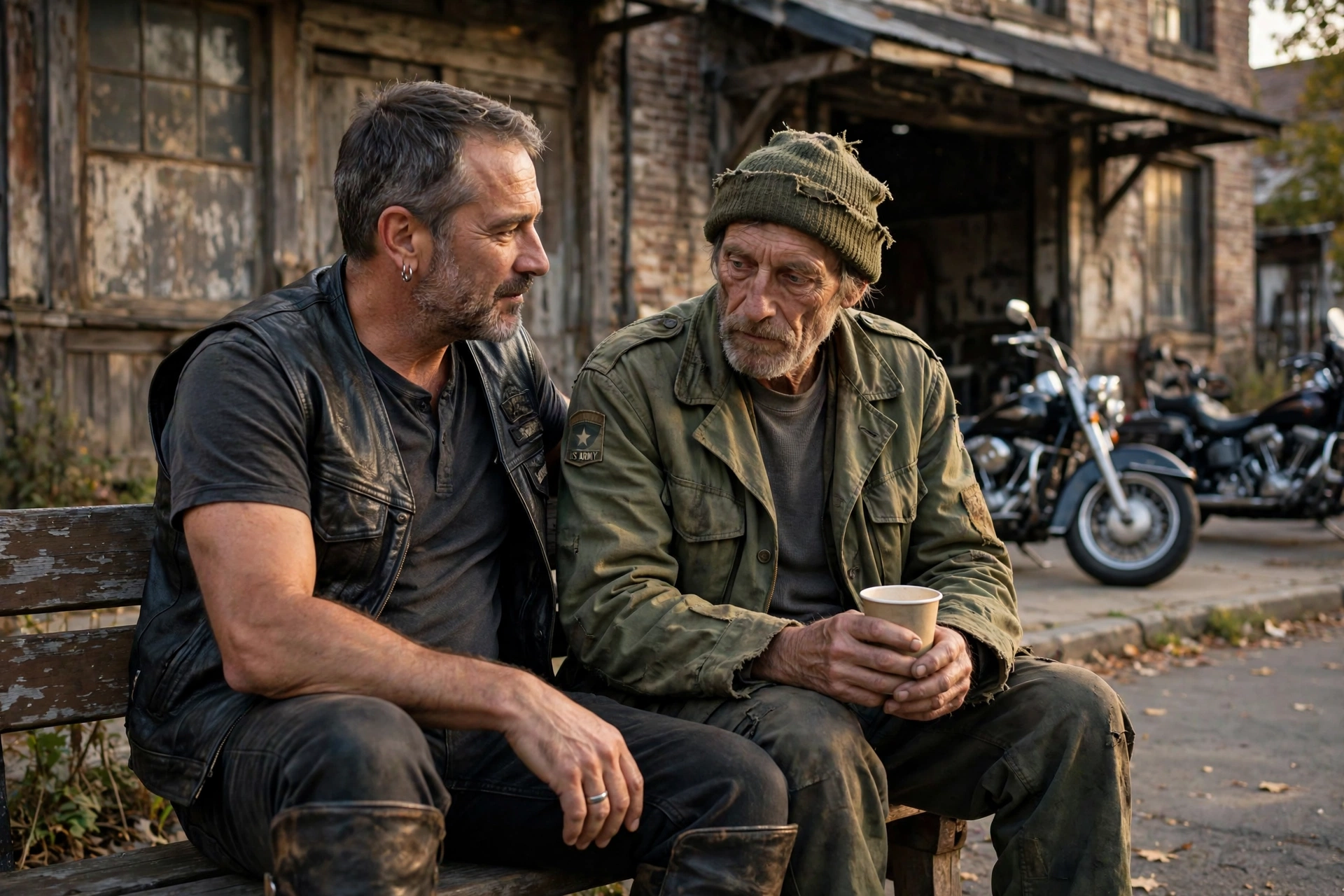
For three straight summers, the Rusty Spurs Motorcycle Club rolled through the town of Cedar Falls on their annual charity ride, and for three straight summers, they saw the same man sitting on the same bench outside the old depot building. He was a thin man in a faded Army jacket, with a paper cup in his hands and eyes that watched the bikes go by like he was watching old friends he hadn’t seen in years. He never asked for anything. He never even stood up.
The riders would wave. He would nod back, just once, and lower his eyes again. That was the whole exchange, year after year. Nobody knew his name. Nobody asked.
Jake Mullins was the club’s treasurer and the kind of man who noticed things other people walked past. He noticed the way the man folded his cup flat when he thought nobody was looking, as if saving it for later. He noticed the careful way the man brushed dust off that old Army jacket every morning, like it was the finest coat in the world. And on the fourth summer, when the club stopped for gas and Jake saw the man sitting there again, thinner than ever, he did something he’d been meaning to do for three years. He walked over and sat down on the bench.
“Mind if I join you a minute?” Jake asked.
The old man looked up, surprised, the way people do when they’ve gotten used to being invisible. “It’s a free bench,” he said quietly.
Jake introduced himself. The man hesitated a long moment, then said, “Hank. Hank Bell.” He didn’t offer his hand. Jake shook it anyway, and felt how light the man’s grip was, like a handshake made of bird bones.
“Army jacket,” Jake said, nodding at it. “You serve?”
Something flickered in the old man’s eyes. “A long time ago. Vietnam. I was a medic.” He said it the way other men might say they’d worked at a grocery store, as if it were nothing. Jake knew enough veterans to know that tone. The men who’d seen the most said the least.
They talked for ten minutes. Hank said he wasn’t from Cedar Falls, exactly — he was from everywhere and nowhere, the way the road makes a man when he stops belonging anywhere. He slept behind the depot most nights. The night watchman let him stay because Hank swept the platform every morning before dawn, and he did it like it was his job, because to him it was.
Jake bought him a cup of coffee and a breakfast plate from the diner across the street. Hank ate slowly, carefully, like a man who had learned never to rush a meal. When Jake asked where his family was, Hank went quiet for a long time. “My wife, Dorothy, passed twelve years back,” he said at last. “Cancer. The bills took the house. I had a granddaughter — sweet little thing named Ellie. When she was nine she needed a surgery her mama couldn’t afford, so I gave them everything I had left. My truck, my savings, all of it. They moved to Oregon after. I didn’t want to be a burden, so I just… kept walking.”
Jake felt something tighten in his chest. He’d heard hard-luck stories before, but this wasn’t a story. This was just a man telling the truth.
“What about the Army?” Jake asked. “The VA? A medic with your service — there’ve got to be benefits.”
Hank shook his head. “I fell through the cracks a long time ago. Records fire, wrong paperwork, you know how it goes. I stopped fighting it. The road’s been all right to me.”
Jake rode back to the motel that night with Hank’s story sitting heavy in his gut. At the club meeting, he told the others what he’d learned. The room went quiet in the way it does when twenty tough men are all feeling the same thing at once. Big Ray Callahan, the club’s founder — a barrel-chested man of seventy with a gray beard down to his chest — stood up slowly.
“Describe him again,” Ray said. “The jacket. What’s on it?”
Jake described the faded patches: a medic’s cross, a unit insignia worn almost smooth. Ray’s face went pale. “A medic,” he whispered. “Vietnam.”
Ray told the room a story most of them had never heard. Thirty-one years earlier, Ray had been a young rider, wild and reckless, and he’d gone off a rain-slick highway outside Cedar Falls at eighty miles an hour. His bike had caught fire. He’d been trapped, pinned under it, the flames getting closer, and he’d been sure he was going to die there on the shoulder of that road. Then a stranger had appeared out of the dark — a man who dragged him clear with his bare hands and held pressure on his wounds until the ambulance came. The stranger had vanished before Ray ever learned his name. Ray had searched for him for years. All he knew was that the man had said one thing before he disappeared: “I was a medic. It’s what I do.”
The room erupted. Men were on their feet, shouting, laughing, some of them crying without shame. It couldn’t be a coincidence. It had to be him. Jake pulled out his phone and showed the photo he’d taken of Hank — he hadn’t even realized he’d taken it, just a quick snapshot of the old man on the bench. Ray stared at it for a long moment, and then the big tough founder of the Rusty Spurs put his face in his hands and wept.
“That’s him,” Ray said. “I’d know those eyes anywhere. That man saved my life, and I’ve spent thirty years trying to find him.”
The next morning, the entire club rode to the depot. Twenty bikes, engines rumbling, and Hank Bell stood up from his bench looking terrified, like he thought he was in trouble. Ray walked up to him, took off his sunglasses, and said the words he’d been carrying for three decades: “You pulled me out of a burning wreck in 1995, and you never let me thank you.”
Hank stared at him. “I remember,” he said softly. “You were just a kid. I told you you’d be all right.”
What happened next is the part people in Cedar Falls still talk about. The Rusty Spurs didn’t just take up a collection — they moved heaven and earth. The club’s secretary, a woman named Carla who worked at the county office, spent two weeks on the phone until Hank’s service records were found and his VA benefits were reinstated, including thirty years of back support. The local barber gave Hank a shave and a haircut on the house and refused to take a dime. The church ladies showed up with three casseroles and a winter coat.
A retired contractor named Dale, who’d ridden with the club for years, found Hank a small furnished apartment above the hardware store and paid the first six months himself. “A man who swept that depot platform every morning for years without being asked deserves a roof,” he said. “That’s all there is to it.”
But the part Hank talks about most didn’t cost a dime. At the club’s fall banquet, Big Ray stood before the whole room and presented Hank Bell with a leather vest — and on the back, stitched in gold, were the words HONORARY MEMBER, with a medic’s cross beneath. The room gave him a standing ovation that lasted five full minutes. Hank cried. He didn’t try to hide it.
Today, Hank Bell lives in that little apartment, and every morning he still sweeps the depot platform — because he wants to, he says, not because he has to. His granddaughter Ellie, now grown, flew in from Oregon for the banquet, and when she hugged him she whispered, “Grandpa, you’re a hero.” He told her what he’d told Ray all those years ago: “I was a medic. It’s what I do.”
And every summer, when the Rusty Spurs roll through Cedar Falls on their charity ride, Hank doesn’t sit on the bench anymore. He rides at the very front of the pack, on the back of Big Ray’s bike, wearing his vest with the medic’s cross — the quiet man with the paper cup, finally home.