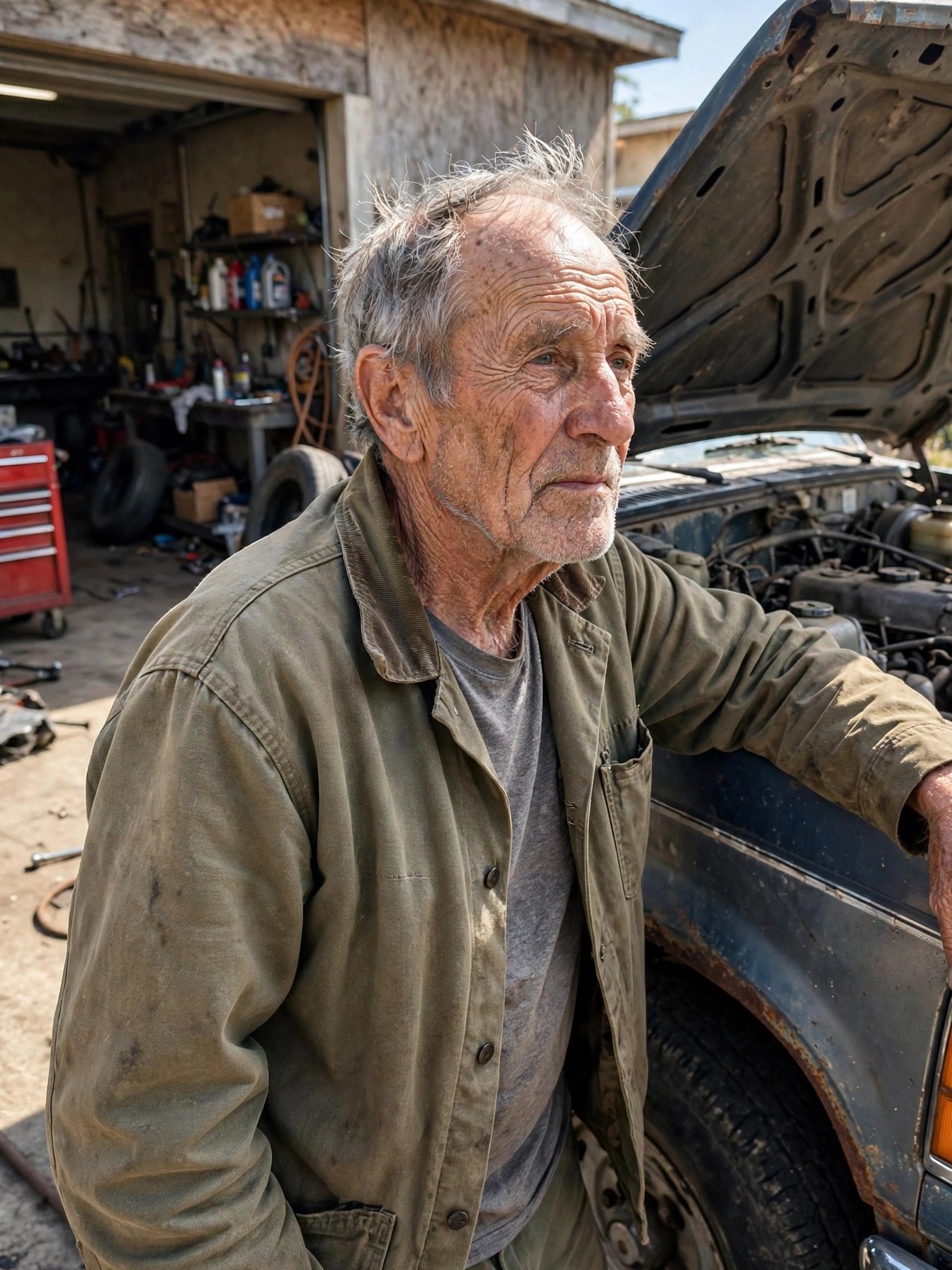
The truck died on a Tuesday, right at the red light on Miller Road, with the grocery bags sliding across the back seat and the engine making a terrible grinding sound, like a bucket of bolts tumbling around inside a washing machine. I knew that sound. It was the sound of something giving up for good.
Her name was Bessie — a 2004 Ford F-150 with 218,000 miles on her, rust chewing through both wheel wells, a cracked dashboard, and a passenger door that only opened from the inside. The radio had been stuck on the oldies station since 2016, and I never saw a reason to fix it.
My wife Dorothy picked that name, God rest her. She said anything that had carried us through thirty years of marriage, two kids, and one cross-country move deserved a name with some dignity. She passed in the spring of 2023, and Bessie and I have been rattling around this town together ever since.
When the light turned green and Bessie wouldn't move, I just sat there with my hazards blinking while the cars piled up behind me, honking. I felt something cold settle in my chest, because that truck was the last thing I owned that still worked — the last thing tying me to Dorothy.
A tow truck hauled us to Keller's Auto Repair out on Route 9, a cinder-block shop with a hand-painted sign, a screen door that slapped in the wind, and a gravel lot full of cars in various stages of giving up. The whole place smelled like hot oil and cut grass.
The mechanic was a big man with forearms like ham hocks and the name MARTY stitched in red thread on his shirt pocket. He took Bessie for a slow drive around the block, came back wiping his hands on a rag, and shook his head in that particular way mechanics do when the news is bad.
"Transmission's shot, Ray," he said, folding his arms across his chest. "A full rebuild'll run you two grand. Maybe a little more once we're inside and see what else is chewed up in there." He said it plain, with no sugar on it, the way you'd want a man to say it.
Two thousand dollars. I stood in that gravel lot with the August sun hammering down on the back of my neck and did the math I already knew by heart: the Social Security check, the electric bill, the last three payments on Dorothy's headstone. There was no two thousand dollars anywhere in my life.
"Then I'll have to scrap her," I said, and my voice cracked in a way that embarrassed me in front of this stranger. "Would you… could you call the junkyard for me? I don't think I can stand to do it myself."
Marty didn't answer. He walked slow around the back of the truck, the way men do when they're turning something over in their minds — and that's when he saw it: the license plate frame I'd bolted on back in '74, white letters on peeling blue paint, reading U.S. NAVY VETERAN.
He went completely quiet. Then he walked back to the front of the truck, laid both big hands flat on the hood, and closed it with a soft, deliberate thud — the sound of a man sealing a promise he hadn't spoken yet.
"Pick it up Friday," he said.
I stared at him. "Marty, I just told you I can't—"
"Friday," he said again, and walked back inside, the screen door slapping shut behind him like a period at the end of a sentence.
I spent three nights staring at my bedroom ceiling, listening to the clock tick in the dark. I'd seen that look on a man's face before — a man who'd decided something and wasn't taking questions. I figured Friday would bring bad news: maybe a patch job that would die again by Christmas, maybe a bill I couldn't pay.
Friday morning I walked into Keller's with $180 in a plain white envelope — every spare dollar I owned in this world — and stopped cold in the doorway. There was Bessie in the lot, washed clean, the rust spots dabbed with gray primer, idling smooth as a sewing machine.
Marty came out wiping his hands on a shop rag, and behind him walked two more men in work shirts: Dale, a broad-shouldered fellow who'd done two tours in Iraq, and a quiet young man named Sam who'd been a combat medic in Afghanistan and barely said a word to anyone.
"Transmission's rebuilt," Marty said, almost casual, like he was telling me the weather. "Me and the boys did it over three evenings after closing time, took turns under the lift. Dale brought the pizza. Sam brought the cuss words."
I tried to press the envelope on him anyway, and when he wouldn't take it, I pulled out my checkbook right there in the gravel lot and started writing. Marty put his big oil-stained hand over mine and said, very quietly, "Ray. Stop."
"Parts came to a hundred and eighty," he said, and gently pushed the envelope back into my shirt pocket. "Labor's on the house. You already paid, sailor — a long time ago, in a hotter place than Ohio." Then he jerked his thumb toward the back of the shop, where a grill was already smoking and Dale was flipping burgers with a spatula, and said, "Now get over here. You're eatin' with us."

