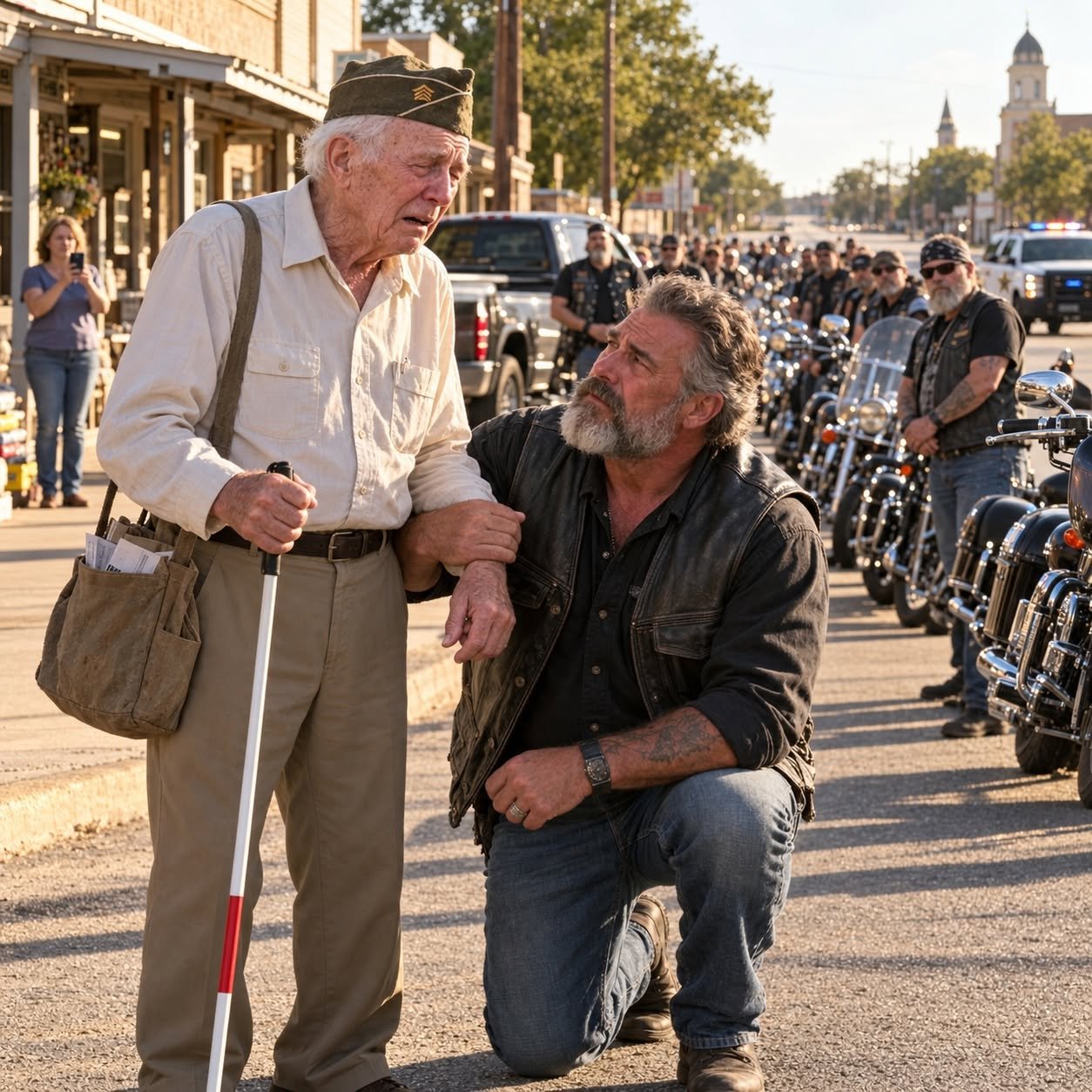
Jack Mercer hit the brakes hard enough to feel his bad knee buckle against the tank. Twenty-two motorcycles stopped behind him in a ragged line. In the center of the lane stood an old man with a white cane, a canvas bag, and a phone he kept pressing to his ear, as if the next try might be the one that worked.
The Man in the Road
Jack was fifty-eight, president of the Crossroads Riders, and considerably better at fixing motorcycles than fixing the relationships in his life. His wife, Ellen, had been dead seven years. His daughter, Claire, lived forty minutes away and sometimes took three days to return his calls. She was an attorney. She had spent much of her childhood waiting for him to come home from somewhere he’d said wouldn’t take long. Jack understood her distance, even when he didn’t like it.
That Tuesday in August, the club was riding through a small town outside San Antonio ahead of a weekend rally. They weren’t in a hurry. That turned out to matter more than any of them knew.
Jack shut off his engine and stepped toward the old man. “Sir, I’m Jack. Can I help you out of the road?”
The man’s face turned toward his voice. “I’m trying to reach the hospital.”
“Which one?”
“County. My wife’s there.” His fingers tightened around the phone. “They called an hour ago.”
Jack offered his arm. The man found it carefully, and they walked to the shoulder while the riders moved their bikes clear of traffic. A woman outside a hardware store was recording them on her phone. The store’s owner stood behind his locked glass door. Jack wondered how long the man had been walking before somebody noticed him.
“What’s your name?” Jack asked.
“Arthur Bell.”
“Arthur, do you have someone coming?”
“The taxi didn’t answer. I knocked next door.” A pause. “Everybody’s busy.”
“My Wife Always Says I Should Try New Things”
The club’s support pickup was two minutes behind the bikes, carrying tools and luggage. Jack called the driver and told him they needed a passenger seat. Arthur heard the conversation.
“You’re motorcycle people.”
“Yes.”
A small, tired smile crossed the old man’s face. “My wife always says I should try new things.”
Before the truck arrived, a sheriff’s deputy pulled onto the shoulder. He approached with the brisk expression of a man expecting an argument. “What’s going on here?”
“We stopped because Mr. Bell needs transportation.”
The deputy looked at Arthur. His whole expression changed. “Mr. Bell, you should have called.”
Arthur went still against Jack’s arm. “I did call. Last week. After you came to my house.”
The deputy glanced toward the woman’s raised phone. “That was a separate matter.”
“You told me I needed to cooperate.”
“Sir, I’m offering to help you now.”
Arthur’s hand tightened on Jack’s arm. “Not today, Deputy.”
Jack looked between them. Then the pickup arrived, and Arthur asked whether they could leave. They could. One rider helped him into the passenger seat. Another secured his cane and bag. Jack told the deputy which hospital we were going to and got back on his bike.
They obeyed every light. For the first time in years, each red one felt personal.
Evie
Arthur’s wife was named Evelyn. A nurse met them at the hospital entrance with a wheelchair, which Arthur accepted only after asking whether walking would be slower. Jack accompanied him upstairs. At the room, he told Arthur where the bed was.
“I can take it from here,” Arthur said. His hand found the rail, then the blanket, then hers. “Evie?”
She opened her eyes. “You made it.”
“Had a little traffic.”
He bent over her hand. Jack stepped outside before Arthur had to ask.
Most of the riders waited downstairs. Two sat with Jack near the elevators. After a while, Arthur came out carrying his canvas bag. “She wants to sleep.”
“We can wait.” Arthur sat down beside him.
Something thick slid from the bag — an envelope bearing the name of a development company. Arthur heard the papers fall. “Could you put those back?”
“Of course.” Jack picked them up, then stopped at the words PROPERTY TRANSFER.
The Signature That Couldn’t Be Hers
“Is this why the deputy came?” Jack asked.
Arthur lowered his head. “A man visited us about assistance. Said there was money to help older people move somewhere easier.” He swallowed. “I told him we weren’t moving.”
“What did you sign?”
“A form to see whether we qualified. He guided my thumb onto the ink pad.”
Jack opened the envelope with Arthur’s permission. According to the enclosed agreement, Arthur and Evelyn Bell had sold their house for $32,000. Arthur told him a local agent had valued it near $250,000.
Then Jack saw the second signature. He read it aloud. Arthur’s hand closed around his wrist.
“That can’t be Evelyn’s signature,” Arthur said, his voice shaking. “She was in intensive care that day — and I hadn’t told them which hospital.”
Jack sat very still. A blind veteran. A wife in intensive care. A “helper” who had guided an old man’s thumb onto an ink pad and forged the signature of a woman who couldn’t have been in the room. And a deputy who had come to the house and told Arthur he needed to “cooperate.”
It was, Jack realized with a slow-building fury, a theft wearing a suit.
Calling Claire
Jack did the thing he had avoided doing for years when trouble got complicated: he called his daughter.
Claire listened without interrupting — the attorney’s habit — and then said, “Dad, do not let him sign anything else. I’m coming.” She was there in under an hour, briefcase in hand, and she looked at the twenty-three motorcycles in the hospital parking lot the way she’d looked at his clubhouse when she was sixteen: like a problem she intended to solve.
What followed took weeks, and Jack will tell you it was the proudest season of his riding life. Claire subpoenaed the development company’s filings. The “assistance” man’s notary stamp turned out to belong to a woman who had died two years earlier. The deputy’s visits to the Bell house were logged nowhere in the department’s records — but the development company had paid him, through a consulting LLC, a sum that made a county ethics board sit up very straight.
The forged signature unraveled everything. A handwriting analyst confirmed what Arthur already knew: Evelyn Bell had not signed that paper. The sale was void. The house — the little house Arthur and Evelyn had lived in for forty-one years — was theirs again.
The developer’s man took a plea. The deputy resigned before the hearing and was indicted anyway.
What Arthur Asked For
Through it all, Arthur asked about only one thing: Evelyn. She held on for three more weeks — long enough to hear that the house was safe, long enough for Arthur to sit beside her every day and tell her the whole story, including the part about the motorcycles. The nurses said she smiled at that part.
“My wife always said I should try new things,” Arthur told Jack at the small graveside service, and this time twenty-three riders stood behind him in the rain with their heads bowed, and Claire stood beside her father holding his hand like she had when she was small.
The Porch
Arthur Bell still lives in his house. The Crossroads Riders make sure of it — not with charity, which he would refuse, but with presence. They mow the lawn. They fixed the porch steps. Every Sunday, two or three of them ride over, and Arthur sits on that porch with his cane across his knees and tells them stories about Evelyn, and they listen like the stories are the most important cargo they’ll carry all week.
Claire calls her father now without waiting three days. Sometimes she rides with them — she bought her own bike last spring, a fact Jack mentions to anyone who will stand still long enough. He says the best thing he ever fixed wasn’t an engine. It was a phone call he finally made.
And Arthur? Ask him about that Tuesday in August and he’ll tell you about the traffic, and the red lights, and the young nurse who asked whether walking would be slower. Then he’ll get quiet, and he’ll say the thing he says every time:
“Twenty-three motorcycles stopped for a blind old man. I never did find out what the hurry was — but I’m glad they weren’t in one.”
Some men ride for the road. The Crossroads Riders learned that day that the finest destination is simply the person standing in it, cane in hand, asking for nothing but a ride to the woman he loves.