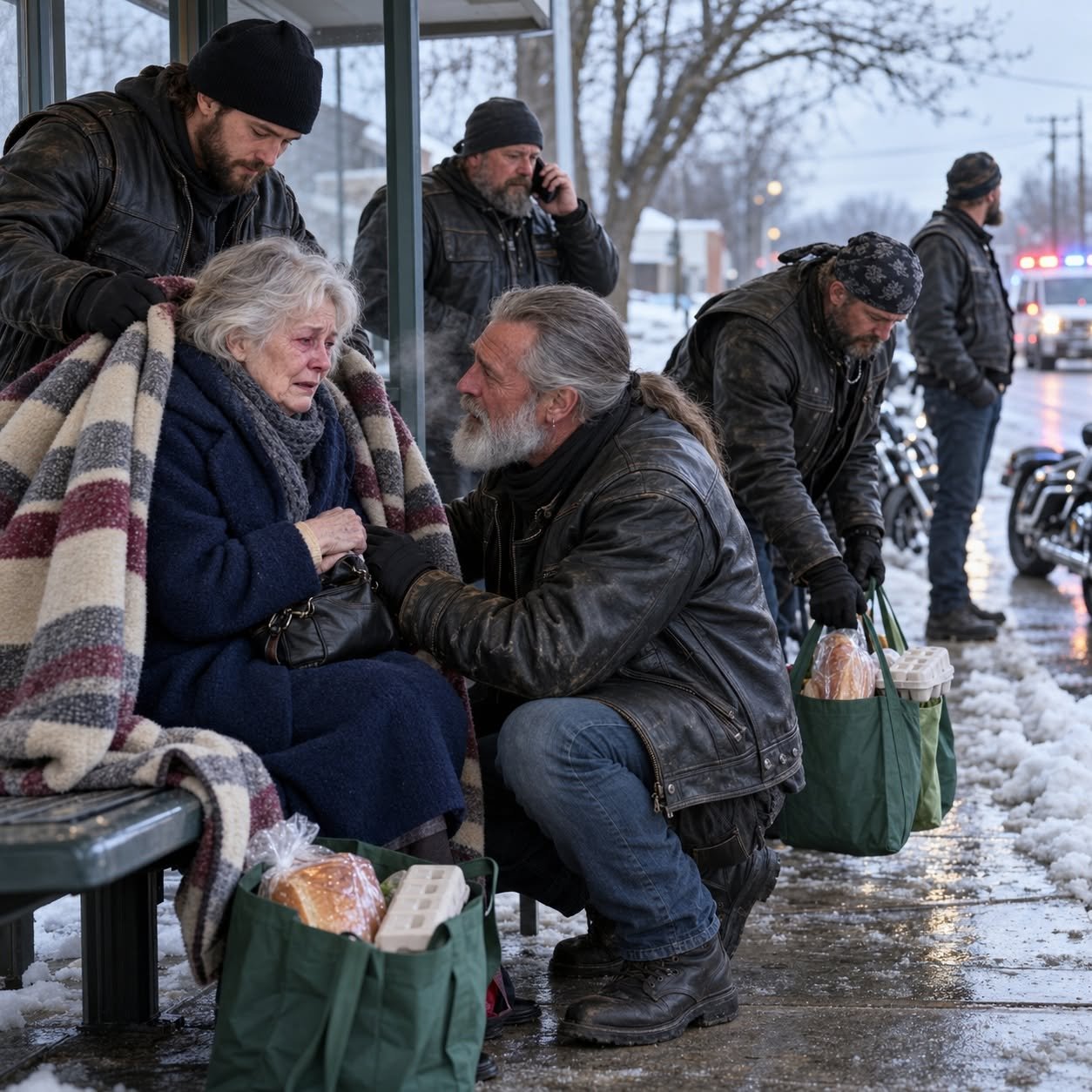
By the forty-seventh car, Margaret Ellis had stopped raising her hand. Her groceries sat beside her feet. She couldn’t feel her fingers, and the bus schedule had become a blur of numbers she no longer understood. Then five motorcycles slowed beside the shelter.
After begging silently for someone — anyone — to stop, Margaret looked at those men in leather and prayed they would keep going.
The Woman Who Made Herself Easy to Manage
Margaret was sixty-two, widowed, and living alone in the Ohio town where she had raised two children and buried her husband. Three months earlier, she had fallen in a supermarket parking lot. A raised seam caught her shoe. Her wrist struck the asphalt first, then her hip. She tried to stand and couldn’t.
People walked past. A teenager glanced down and returned to his phone. A woman hurried around her shopping bag. A little boy pointed, and his mother pulled him closer. Margaret began counting, because counting gave her something to do besides asking again. Twenty-three people. Eventually, a security guard knelt beside her and called for help.
She had a badly sprained wrist and bruising that took weeks to fade. But the part she remembered was the shoes passing her face.
She told her daughter, Amy, that she’d bumped into a cabinet. Amy lived outside Columbus — a job, children, a calendar that always sounded full. Margaret’s son lived in Oregon. She didn’t tell him anything. She was afraid that if she described lying helpless in a parking lot, her children would start discussing where she should live instead of asking how she felt.
So she made herself easier to manage. She declined invitations. Stopped attending book club. Told her neighbor, Carol, that she was busy until Carol stopped asking her over.
When Amy called, Margaret said, “Everything’s fine.” Amy believed her. Margaret wanted her to.
The Walk
By February, her world had narrowed to the kitchen, the television, and the photograph of her husband beside the lamp. Then her car wouldn’t start. It had been clicking for weeks. She’d postponed calling a mechanic because even arranging repairs felt like admitting she needed something.
The grocery store was a mile and a half away. She decided to walk. The morning was cold but manageable. She wore her husband’s old navy coat, added a sweater, and left without the gloves sitting beside the kettle.
Inside the store, she saw a woman from church. “Haven’t seen you lately,” the woman said. “Oh, you know how it gets.” She smiled and hurried toward the checkout.
Margaret bought eggs, milk, bread, chicken, and apples. By the time she stepped outside, a bitter wind had risen. The return walk suddenly seemed much longer. She remembered the bus stop two blocks away. She could wait. Pay her fare. Get home without bothering anyone.
The posted schedule said a bus was due shortly. It didn’t come. Later, she learned the route had been suspended after a breakdown. There was no notice at the shelter.
She called Amy once. The phone went to voicemail. She didn’t leave a message. Then she tried the transit number. By the time she finished listening to recorded instructions, her old phone had shut down.
The wind drove through the shelter’s open side. She stood and waved toward a passing car. The driver looked at her. Kept going.
Cars passed. Some drivers never looked. Others did. She counted until she couldn’t hold the numbers properly. Forty-seven was the last one she remembered.
Then came the motorcycles.
The Question That Broke Her
The lead rider stopped several feet away and removed his helmet. Gray beard. Weathered face. A large man in a jacket covered with patches. Margaret tightened her grip on her purse.
“Ma’am, are you waiting for somebody?”
“The bus.” Her voice sounded thick.
He looked at the empty road, then at my hands. “How long?”
“I’m fine.”
He didn’t argue. He crouched, keeping his distance. “My name’s Ben. What’s yours?”
“Margaret.”
Behind him, one man was already on the phone. Another opened a compartment on his motorcycle and pulled out a blanket. Ben glanced toward him. “Dispatcher’s sending an ambulance,” the man said.
“No,” Margaret whispered. “Please. I just need to go home.”
“We’re going to stay with you.” Someone gently wrapped the blanket around me.
She began to cry. Ben asked whether there was family they could contact. She shook my head so fiercely the shelter seemed to move. Then she heard myself say the thing I had hidden from everyone, the fear that had been quietly running her life for months:
“Please don’t call my daughter. She’ll finally have proof I can’t be trusted to live alone.”
The words hung in the cold air. Ben didn’t flinch. He just nodded slowly, the way you nod when someone hands you something fragile.
“Nobody’s proving anything today, Margaret,” he said. “Today we’re just getting you warm.”
The Men Who Wouldn’t Leave
They stayed. All five of them. One held an umbrella over the shelter’s open side against the wind. One went into the store down the block and came back with hot coffee and a pair of gloves — thick, wool, still tagged. The blanket man turned out to be a retired EMT, and he talked to the dispatcher with the calm of a man who had done this a hundred times.
When the ambulance arrived, Margaret tried to refuse it. Ben crouched again. “Here’s the deal,” he said. “You let them check you over. If you’re fine, I’ll personally make sure you get home with your groceries. No daughter called. That’s a promise.”
She let them check her. Mild hypothermia, the paramedics said. Borderline. Another half hour in that wind and it would have been worse. They warmed her in the rig, and Ben — true to his word — loaded her grocery bags onto his bike like they were the most precious cargo he’d ever carried, and rode her home at twenty miles an hour with the other four forming a slow escort around her taxi of a motorcycle, because Margaret flatly refused to get in the ambulance and Ben flatly refused to let her walk.
The Kitchen Table Confession
At her door, with the groceries on the counter and the heat coming up, Margaret did something she hadn’t done in months: she asked them in. They filled her small kitchen — five enormous men in leather, holding mugs of tea she insisted on making, careful with her good cups.
And then, with the wind still rattling the windows, she told them everything. The parking lot. The twenty-three people. The lie about the cabinet. The invitations declined, the book club abandoned, the neighbor she had pushed away.
“I didn’t want to be a burden,” she said. “So I made myself disappear instead. And nobody even noticed.”
The retired EMT — his name was Sal — set down his mug. “Ma’am, with respect? Disappearing is the one thing that guarantees you’ll become exactly what you’re afraid of. People can’t help someone they can’t see.”
Ben leaned forward. “Margaret, I’m going to say something, and I want you to hear it. Calling your daughter isn’t surrender. It’s the bravest thing you haven’t done yet.”
She cried then — really cried, the way you cry when someone finally says the true thing out loud.
The Call
Ben dialed the number for her. He held the phone while it rang, and when Amy answered, he said, “Ma’am, my name’s Ben. Your mother’s okay. She’s sitting right here. But she’s cold and she’s tired, and I think she’d like to hear your voice.”
Then he handed Margaret the phone and walked the other four men out onto the porch to give her privacy, and they stood in the February cold without a single complaint.
Amy listened. Really listened — maybe for the first time in months, because this time her mother wasn’t saying “everything’s fine.” Amy cried too. She said she was coming that weekend. She said, “Mom, why didn’t you tell me?” And Margaret said the truest thing she had left: “Because I was scared you’d stop asking how I feel and start deciding where I live.”
“I’ll ask,” Amy promised. “I’ll keep asking.”
The Spring
Amy came that weekend, and the next. The car got fixed — Ben knew a mechanic, because of course he did, and the mechanic charged her the “friend of Ben” price, which turned out to be parts plus a lecture about maintenance. In March, Margaret walked back into book club. The women fussed over her exactly as much as she pretended to hate and secretly loved. In April, she started volunteering at the church food pantry twice a week — “giving back,” she said, though Sal pointed out she’d already given plenty just by surviving February.
And every few weeks, five motorcycles roll down her street. Ben checks the porch light. Sal checks her blood pressure “just for fun.” The others check that she hasn’t gone quiet again — because they made her promise, that day in the kitchen, that disappearing was off the table for good.
What Forty-Seven Cars Missed
Margaret keeps the wool gloves by the kettle now. She wears them every time she goes out, and when people ask about them, she tells the story — all of it. The forty-seven cars. The five motorcycles. The blanket. The promise.
“People think those men are the scary ones,” she says. “But scary was standing in the cold while the whole world drove past. Those men were the first people in months who actually stopped.”
She still counts sometimes — old habits. But now she counts different things. The Sundays her daughter calls. The Tuesdays at the pantry. The rumble of engines on her street, right on schedule.
Forty-seven cars passed while Margaret Ellis froze at a bus stop. It took five bikers to teach her what she had forgotten since her husband died: that needing help is not the same as being helpless — and that the bravest thing a person can do is let herself be seen.


