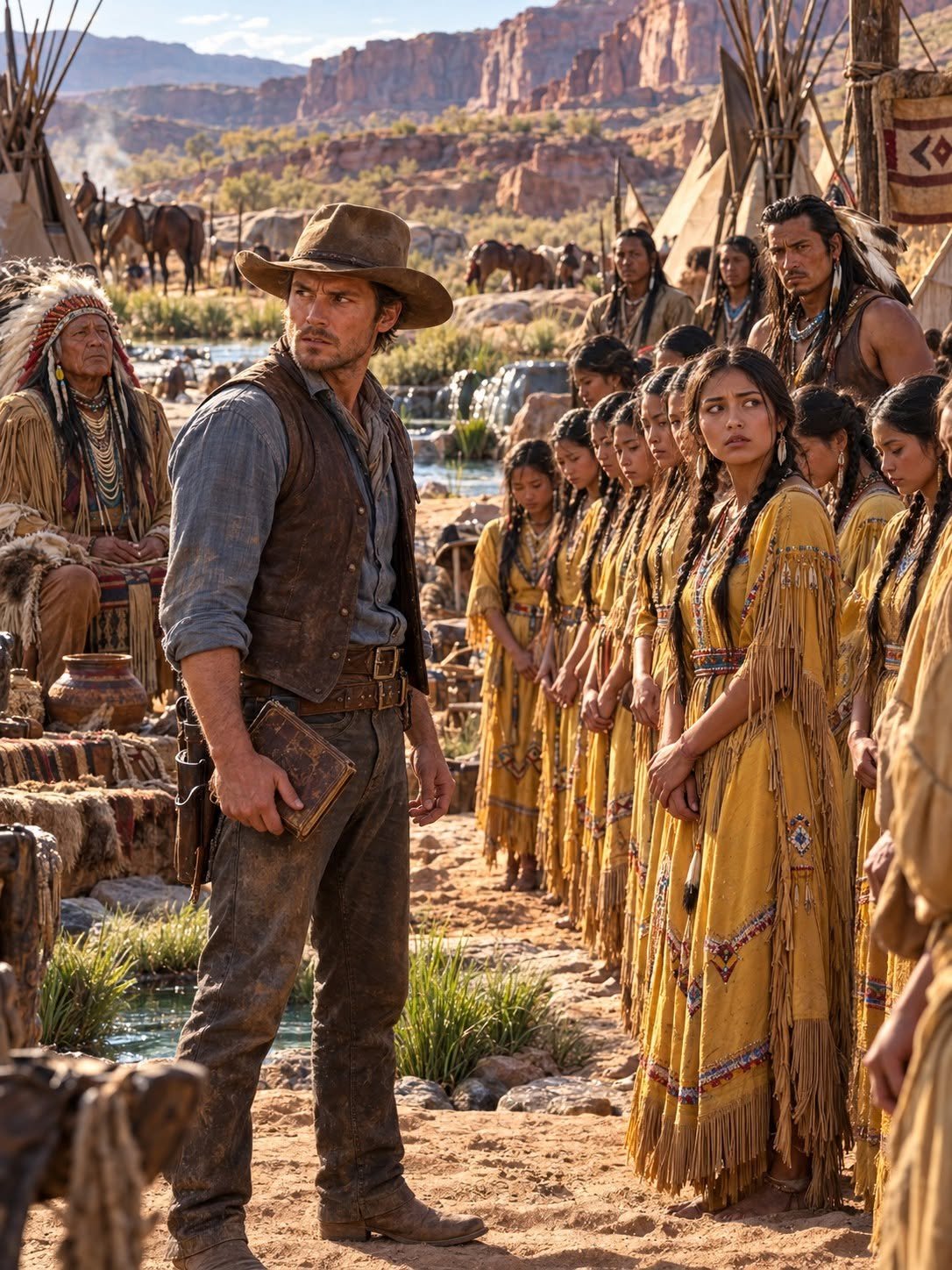
My name is Elias Boone. I was thirty-one years old when I saved forty strangers from dying in the Arizona desert, and I never imagined that their gratitude would lead to the strangest — and most dangerous — marriage proposal of my life.
It was 1883, and I had spent years avoiding people. After losing my family to fever and being betrayed by men I had trusted with my life, I had decided that being alone was safer than loving anyone. All I owned in the world was an aging horse, a good rifle, and an old leather journal that had once belonged to my father. That journal was the reason forty people survived. And it was nearly the reason I lost my freedom.
I was crossing a dry riverbed one blistering afternoon when my horse stopped dead and refused to move another step. I climbed a nearby ridge to see what had spooked him, and the sight below turned my stomach. Nearly forty Apache people were struggling across the burning sand — women carrying exhausted children, old men stumbling between the rocks, and one young mother clutching an infant that had gone frighteningly quiet. They had been driven from their homeland by soldiers and forced through country where every waterhole had gone dry.
I knew that helping them could bring soldiers or settlers down on my head. For a long moment, I sat on that ridge and considered riding away. Then my father’s voice came back to me, the way it always did when I needed it most: “A man isn’t measured by the trouble he avoids, son. He’s measured by the lives he refuses to abandon.” I turned my horse around and rode down toward them.
Their leader stepped forward as I approached — a weathered man of about fifty-eight named Red Hawk, exhausted but carrying himself with the dignity of a chief. I offered him my canteen. He looked at me with suspicion, accepted it, and then — instead of drinking — turned and passed it to a weak child. Only after the others had all taken a little did he allow himself a sip. That told me everything I needed to know about the man.
“I might know where there’s water,” I told him. A younger warrior stepped forward at once — Tomas, Red Hawk’s twenty-seven-year-old nephew, his eyes hard with distrust. “Why should we trust you?” I couldn’t blame him for asking. “Because if I wanted you dead,” I said, “I’d have kept riding.” He didn’t smile. Neither did I.
I opened my father’s journal and thumbed through the worn pages until I found the passage I had read years before. It described a strange rock formation called the Stone Hawk, and according to my father, when its afternoon shadow pointed east, a hidden spring could be found beneath the desert floor. I had never seen the place myself. But it was the only hope we had.
We traveled slowly through the brutal heat, every step harder than the last. One woman collapsed, and Tomas lifted her in his arms and carried her across the rocks without a word of complaint. He distrusted me, but I could see how fiercely he loved his people. At last I spotted it — a massive stone formation rising above the desert like a great bird spreading its wings. “The Stone Hawk,” I whispered. Red Hawk studied the cliffs. “You are certain?” “No,” I admitted honestly. “But my father believed it.”
We reached the formation before the sun stood in the right position, and the waiting nearly killed us. A small child grew dangerously weak, and I knelt beside her and gave her the last drops of water I had saved for my own return journey — every single drop. Tomas watched me in silence. Then, at last, the afternoon shadow swung across the ground. I followed my father’s directions, counted the steps, and began to dig. Sand. More sand. Then my shovel struck stone. Red Hawk dropped to his knees beside me, and together we hauled the rocks away. Suddenly dark moisture bloomed beneath the soil — and then water began to rise. Real water. The exhausted people cried out. Some fell to their knees. Others wept openly. I stood there with trembling hands, staring at the miracle my father had left behind, and for the first time in years, I wished he were alive to see it.
Over the following days, the camp transformed. Children laughed again. Families raised temporary shelters. The people who had barely survived were beginning to truly live. I planned to slip away quietly — a lone rider has no place in a tribe’s celebration — but Red Hawk asked me to attend a council gathering. “You saved our people,” he said. “Such a debt cannot be forgotten.” I told him I wanted no payment. He shook his head gravely. “You gave us life. We must honor that.”
The next morning, I walked into the council circle and stopped cold. Twenty-two unmarried women stood gathered before me, and Red Hawk faced me with great solemnity. “You may choose a bride,” he announced. I thought I had misunderstood. “A bride?” He nodded, as if this were the most natural thing in the world.
I looked around the circle, stunned — and one woman caught my attention. Her name was Mara, Red Hawk’s twenty-five-year-old daughter. She was intelligent and beautiful, with a confidence that set her apart. But she looked deeply uncomfortable, and every few moments her eyes drifted toward Tomas. Then I understood. Those two were in love — quietly, desperately, and hopelessly, because a chief’s daughter does not choose a warrior nephew without her father’s blessing, and Red Hawk’s honor stood between them like a wall.
Later, Mara found me alone and spoke barely above a whisper. “Please don’t choose me.” I met her eyes and said simply, “I won’t.” The relief that washed over her face nearly broke my heart. But Tomas was not convinced. He confronted me away from the fires. “Are you planning to take Mara?” “No.” “My uncle expects you to accept his gift.” I sighed. “Tomas, I didn’t save your people to be handed a wife.” He stared at me for a long moment. “Then what will you do?” I looked toward the council fires and admitted the truth: “I don’t know yet.” His voice dropped. “I love her. But my uncle’s honor comes before my happiness.” I shook my head. “Love without a choice isn’t love.” He fell silent, and I could see the war raging behind his eyes.
That night I sat alone under the desert stars with my father’s journal open in my lap, and I faced the terrible arithmetic of my position. Refuse Red Hawk publicly, and I would insult the chief of the people I had just saved — the man who had given water to a child before drinking himself. Accept, and I would destroy Mara and Tomas, taking a woman whose heart belonged to another. My father had written something on the last page of that journal that I had read a hundred times: “The greatest gift a man can give is to set another man free.” I read it again, and slowly, a plan began to form — not a refusal, and not an acceptance, but something my father would have been proud of.
When the council gathered the next morning, all forty people stood watching. Red Hawk rose and gestured to the circle of women. “Choose,” he said. The silence was so complete I could hear the wind moving through the canyon. I stepped forward, and instead of looking at the women, I looked straight at Red Hawk. “Chief,” I said, “you honor me beyond anything I deserve. But I cannot choose.”
A murmur ran through the crowd. Tomas went pale. Red Hawk’s face hardened — and then I kept speaking before the insult could take root. “A gift this great cannot be repaid with a refusal, and it cannot be accepted by taking what belongs to another man’s heart.” I turned then, and looked directly at Tomas, and then at Mara. “I ask instead for the one honor greater than a bride,” I said. “I ask you, Chief Red Hawk, to give your daughter Mara to the warrior who loves her — to Tomas, your own nephew, who carried the weak across the rocks and never left a single one of your people behind.”
The silence that followed was the longest of my life. Mara’s hand flew to her mouth. Tomas stared at me as if I had struck him. And Red Hawk — the proud chief who had offered me twenty-two brides — stood perfectly still, his dark eyes moving from my face to his nephew’s to his daughter’s. I had gambled everything on what I had seen in him that first day: a man who gives water to a child before drinking himself is a man who understands that love given freely is worth more than honor taken by force.
Slowly, Red Hawk walked to Tomas and placed a hand on his nephew’s shoulder. Then he turned to Mara, and his stern face softened into something I had never seen there before. “My daughter has been waiting for her father to see what was in front of him,” he said. “It took a stranger to open my eyes.” He raised his voice so the whole tribe could hear. “Tomas! Mara! You will be married at the new moon — and this wedding will celebrate not only your union, but the survival of our people, and the friend who gave us water when we were dying.”
The cheer that rose from those forty people shook the canyon walls. Mara wept openly. Tomas seized my hand in both of his, unable to speak. And Red Hawk himself embraced me — a chief’s embrace, before his whole tribe — and named me “He-Who-Brings-Water,” a friend of the people forever. That night they feasted, and Mara and Tomas sat together openly for the first time, her head on his shoulder, and I have never seen two people so happy.
I rode out three days later, my canteen full and my heart fuller. Red Hawk walked beside my horse for the first mile, and before he turned back, he said something I have carried with me ever since: “You refused twenty-two brides, Elias Boone, and gained forty brothers and sisters instead. That is the trade of a wise man.”
Years later, a rider found me in a border town with a message wrapped in deerskin: Mara and Tomas had a son, strong and loud, and they had named him Boone. I keep that message in my father’s journal, on the page where he wrote about setting another man free. I spent years believing that being alone was safer than loving anyone. The desert taught me otherwise. Sometimes the bravest thing a man can do is not to take what is offered — but to give back something even greater, and ride on knowing that forty people are alive because he refused to abandon them.