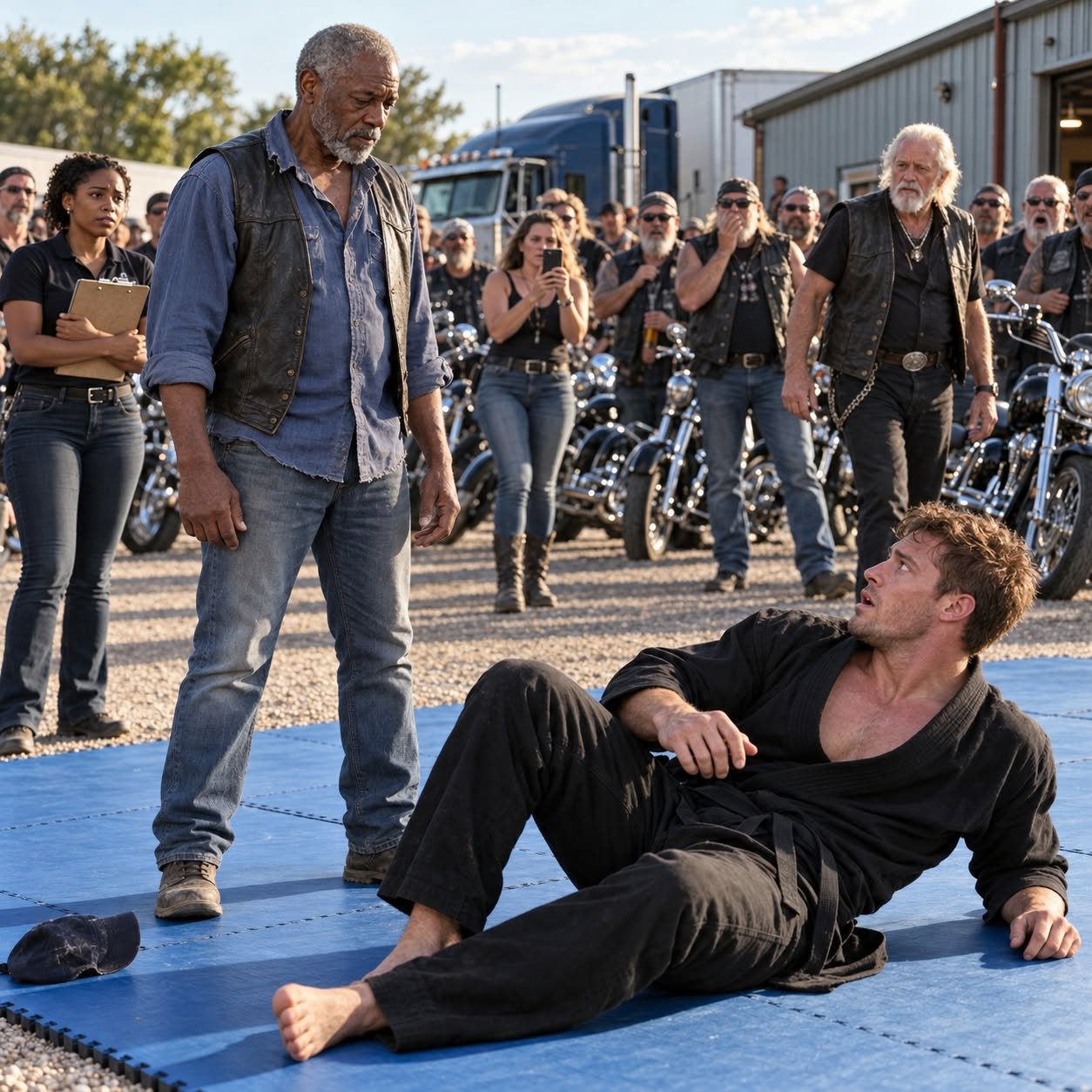
He took my delivery receipt, slipped it into his pocket, and pointed toward the training mats.
“Last ten seconds with me, Grandpa, and I’ll sign.”
I had driven three days for that signature. My overdue property taxes were due Monday.
Then he stepped on the cap my wife had bought me before she died.
My name is Leon Carter. I was sixty-five that fall, Black, and tired enough the morning I rolled into Texas to feel every mile between Oklahoma City and the gravel lot outside the Iron Ridge Riders clubhouse.
I wasn’t there to fight. I was there to deliver a load of motorcycle parts, collect a proof of delivery, and get home while I still had a home to get to.
The property-tax notice lay on my passenger seat beside a photograph of Ruth.
We had lived in our little white house for thirty-two years. She planted roses along the walkway and insisted on painting the porch yellow, because, according to her, I brought enough gray into a room by myself.
After Ruth died, I kept working. What I didn’t keep up with was everything else. Repairs waited. Bills slipped. I opened important envelopes, set them down, and somehow found them again weeks later. This load would cover the last payment on the arrangement I’d made with the county.
All I needed was a name at the bottom of a page.
The Iron Ridge Riders were celebrating their club anniversary when I arrived. Motorcycles filled the lot. Someone was grilling under a canopy. Near the clubhouse entrance, a young man in a black martial arts uniform was throwing volunteers onto blue mats, and every landing brought applause.
A woman followed him with a phone mounted on a small stabilizer, streaming it all live.
A young staff member named Tasha met me beside the truck. She checked the shipment, offered me water, and I liked her immediately. Then she glanced toward the mats.
“Brent has to approve the receipt.”
Brent Lawson was thirty-two, broad-shouldered, and accustomed to people moving when he spoke. He noticed us before Tasha could call him over.
“Hey, truck driver,” he said. “Come help with a demonstration.”
“No, thank you,” I said. “Just need a signature.”
He turned toward the phone. “Looks like we’ve got ourselves a motorcycle thief. Perfect practice.”
A few men laughed. I’d heard that kind of joke before. The speaker always wants you to understand exactly why he chose you, while leaving himself room to claim you were being sensitive.
I held up the clipboard. “Where would you like the freight unloaded?”
Brent walked over and pulled the receipt from beneath the clip. He read it, smiling. Then it disappeared into his pocket. That was when he offered his ten-second deal.
Tasha stepped forward. “The order is complete. We need to unload him.”
“Go handle the food.”
“I’m handling deliveries.”
Brent looked at her until she stopped speaking. I held out my hand.
“Give that back, please.”
He flicked the brim of my cap. I stayed still. He did it again. The third time, it fell.
Ruth had bought that cap at a county fair during our last summer together. Navy blue, plain, with a crooked adjustment buckle she’d said gave it personality.
Brent put his boot on it.
Something inside me became very quiet.
“Pick it up,” I said.
He looked delighted. “There he is.”
“Pick up my cap. Give me my paperwork. Then I’ll leave.”
He grabbed the front of my leather vest. Two buttons snapped off my work shirt. There was a metal step behind my heel and Tasha was too close, so I didn’t fight him there — I moved with him instead, keeping my feet under me while he dragged me toward the mats.
People made room. Phones rose. Nobody put one down to help.
At the edge of the blue square, he shoved me and announced what he planned to do. “The Carter reversal,” he told the camera. “Old-school counter. Most of you won’t even see it.”
For the first time that morning, I nearly laughed.
Thirty-eight years earlier, a tournament commentator had put my surname on a variation my coach and I had spent months perfecting. I never liked the name. My coach used to say the important part wasn’t what people called a technique — it was knowing when you had no business using it.
Brent clearly hadn’t learned that part.
The woman with the phone started a timer. Someone shouted, “Ten seconds!”
I looked at Brent. “One more chance. Let me go back to work.”
He reached for my collar. I shifted my weight. His balance went past the point where his strength could help him, and he landed on the mat hard enough to lose his breath.
I stepped back. He got up angry and came at me again. This time I brought him down and held him until his palm struck the mat flat.
When I released him, he didn’t reach for my hand. He reached for his phone.
Minutes later, my dispatcher called. “Leon, the customer says you assaulted him and damaged the shipment. Payment’s on hold.”
Across the lot, Brent smiled at me and turned his screen around. The video began with me throwing him. Everything he had done before that — the taunts, the receipt in his pocket, Ruth’s cap under his boot — was gone.
I stood there in the gravel with my broken shirt buttons and my crushed cap, and I did the math the way a sixty-five-year-old man does math: three days of driving, frozen pay, taxes due Monday, and a house with a yellow porch I was about to lose. I picked up my cap, brushed the dust off it the way Ruth used to brush lint off my shoulders, and walked back to my truck to wait.
Tasha found me there twenty minutes later. She was holding her own phone, and her hands were shaking.
“I saved the livestream replay,” she said. “The whole thing. Before he could get it taken down.”
The full video showed everything: the stolen receipt, the cap, the ten-second stunt, the crowd laughing. It showed a tired old delivery man asking three times to be left alone to do his job.
“The president’s inside,” Tasha said. “He doesn’t know any of this yet. Come with me.”
The Iron Ridge Riders’ president was a man named Walt Garrett, Jr., in his fifties, with the weathered look of someone who’d spent his life on two wheels. He watched Tasha’s phone from start to finish without blinking. When the video ended, he looked at Brent — who’d followed us in, still smug — and then he looked at me.
“Stand up, old-timer,” he said quietly. “Let me see that vest.”
I stood. He stepped close and turned back the inside lining of my vest, where I’d sewn a faded patch forty years ago to keep it safe — the original Iron Ridge Riders emblem, from before the club changed its colors, from the days when it was just a dozen men riding out of a garage in Tulsa.
Walt Garrett, Jr. stared at it. And then this big, hard man started to cry.
“My father rode with this patch,” he said. “Walt Garrett Senior founded this club. He talked about a man named Leon Carter until the day he died — the rider who pulled him out of a burning bike on Route 66 in ’74 and then walked away from racing to take care of his family. He said Leon Carter was the best man he ever knew.”
The room went silent. Brent’s smile was gone.
“He also said,” Walt continued, “that the day Leon left, the club lost its conscience.”
Walt turned to Brent. “You stole a working man’s pay. You desecrated his wife’s memory on camera. You posted a lie to ruin him.” His voice didn’t rise. It didn’t need to. “You’re done here. Patch off. You’re barred from every chapter, and I’ll be sending the full video to every one of them with your name on it.”
Then he turned back to me. “Mr. Carter, your payment is released — with a bonus that covers every mile you drove to get here. And the taxes.” He paused. “My father would never forgive me if I let the county take the house of the man who saved his life.”
Brent tried to apologize. I stopped him with one look — not anger, just weariness. “Son,” I said, “the mat taught you the throw. It didn’t teach you the man.” He left the clubhouse with his uniform in a bag, and I never saw him again.
That evening, the club held a small ceremony. They hung a photograph on the clubhouse wall — Walt Senior and a young Leon Carter, arms over each other’s shoulders, leaning on their bikes in the Tulsa sun. Under it, a brass plate read: OUR CONSCIENCE.
Tasha handed me a box. Inside was a new navy cap with a crooked adjustment buckle — she’d had it made special — and embroidered inside the band, in small yellow thread, one word: Ruth.
I drove home through the night with that cap on my head and my old patch back where it belonged — not hidden in my vest anymore, but sewn on the outside, where it could be seen.
Monday morning, I walked into the county office and paid the taxes in full. Then I drove home, parked the truck, and sat on the yellow porch for a long time, looking at Ruth’s roses.
“We’re keeping the house, baby,” I told her photograph. “And they remembered.”
The wind moved through the roses, and for just a moment, I swear I could smell her perfume in it — and hear her laughing at that crooked little buckle, saying it had personality.


