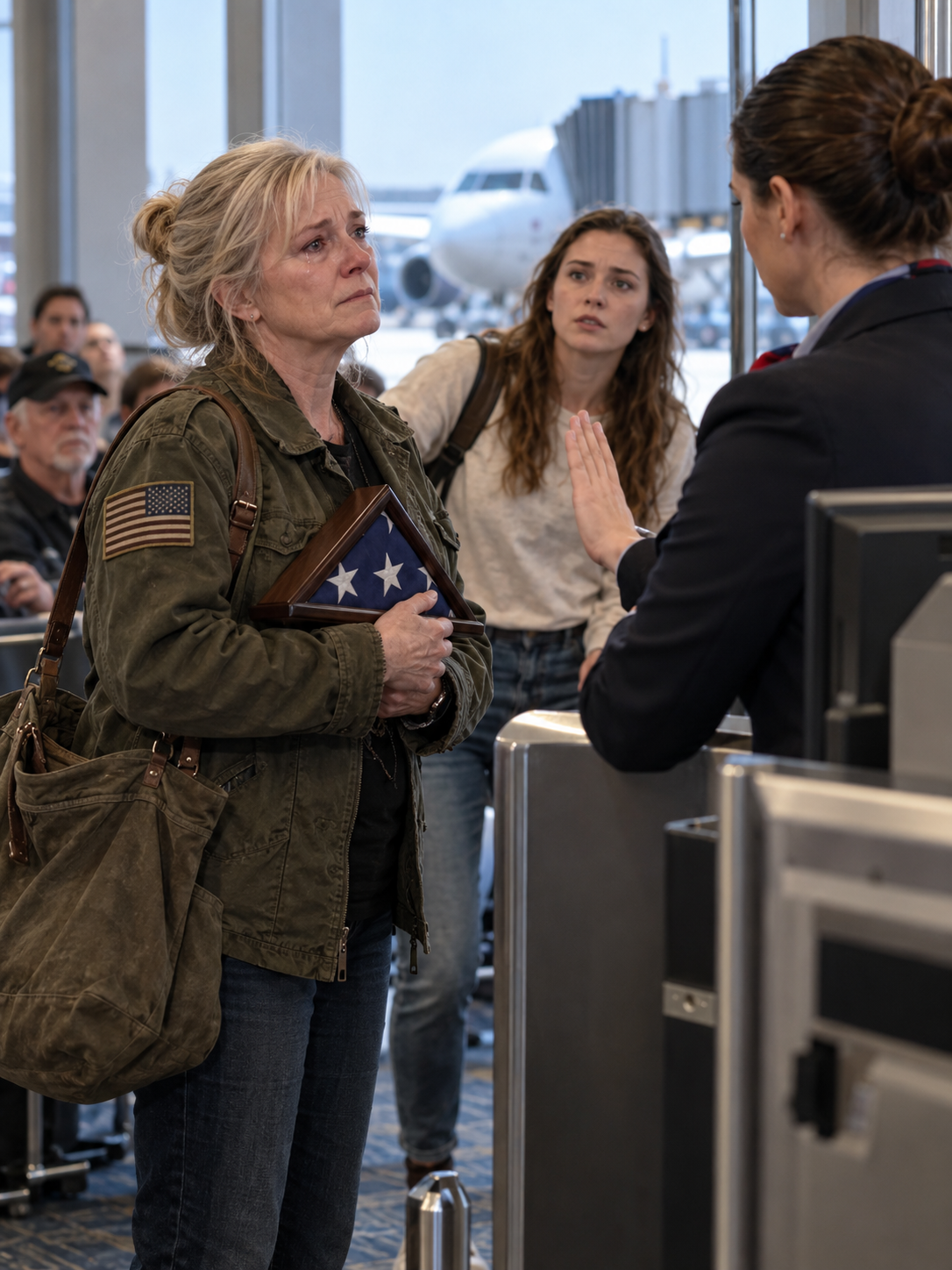
At the airport gate, retired Army medic Erin Shaw held a triangular flag case against her chest while an airline employee told her she could not board with an extra item. Her carry-on fit the allowance. The case had belonged to her brother. Erin’s eyes moved from the waiting aircraft to the clock above the gate.
Erin was fifty-nine and traveling to a family remembrance in another state. She had packed light because she wanted to carry the flag herself. Her brother had served years before her, and the case was the one thing their mother had asked her to bring. The thought of checking it with luggage made her uneasy.
The employee, Dana, said the rigid case exceeded the personal-item rule. Erin asked whether it could count as her one carry-on if she checked the small bag instead. Dana said the flight was full and the bag-check cutoff had passed. Passengers behind Erin began moving around her toward the scanner.
A young woman, Priya, stood from the seating area. She had seen Erin measure the case against the carry-on frame without a problem. She asked Dana whether the issue was size or the number of items. Dana said it was both, then checked the dimensions again. Erin stayed quiet, afraid an argument might cost her the last flight that evening.
Erin had spent years helping frightened people in difficult places. She disliked being the center of a gate dispute. But the flag case was not something she could casually hand to a stranger. She asked whether the supervisor could review the options while boarding continued, and Dana made a call.
Priya offered to place Erin’s soft bag inside her own empty tote. Erin thanked her but declined; she did not want another passenger responsible for her belongings. Dana overheard and said even that might violate the boarding rule. The conversation hardened until everyone seemed to be defending a position rather than finding a workable arrangement.
Erin opened the small bag to show that it held a sweater, a book, and a photograph. She was willing to check it. The supervisor arrived and asked for the boarding pass. Priya noticed a handwritten note on the back of the photograph, visible for an instant before Erin put it away.
The note read, “Tell them how she carried me home.” Priya did not know who had written it. She did know the words had made Erin stop breathing for a moment. She asked the supervisor to give Erin a minute and to explain the rule clearly, one option at a time.
The supervisor checked the current cabin allowance. The flag case fit the carry-on dimensions. The soft bag could be gate-checked as an ordinary carry-on, despite the earlier statement about the cutoff; that deadline applied to a different baggage process. Dana had combined two rules during a rushed boarding call.
Erin accepted a printed tag for the bag and carried the flag case onto the plane. The supervisor asked a colleague to make sure it would fit safely in an overhead bin without anything pressing against the glass. He did not promise special treatment, only ordinary care for a permitted item.
Priya boarded a few rows behind. Erin thanked her again while they waited in the aisle. Priya said she had not done much. Erin said asking a question when everyone else was walking past had given her time to think. She had almost surrendered the case simply to avoid holding up strangers.
During the flight, Erin looked at the photograph. It showed her brother, Michael, standing beside their mother at a backyard picnic. The note was from their mother. After Michael died, Erin had brought the flag home from the ceremony and held it on the long drive because their mother could not bear to have it out of sight.
Their mother had died the previous spring. The family remembrance would gather both generations around the stories they had told at that picnic. Erin had been carrying more than a case through the airport, though she knew Dana could not have understood that from the boarding pass alone.
At the arrival gate, the soft bag came back with its tag attached. Dana’s supervisor had filed a correction to the gate notes so the staff would distinguish cabin allowance from bag-check timing. Erin received an apology by email later. It did not erase the minutes she had spent believing she might miss the flight, but it was specific.
At the gathering, Erin placed the flag beside the photograph. Her niece asked why her grandmother had written the note. Erin told the story of the drive home. She also told the niece that asking for help at an airport had felt harder than she expected. The room answered with the gentle laughter that follows an honest admission.
Priya sent no message and expected none. She returned to her own life after the flight. Erin occasionally remembered her standing near the gate, willing to ask whether the case actually broke a rule. They had been strangers for fewer than twenty minutes. Those minutes still mattered.
Erin did not believe every employee should be able to infer a passenger’s private grief. She did believe rules should be checked carefully before they are used to stop someone. A clear answer would have spared everyone the scene, and a little patience had made the answer possible.
The flag case traveled home with her after the remembrance. She put it on a shelf near her own service photograph, leaving space for a picture of Michael and their mother. Once a week she dusted the glass. The practical act helped her feel that the people behind the objects were still being cared for.
At another airport months later, Erin saw a passenger struggling with a different baggage rule. She did not assume the answer; she suggested asking which written allowance applied. It was the question Priya had asked for her. The employee checked and explained. Sometimes the solution was yes; sometimes it was no, but at least it was clear.
What stayed with Erin was the moment at the gate when she thought she would have to choose between a family promise and a seat on the plane. The choice had never been required by the actual rule. A stranger’s calm question gave the staff a chance to read it again, and gave Erin the chance to carry the flag herself.


