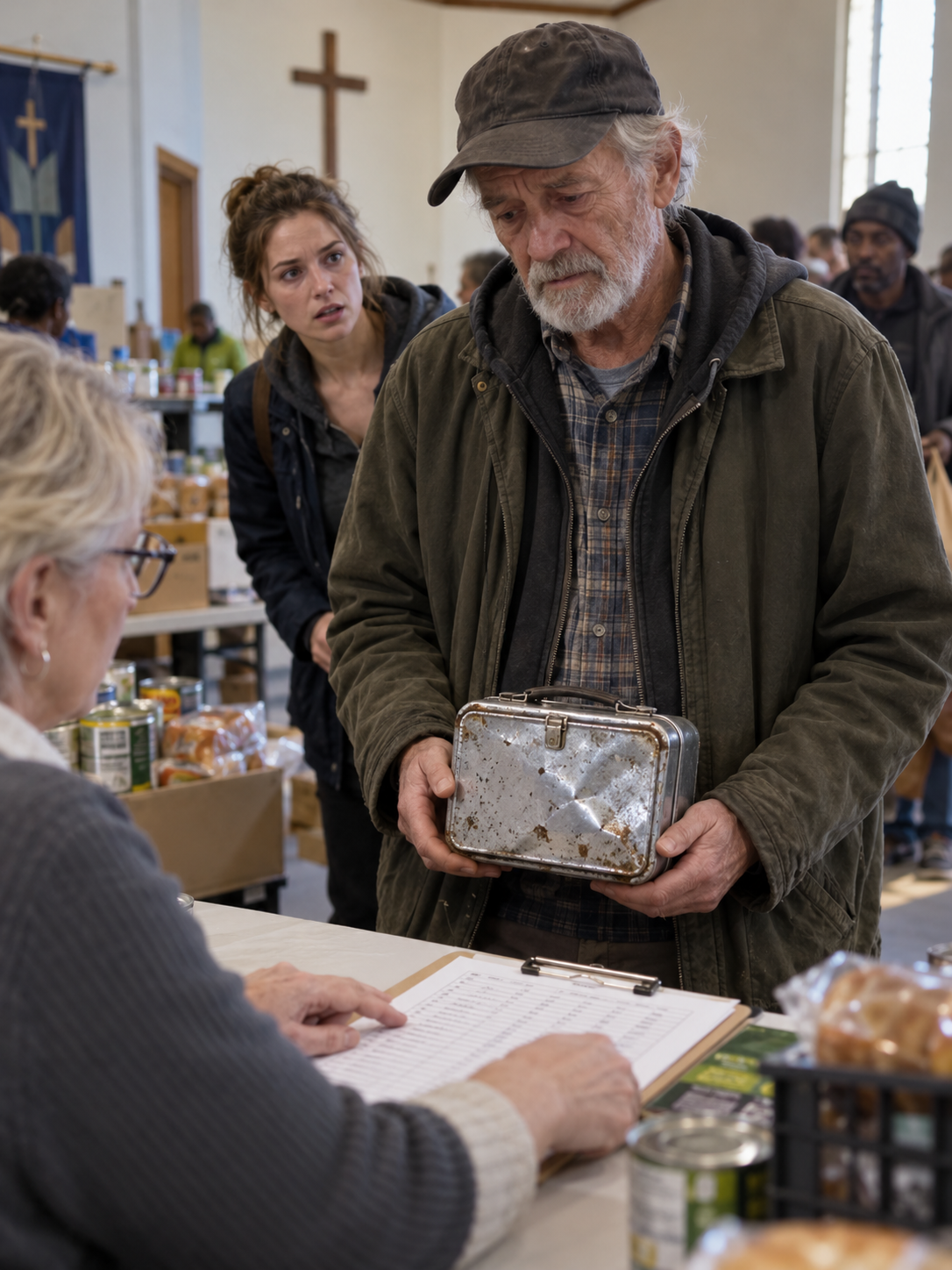
At the church pantry, a volunteer searched the printed list and shook her head. Samuel Price held a dented metal lunchbox against his coat. He had ridden two buses for a food parcel his neighbor said had been reserved. Behind him, a young woman stared at the lunchbox as if she had seen it somewhere before.
Samuel was sixty-three and newly widowed. His wife, Lena, had once volunteered at the pantry on Tuesdays. He had avoided returning after her funeral, even when the refrigerator at home grew sparse. That morning a neighbor had made the call for him, carefully spelling his name and reading the pickup time back twice.
The volunteer, Beth, said there were no parcels under Price. She had a long queue and did not know Samuel. When he asked whether the list could be checked again, she pointed toward a table for walk-ins. The parcels there were already gone. Samuel thanked her automatically, then stood still because he had nowhere else to go.
The younger woman was Lena’s former helper, Nia. She knew the lunchbox: Lena had used it to carry sandwiches and a pencil for labeling bags. Nia stepped forward, surprised that Samuel had brought it. He told her it was the only bag he had found by the door that morning. He had not known anyone would recognize it.
Beth repeated that the name was absent. Nia said Samuel should not have to prove a relationship to receive help, and Samuel agreed. He did not want Lena’s years of service used as a special ticket. He wanted to understand why the neighbor’s reservation had vanished and whether there was a parcel for someone who needed it.
Nia checked the volunteer notebook and found a phone message from the neighbor. The entry was not filed under Price; someone had written “Sam P.” on a loose page that never reached the pickup table. Beth frowned at the notebook. She had believed the printed sheet was complete because nobody had told her about the second page.
Samuel said he could return tomorrow. Nia knew how hard it had been for him to come today. She asked the coordinator to check the prepared bags before he left. Beth looked at the line and at Samuel’s empty lunchbox, then opened the storage-room door without another argument.
Inside sat a parcel labeled in Lena’s unmistakable slanted handwriting. Nia stopped. Lena had been gone for months. Beth explained that the label had been reused from an old sorting bin, but the date beneath it was new. Samuel looked closer. The name written on the paper was not his.
It was the neighbor’s name. She had ordered the parcel for Samuel but asked staff to use her own details because he was not yet registered. The coordinator found the phone message and confirmed it. No one had saved a parcel under Price, but the food had been ready all along, one shelf away from the place Beth was checking.
Samuel insisted that the neighbor should be thanked, not scolded for the confusion. The coordinator agreed and gave him a simple registration form for future visits. Beth packed the parcel with him at the table, asking which items he could use and which another household should have. His answers became steadier as they worked.
Nia asked about the lunchbox. Samuel opened it and showed a folded index card with Lena’s old pantry recipe for bean soup. On the back she had written, “Ask if they need help carrying it.” He had found the card that morning and brought it without fully knowing why. Nia recognized the handwriting immediately.
For years, Lena had quietly walked bags to the bus stop for people who did not want to admit they were struggling. Samuel had known she volunteered but had not known about that habit. Nia told him how Lena remembered the names of children and which older visitors needed items they could open without a can opener.
Samuel sat down on a folding chair. He had come for food and encountered a piece of his wife’s life that grief had kept him from seeing. Beth brought him water. There was no speech and no public collection. Nia simply waited while he held the card and let the room be quiet around him.
The coordinator fixed the process before the next pantry day. Phone reservations were entered into one list, with the person receiving the parcel clearly noted even when someone else made the call. Beth suggested a separate note for names that might be abbreviated. It was not an elaborate system, but it addressed exactly what had failed Samuel.
At the bus stop, Nia carried one bag because the lunchbox occupied Samuel’s hands. She asked whether he would come back next Tuesday. “If I need to,” he said. Then he added that perhaps he could help label parcels for an hour. He had not been ready to stand where Lena once stood, but he was ready to consider it.
His neighbor met him at the apartment steps and apologized for using her own name. Samuel told her the parcel had been waiting. He thanked her for making the call in the first place. He cooked the bean soup that evening, following Lena’s card and adjusting the seasoning the way she used to complain he always did.
The following week he returned with the lunchbox. Beth greeted him by name before looking at a list. Nia set out blank labels and a pencil. Samuel spent an hour writing carefully and asking people whether they could carry their bags. Each question felt like a small conversation with Lena, carried forward rather than repeated exactly.
Some days he came only to collect food. Some days he stayed to help. The pantry did not turn grief into a tidy lesson, and it did not make every hard month easy. It gave Samuel a place where asking for help and offering help could happen in the same room, without either role defining him forever.
Beth kept the loose-page notebook as a reminder while the new list settled into use. She told new volunteers about a man who had nearly been sent away because they had checked only one page. She did not mention his marriage or his lunchbox; those parts belonged to Samuel, not to a training story.
On the bus home, Samuel rested the dented metal box on his knees. It still held the recipe card, now protected in a clear sleeve. He had come to the pantry afraid people would see only a widower in need. Instead, someone had recognized Lena’s lunchbox and helped him find a way to be seen as himself.


