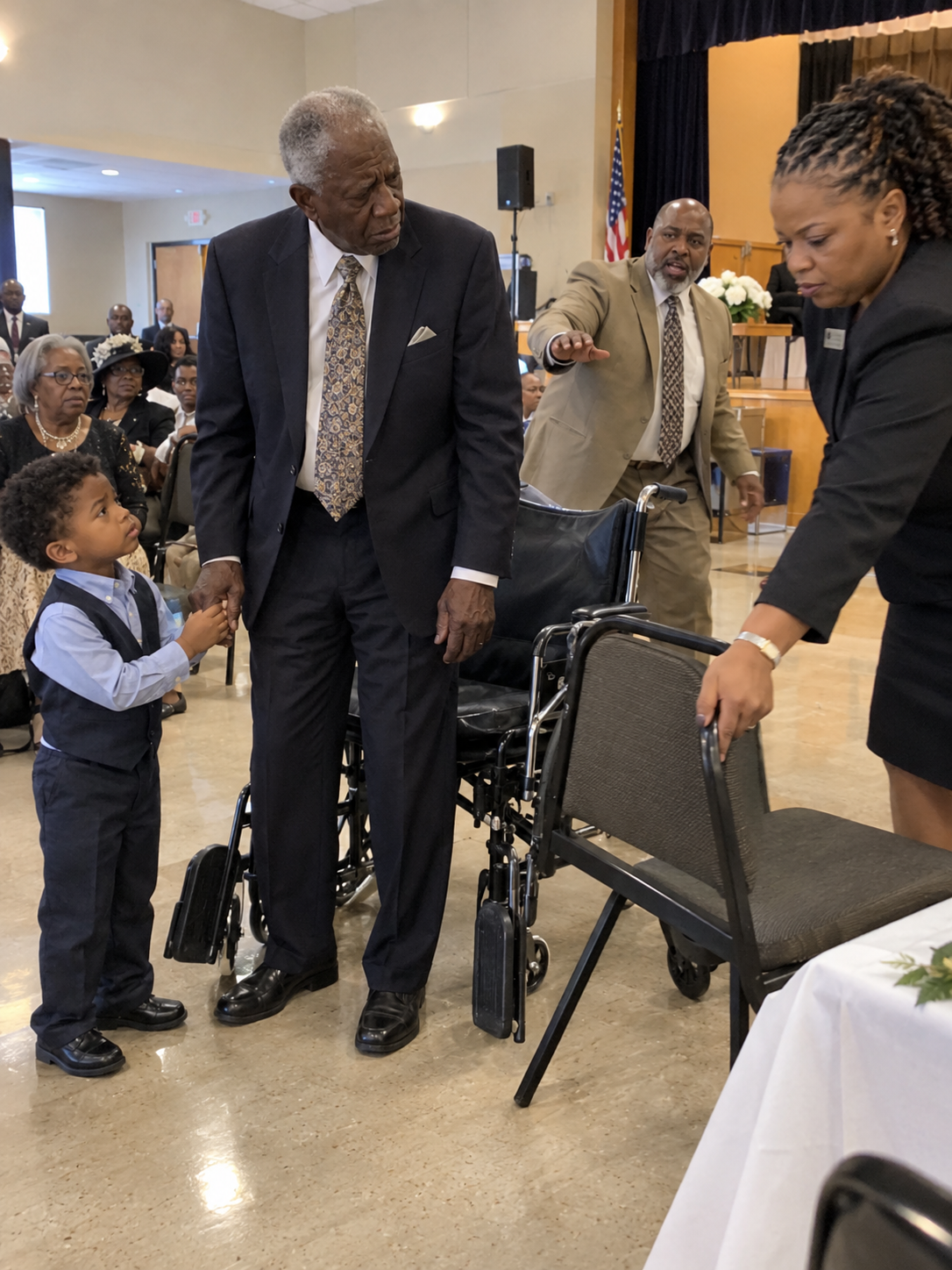
The chair disappeared just as Isaiah Reed arrived with his grandson. At eighty-three, Isaiah walked slowly and relied on a wheelchair when the distance was long. A ceremony organizer said the front row was reserved for honorees. The little boy looked from the empty spot to the medal in his grandfather’s hand.
Isaiah had been invited to a community celebration for the people who restored the town’s old recreation center. Years earlier, when the building’s roof leaked and the city considered closing it, he had organized neighbors to patch walls, raise funds, and keep the doors open for children.
His grandson Noah had never seen the center as anything but a busy place. To him, it smelled of basketball wax and popcorn. Isaiah remembered winters when buckets lined the hallway to catch rain and volunteers played music loudly so children would not hear the water dripping.
The invitation had promised accessible seating near the stage. Isaiah’s daughter had called ahead to confirm the arrangement. She was parking the car when he and Noah entered. An organizer moving chairs quickly assumed the space was meant for a different guest and folded the chair beside the aisle.
Isaiah explained that he had been invited. The organizer looked at his worn suit and said she could not verify that without a program. Noah held up the folded invitation. She glanced at it, then said they should wait in the back until the schedule was settled.
People were already taking their seats. Isaiah’s knees hurt from the short walk inside, and the wheelchair needed a clear turning space. Noah stood close, trying to make himself taller. “Grandpa helped build this place,” he said. His voice carried farther than he expected.
The organizer told Noah not to interrupt. Isaiah asked his grandson to be respectful, then repeated the seating request himself. He did not want a special speech, just the place he had been told would be ready. The exchange became public because the room had gone quiet.
Isaiah’s daughter came in carrying the parking ticket and saw the wheelchair beside a blocked aisle. She asked where the designated space had gone. A man who had helped Isaiah with the roof stood up and identified him to the organizer. Another volunteer showed the original seating plan.
The organizer realized the space had been changed while rearranging the front row. She apologized and cleared the aisle. Isaiah accepted the chair Noah brought over but said the access problem should be fixed before anyone else arrived. An apology would not help the next guest if the furniture stayed there.
Staff moved two tables and marked a clear route to the stage. The ceremony began late. The director opened by acknowledging the delay and the mistake, then asked Isaiah whether he would still be willing to say a few words. He looked down at Noah and nodded.
Isaiah had prepared a speech about donors and repairs. Instead, he told the room about a child who used to sit beside him while he painted the gym doors. The child had wanted to know why adults were working on a building they did not own. Isaiah had replied that a neighborhood belonged to everyone who cared for it.
Noah knew the answer before the rest of the room did: the child had been his mother. She covered her face and laughed. Isaiah reached for her hand, and the story became less about an old building than about how a habit of showing up can pass through a family.
The director presented a small plaque, but Isaiah asked that it be displayed beside a photo of all the volunteers. He named the plumber who fixed the sinks, the teacher who ran free tutoring, and the teenagers who swept floors after their own games.
When Noah was invited onto the stage, he brought the invitation with him. He had folded it so often its edges were soft. He wanted to show everyone that his grandfather’s name really had been there, even when an adult had been too hurried to look.
Afterward the organizer approached the family privately. She explained what had happened, then promised to make an access checklist part of every event plan. Isaiah said that was what he wanted to hear. He did not ask her to feel ashamed in front of the room.
The director showed Noah a photograph taken before the restoration. The hall was almost unrecognizable, with peeling paint and empty windows. Isaiah pointed to the doorway where his daughter had once held a paintbrush twice the size of her hand.
Noah asked whether he could volunteer at the center when he was older. Isaiah said he did not have to wait. There were books to sort and games to set out on Saturdays, tasks that mattered even if nobody put a name on a plaque.
The next weekend, Noah and Isaiah arrived with a box of donated board games. A new sign showed the accessible entrance, and the route through the hall was clear. Isaiah noticed it immediately. So did another visitor using a walker, who moved through without asking anyone to shift a chair.
Isaiah sat in the same front row for Noah’s first basketball game of the season. He cheered too loudly and embarrassed the boy. Noah grinned anyway. Their earlier argument about a chair had turned into a concrete change, and the gym sounded exactly as Isaiah had hoped it would years ago.
Before leaving, Noah touched the volunteers’ photograph on the wall. He could pick out his grandfather in the middle, a younger man holding a paint roller. Then he looked back at Isaiah in the wheelchair and said, “I know why you kept the doors open.”


