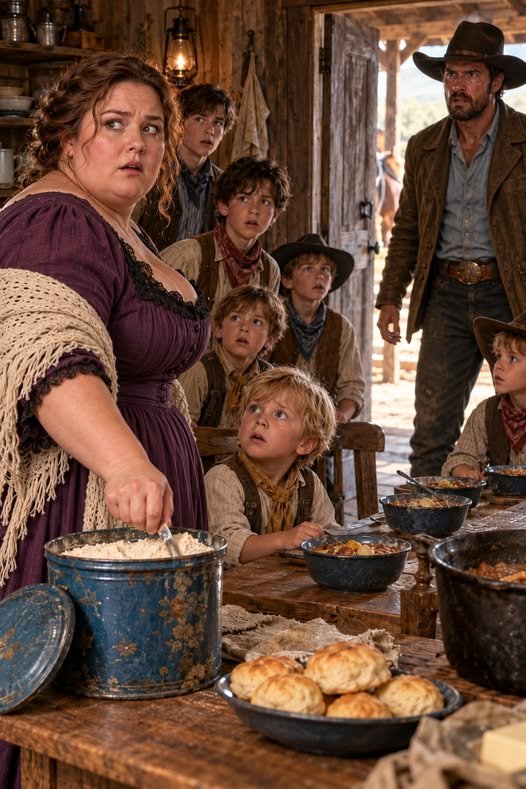
The road from Oak Haven to the Holt ranch was ten miles of dust and heartbreak, and Madeline Higgins walked every one of them with nothing left but a dead husband’s lies for company.
She arrived at Grayson Holt’s ranch house at suppertime, a thin woman in a threadbare dress with holes in her boots and a look in her eyes that said she had stopped crying only because her body had run out of tears.
Grayson found her standing over his stove. She had let herself in through the unlocked kitchen door, and by the time he walked in with his revolver drawn, his filthy kitchen had a fire going and a pot of stew bubbling that smelled like heaven had opened its windows.
“Sir,” she said, not flinching at the gun, “that beef in your icebox is two days from spoiling, your floor hasn’t been swept since winter, and your men are about to eat that stew whether you shoot me or not.”
Six hardened Colorado cowboys filed in behind him, and they all stopped dead at the smell. One of them, an old hand named Pete, sat down at the table without being asked. Grayson lowered the revolver.
Madeline told her story while she served. Her husband Thomas had died of fever three weeks earlier in Oak Haven. On his deathbed he confessed that the ranch land he’d sworn was theirs belonged to the bank, and the savings he’d promised were spent years ago. The boarding house kept her six days out of Christian charity, then put her trunk on the porch when the money didn’t appear.
“I walked ten miles because there was nowhere else to walk to,” she said. “I don’t ask for charity. I ask for wages. I can cook, I can clean, I can keep your books if your books need keeping. Pay me fair and I’ll earn every cent.”
Grayson Holt was not a soft man. The territory had taken his wife and his son in one bad winter, and he had buried his gentleness with them. But he watched his men eat Madeline’s stew like it was the first real meal of their lives, and he saw the way her hands shook — not from fear, but from hunger she would not admit to.
“You sit down and eat,” he told her. “We’ll talk wages after.”
She ate like a woman remembering what food was. Then she stood, rolled up her sleeves, and started scrubbing his stove before anyone could stop her.
“One week,” Grayson said. “You get a week’s trial. Room over the kitchen, three dollars a week if you last.”
That night, from the porch, Pete heard Madeline through the kitchen window talking to herself — or to someone who wasn’t there. “Thomas,” she whispered, “you lied to me about everything. But you can’t lie to me anymore. Watch me make something of nothing.”
By week’s end, the ranch had transformed. The bunkhouse got fed at regular hours. Grayson’s ledgers, which he hadn’t touched in two years, were balanced and neat in Madeline’s careful hand. The men had started washing their faces before supper without being told.
But on the seventh evening, Grayson found her sitting on the back step, staring down the road toward Oak Haven, her hands folded tight in her lap.
“I’ve been thinking,” she said quietly. “This was charity with wages attached, wasn’t it? A week’s trial out of pity. Come Monday I should walk back to Oak Haven and face whatever’s there, because I can’t keep pretending I earned a place that was given from kindness.”
“Madeline—” Grayson began, but dust was rising on the road, and a wagon was coming hard from the direction of Oak Haven.
It pulled up in a cloud of grit. The driver was Sheriff Amos Crane, and beside him sat Mrs. Whitfield, who owned the boarding house that had thrown Madeline out.
“We’ve been looking for you, widow Higgins,” the sheriff called. “Mrs. Whitfield here has something to say, and she’d better say it quick before I lose my patience with her.”
Mrs. Whitfield climbed down, red-faced and wringing her handkerchief. “Mrs. Higgins — Madeline — I was wrong. The day after you left, a letter came from Denver. From a bank. Your husband — God rest him — had an account there. A real one. Four hundred and sixty dollars, left in your name.”
Madeline went very still. “Thomas had money? Real money?”
“Seems he put it aside years back and never told you. Or never told himself, the way men are. The bank’s holding it for you. I came to say I’m sorry I put you out, and the whole town’s sorry, and you can come home whenever you like.”
The cowboys had gathered on the porch. Pete was grinning fit to split. Grayson stood with his arms crossed, and something was working in his face.
Four hundred and sixty dollars. It was a fortune. It was a fresh start anywhere she wanted — Denver, California, back to her people in Missouri.
Madeline looked at the sheriff. She looked at Mrs. Whitfield. Then she looked at Grayson Holt’s ranch house, with its clean windows and the smell of bread she had set to rise that morning still hanging in the air.
“Sheriff,” she said, “you tell that bank to hold my money. I’m not done here.”
Mrs. Whitfield blinked. “But Madeline — you could—”
“I could. But I walked ten miles to get here, and I’m not walking away from the first honest work I’ve had in years just because fortune finally remembered my name.” She turned to Grayson. “Mr. Holt, my week’s trial is up. I’ll stay on at three dollars a week. And if you ever again call it charity, I’ll quit on the spot.”
Grayson Holt looked at this thin, fierce woman who had walked into his kitchen and rebuilt his whole world in seven days. And for the first time in three years, Grayson Holt laughed — a real laugh, rusty and surprised.
“Deal,” he said. “But the wages are going up to five. I can’t have my cook thinking she’s underpaid.”
She stayed. She drew her Denver money a little at a time and used it to buy laying hens, then a milk cow, then new boots for every man in the bunkhouse at Christmas. She never did go back to Oak Haven to live, though she visited, and Mrs. Whitfield cried on her shoulder every time.
And Madeline would smile and say, “I came looking for wages. I found a home. Turns out they were the same thing all along.”
Years later, when folks in the territory asked Grayson Holt how he got the finest ranch kitchen in Colorado, he would nod toward Madeline and say, “She walked ten miles to get here. Everything good on this ranch arrived on foot.”