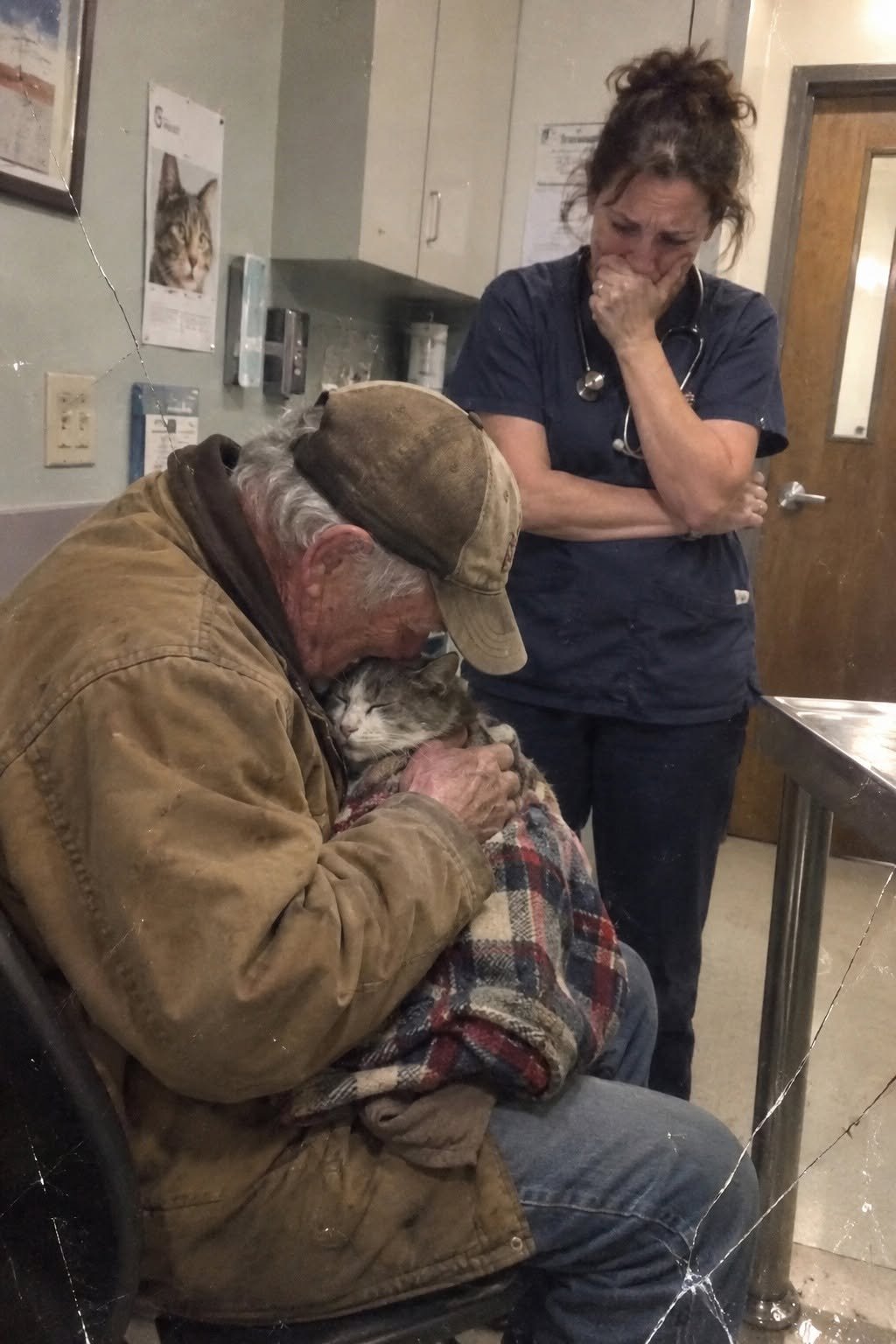
The hardest sound in my clinic wasn’t a dying cat, it was an old man begging her not to leave.
I learned how to handle claws in vet school. I learned how to clean bites, read bloodwork, calm a scared animal, and keep my face steady when things went bad.
Nobody taught me what to do when a man twice my age folded over a six-pound cat like his whole world was leaving with her.
It was a little after 7 on a Tuesday night. The clinic was closed. My front desk girl had gone home. The floors still smelled faintly of disinfectant, and the only sound was the old refrigerator humming in the back.
Then Mr. Wallace came through the door.
He was carrying a faded plaid blanket against his chest like it held something breakable.
Inside was Juniper.
Everybody in our clinic knew Juniper. She was eighteen, gray and white, with one cloudy eye and the attitude of a woman who had paid taxes for fifty years and trusted nobody.
She had scratched me once. She had hissed at my assistant so hard the poor girl dropped a thermometer. She hated the exam table, hated carriers, hated being weighed, and hated anyone who spoke to her in a baby voice.
But she loved Mr. Wallace.
Only him.
He was a retired handyman, the kind of man who wore the same work jacket every winter and always smelled a little like sawdust. He didn’t talk much. He never complained. But when he came in with Juniper, his voice changed.
“She doesn’t like that table, Doc.”
“She prefers her medicine mixed with warm tuna.”
“She’s not mean. She’s particular.”
That night, he didn’t say any of that.
He just looked at me and whispered, “She won’t stand up anymore.”
I took Juniper from his arms as gently as I could. She didn’t fight me. That scared me more than any hiss ever had.
Her body felt too light under my hands. Her fur, usually clean because she was proud that way, had started to clump. Her breathing came in small, shallow pulls. When I touched her gums, they were pale. When I felt her belly, she gave one weak sound, not even a real cry.
Mr. Wallace stood beside the table, his cap twisting in both hands.
“Maybe fluids?” he asked. “Maybe one more night here? I can pay. I mean, I’ll figure it out.”
I looked at him.
He already knew.
People always think the hard part is telling them. It isn’t. The hard part is watching them try to bargain with a truth their heart already understands.
“Mr. Wallace,” I said softly, “her body is shutting down.”
He stared at Juniper.
“She ate yesterday,” he said. “Just a little, but she ate.”
“I know.”
“She slept on my chest last night.”
“I know.”
“She still knows me.”
That one nearly broke me.
I put my hand on the blanket beside her. “Yes. She knows you. And I think that’s why she held on this long.”
His face tightened like he had taken a punch.
Juniper had come into his life through his wife. After she passed, Juniper stopped sleeping in the window and started sleeping on his chest. Every night. Same spot. Same little paws tucked under her. Mr. Wallace once told me he hadn’t liked cats before Juniper.
Then he said, “She didn’t ask me.”
I asked what he meant.
He said, “She didn’t ask if I needed saving. She just did it.”
Now the little cat who had kept his house from feeling empty was the one who needed mercy.
He bent down close to her ear.
“Junie,” he whispered, “if you’re tired, you don’t have to stay for me.”
For a moment, nothing happened.
Then Juniper lifted one thin paw and placed it on his wrist.
No claws.
No pushing away.
Just her paw resting there, light as a leaf.
Mr. Wallace covered his mouth. His shoulders shook.
“Can she stay in my lap?” he asked. “She hates that metal table.”
“Of course,” I said.
He sat in the chair by the wall, and I helped settle Juniper into the plaid blanket across his knees. She fit there like she had been made for that exact place.
I explained everything. The first medicine would help her sleep. The second would stop her heart. No fear. No pain.
He nodded, but his eyes never left her face.
I gave the first injection.
Juniper relaxed almost at once. Her head sank into the crook of his arm. For the first time in months, she looked comfortable.
Mr. Wallace stroked the space between her ears.
“You did good, sweetheart,” he whispered. “You took care of me real good.”
Then came the second injection.
I listened with my stethoscope as her small heart slowed. Slower. Softer.
Then silence.
“She’s gone,” I said.
Mr. Wallace didn’t yell. He didn’t make a scene.
He just pulled that tiny body to his chest and made a sound I will never forget. It was quiet, but it had the weight of an empty house, an empty chair, and a bed too big for one person.
After a while, he stood. He placed Juniper’s collar on the table. It had a little silver bell wrapped in tape.
“She hated the ringing once she got old,” he said. “I didn’t want it bothering her.”
Then he walked out alone.
I sat on the floor after he left and cried.
Some people think letting an animal go is giving up.
It isn’t.
Mr. Wallace could have kept Juniper breathing a little longer because he was scared to be alone. But he loved her enough to take the pain himself.
That is love at its hardest.
Sometimes kindness is not holding on.
Sometimes it is opening your hands while your heart breaks.
Part 2 — The Old Man Came Back Without Juniper, But Her Love Wasn’t Finished.
The morning after Mr. Wallace walked out of my clinic without Juniper, I found her gray-white hair on my sleeve.
Just three tiny strands.
That was all she left behind.
But somehow, it felt heavier than the body I had held the night before.
The clinic opened at 8.
By 8:07, a golden retriever had thrown up in exam room two.
By 8:20, a woman was arguing about why her indoor cat needed vaccines.
By 8:45, a little boy asked me if hamsters went to heaven.
Life kept moving.
That felt unfair.
Because somewhere across town, Mr. Wallace had woken up in a house that did not have Juniper in it.
And I could not stop thinking about that.
I kept seeing him in my mind.