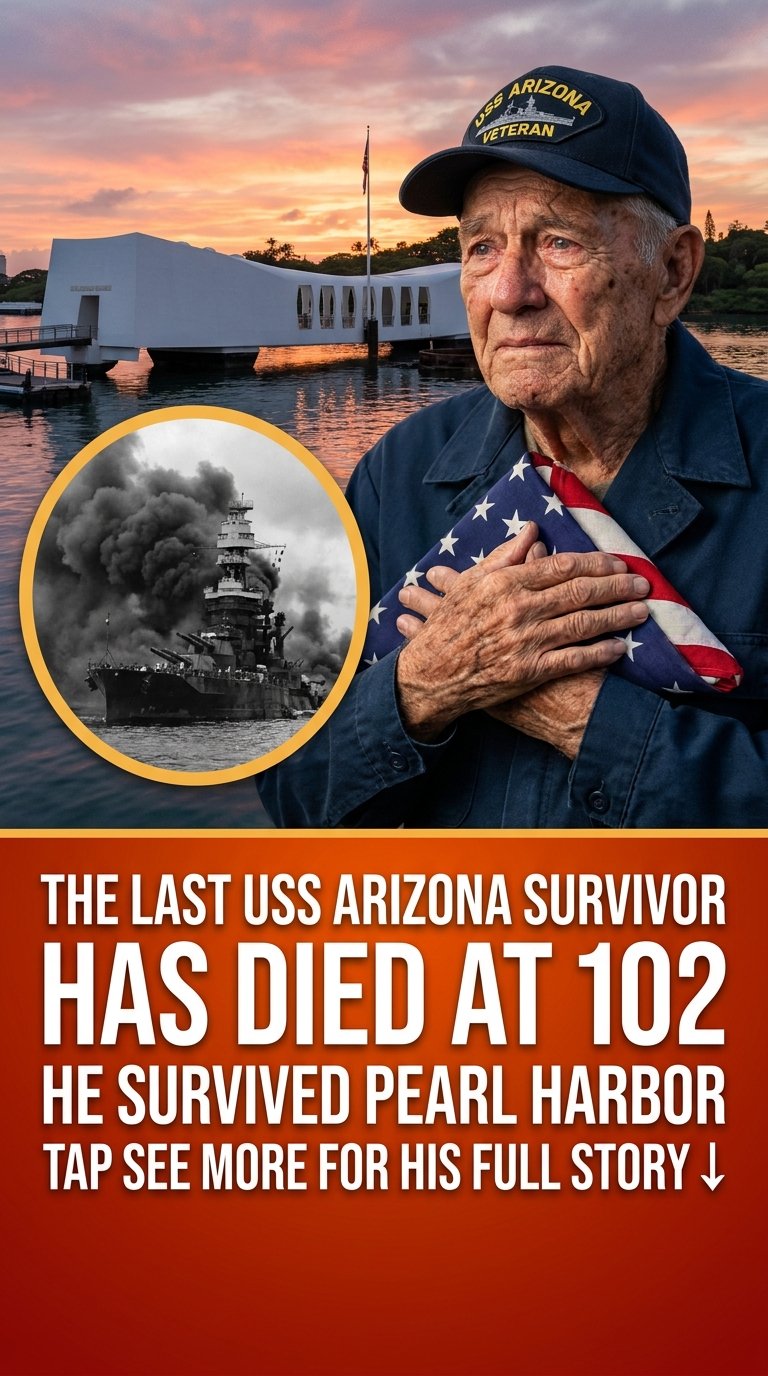
This is a verified historical news story. Lt. Cmdr. Louis “Lou” Conter died in April 2024; it is not a current breaking-news event.
For more than eight decades, Lou Conter carried a story that few people on Earth could tell from personal memory.
On the morning of December 7, 1941, Conter was 20 years old and serving as a quartermaster aboard the USS Arizona at Pearl Harbor. His work involved navigation. Then the attack began.
The Arizona was hit and catastrophically exploded. The loss of life was immense: 1,177 officers and crewmen aboard the battleship were killed. Conter survived. In the immediate aftermath, he helped other survivors and spent days assisting with the fires and the recovery of bodies.
On April 1, 2024, Conter died peacefully at his home at age 102. The U.S. Navy described him as the last living survivor of the USS Arizona.
His service did not end at Pearl Harbor
It would have been enough for one lifetime to survive Pearl Harbor. But Conter continued serving.
He became a Naval aviator and flew more than 200 missions in the South Pacific during World War II. He was shot down twice and survived both times. The Navy says he later served during the Korean War, received the Distinguished Flying Cross, and helped train service members in survival skills.
Those facts are part of why the news of his death reached far beyond his California hometown. Conter was not only a witness to a defining moment in American history. He was one of the people who continued to serve long after that morning at Pearl Harbor.
Why his death carries special weight
The USS Arizona is more than a battleship in a history book. It remains a symbol of the attack that brought the United States into World War II. The wreck still rests in Pearl Harbor, and the memorial above it is visited by people from across the country and the world.
For decades, survivors returned to speak, remember their friends, and make sure the story stayed personal. With Conter’s death, there is no longer a living member of the Arizona crew who can describe that morning firsthand.
That does not mean the story is over. It means the responsibility shifts. Families, teachers, veterans, museums, and younger generations now carry the memories that people like Conter spent a lifetime protecting.
At his memorial service, active-duty service members, veterans, relatives, and community leaders gathered to honor him. The Navy held full military honors. His daughter said the family felt blessed to have had him for 102 years. Conter was laid to rest beside his wife, Valerie.
What his story can remind families to preserve
Many families have a photograph, a letter, a uniform, a medal, or a short story from an older relative that has never been fully recorded. Conter’s passing is a quiet reminder that those memories do not remain available forever.
A few questions at a family table can preserve details that a history book cannot: Where were you? Who was beside you? What did you carry with you afterward?
The goal is not to turn every memory into a public story. It is simply to keep it from disappearing. Even a name written on the back of a photograph can become valuable to children and grandchildren decades later.
Sometimes history feels distant because it is told through dates, ships, and numbers. Lou Conter’s life is a reminder that the people inside those events were very young, very real, and often asked to carry unimaginable experiences for the rest of their lives.
He was 20 when he survived one of the most devastating attacks in American military history. He went on to fly combat missions, train others, raise a family, and return to memorial events for nearly a century.
His passing closes a living chapter of Pearl Harbor. But the legacy he left is still visible: in the USS Arizona Memorial, in the stories told by families, and in every effort to remember the people who did not make it home.